

Source record
Keys and Gates
Sixteen photographs selected in 2026 ask one shared question: how does a permission decide who may move, who must wait, and what remains outside the frame?
Read the complete studyOpen the full essay, notes, bibliography, and publication record.
Sixteen photographs selected in 2026 ask one shared question: how does a permission decide who may move, who must wait, and what remains outside the frame?
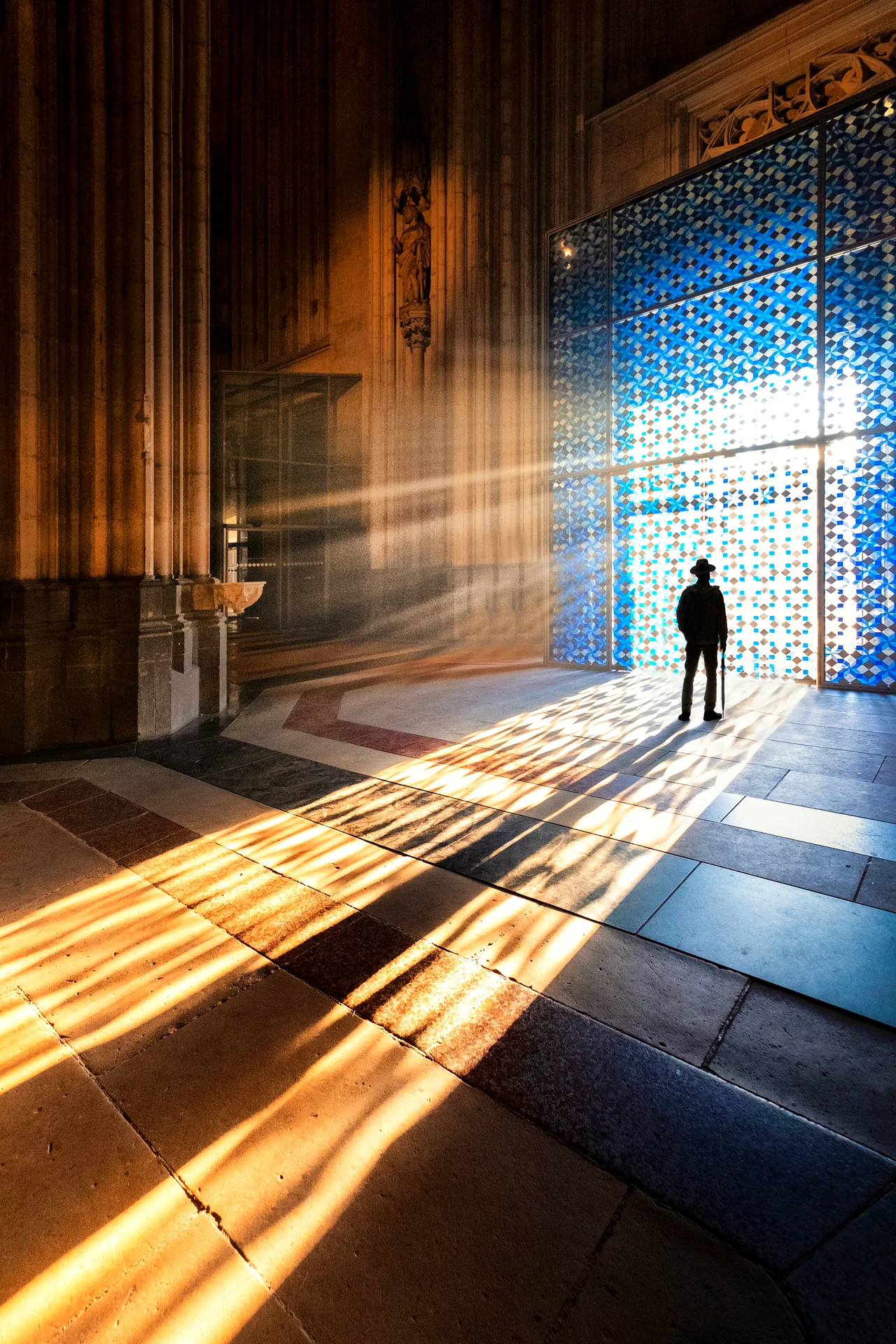
The group begins with gates made of light: a blue patterned screen in a stone hall, a passage opening into glare, a ruined sequence of arches, and a small house glowing behind a warning sign. It then moves into systems that organize movement—traffic, a horse herd, a reservation-only landscape, and an aerial boundary between homes and palms. These images make access visible as pace, scale, and distance, with each threshold regulating more than the line between inside and out.
The next movement is historical and infrastructural. A weathered wall carries graffiti after its barrier has weakened; an industrial compound carries painted words; water radiates through a fluted structure the artist identifies as a spillway; a train window frames two women against the memory of liberation. The final works place the checkpoint in the body and the interface: a refrigerator, a concealed torso, a small booklet or document held in a theatrical room, and an “Esc” key that promises an exit to a subject too small to use it.
Taken together, the photographs keep freedom open as a live question. They show how an opening can filter, how a road can be open and still rationed, how a document can enable passage while exposing a person, and how a house can remain visible from the wrong side of a gate. Staged images, documentary views, collage, long exposure, and focus stacking make different kinds of access visible. The research publication, Access, Control, and Exit, follows those formal and historical relations through sustained close readings.
The sequence supplies a curatorial order for reading the group. The final acquired quantity may be fewer than sixteen because availability, terms, documentation, minting, purchase, and program quantity remain open. The written scholarship, Work records, visual descriptions, and contextual image presentation form the current accession-publication edition. Fourteen Works are presented at 640, 1280, and 2400 pixels; OUT-004 and OUT-011 are restricted to 640 pixels. OUT-004, OUT-010, and OUT-011 retain their work-specific age, identity, consent, privacy, document-legibility, venue, and sensitive-biography cautions. Those cautions constrain interpretation and reuse; they do not erase the Works from the selected acquisition or consign the Museum's accession work to a future reviewer. The group’s current relationship is summarized below; the Research and record page keeps the supporting record.
Visual sequence — curatorial order
| Sequence | Works | Artists | Shared visual question |
|---|---|---|---|
| SequenceApertures and exits | WorksTake the Key!, No Key, Only Light, Rusted, No Access | ArtistsGulYildiz, intrepid, Teyhu, Veerendra | Shared visual questionWhat can be seen through an opening before passage is granted? |
| SequenceManaged movement | Worksthe Artist in the Open Sea, Managed Freedom, the cost of open, Dichotomy. | ArtistsHugoFaz, nasimghanizadeh, priyanka, Rakesh | Shared visual questionWho sets the speed, route, or altitude of movement? |
| SequenceResidual infrastructures | WorksResidual Barrier, Now Is Our Time, Morning Glory, Fight for Freedom | Artistsikertje, pandelic, Zoku, shamspranto | Shared visual questionWhat remains after a barrier changes function? |
| SequenceBodies and interfaces | WorksThe Hostile Gate, Checkpoint, Sina Beizavi in Brazil, Nowhere To Esc. | ArtistsGIANT, Minalisa, HugoFaz, arsonic | Shared visual questionWhen does the body or command become the checkpoint? |
Artists
GulYildiz · HugoFaz · nasimghanizadeh · intrepid · ikertje · GIANT · priyanka · Rakesh · pandelic · Minalisa · Teyhu · arsonic · Zoku · shamspranto · Veerendra
HugoFaz appears twice in the selected group, in OUT-002 and OUT-011. Each work has a separate treatment; the artist has one canonical profile.
Relationship and status
Program: Keys and Gates,
6529NM-AP- 01
Curated Acquisition ID:6529NM-CA- 2026- 002
Selected works: 16
Visitor state: Selected through an acquisition program; acquisition pending
Mint qualifier: Not yet minted; minting route under consideration Artist count: 15
Collection relationship: Not in the permanent Collection; no accession recorded.
The display title for OUT-015 follows the exact UTF-8 submission/media text: মুক্তিযুদ্ধ - Fight for Freedom. A compact transcription and correction note records the source-layer history; the historical JSON remains unchanged.
Research context
Research context
- Related acquisitionKeys and GatesStatus Selected through an acquisition program; unmintedStatus as of