

Museum works
Palmyra, Syria
Lorenzo Meloni / Magnum Photos 75 · 2016
About this work
Accession: 6529NM.2026.002
Artist: Lorenzo Meloni
Date: 2016
Medium: Photograph
Credit: © Lorenzo Meloni/Magnum Photos 2022 All Rights Reserved
The 6529 Network Museum presents this photograph in Conflict at Its Edges, a five-work group from Magnum Photos 75. The image remains tied to its source caption and archive context; the Museum does not extend unresolved details beyond the evidence recorded in the proposal and source dossier.
Token record
- CAIP-19: eip155:1/erc721:0xe628b59d34f42b16c53f4d697f1ffd4d8d987b91/104
- Transfer: 0x443e02349d0b5538fd33acb392edbb6ce63a6479917b3be0d71cd5069cdaaa07 at block 25741705, log 385
- Common finalized observation: block 25741809 (0x8581c55db52accfd3750ec3af9972430fd4717f3486ac51bc7c1e0b00c335731)
- Owner at that observation: 0xbecfa2ba5a782d11e1a0e821e8f2e30b6684178c
The tokenized object is accessioned into the permanent Collection. Copyright and reproduction permission remain separate; the source record states All Rights Reserved.
Title, rights, and accession review
Accession lot: 6529NM.2026.002
Gift: Conflict at Its Edges, five photographs from Magnum Photos 75
Donor: punk6529
Status: accepted and accessioned into the permanent Collection
Title basis
The donor offered the five scheduled tokens as a full gift. The Museum maintainer instructed the Museum to record the gift as accepted and accessioned. The five transfer receipts identify delivery from the donor address to networkmuseum.6529.eth; the custody package records the receipts, their Transfer logs, and the common finalized-block ownerOf observation.
The Museum's title record therefore covers the donor's transferable interest in the five tokenized objects. This public record derives that determination from the full-gift offer and the maintainer's instruction. It does not cite a separate private instrument.
Rights position
The source records identify the photographs as All Rights Reserved and credit each artist and Magnum Photos. The gift transfers the tokenized objects and the donor's transferable interest in them; it does not transfer copyright or create a general reproduction licence. The Museum's public presentation is limited to the credited accession context and remains subject to the source rights position.
Supporting records
- Gift acceptance and accession authorization
- Accession certificate
- Finalized custody evidence
- Source and rights record
6529 Network Museum, Curatorial Research · Edition 1.0.0 · Published 9 August 2026 · Research through 9 August 2026 · Publication record and suggested citation
Short label: Palmyra, Syria · 1 April 2016. Accessioned gift in the permanent Collection under 6529NM.; the Wave proposal remains part of the work’s recorded origin.
Looking at the Work
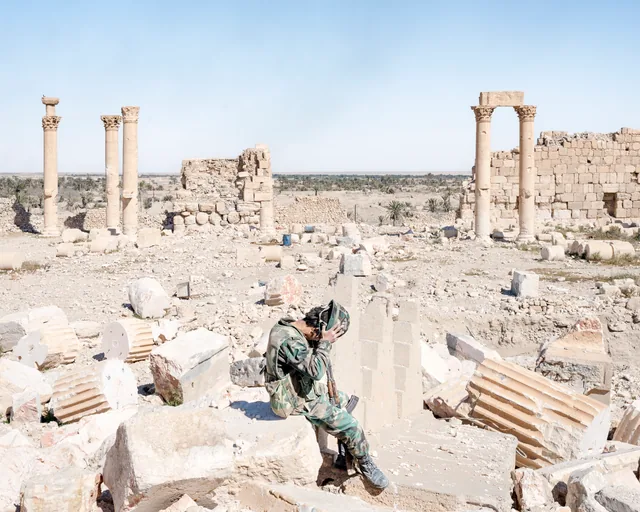
A small seated figure occupies the middle of the frame. He wears a dark uniform and raises a helmet across his face, while pale rubble and standing columns extend around him. The gesture is obscured and difficult to read. The helmet may be in the act of being removed; the image gives no decisive access to the figure’s expression or state.
Colour organizes the photograph through a restrained opposition. The blue sky opens the upper field, warm stone carries the middle distance, and the dark figure gathers the eye near the base of the surviving architecture. The columns provide scale. They make the soldier appear temporary within a site whose history exceeds the immediate scene.
The photograph holds two kinds of attention together. The body supplies a pause, an action that remains psychologically unresolved. The ruins supply a historical duration. The frame offers rubble, columns, helmet, uniform, and sky with considerable clarity. Its explanation arrives through the caption and the circumstances of access that surround it.
Caption and chronology
The token record identifies the work as Palmyra, Syria, 2016, with Magnum archive reference MEL2016002G0401/. A TIME report published on 7 April 2016 dates the exposure to 1 April and identifies the figure in its caption as a Syrian army soldier seated on rubble associated with the former Temple of Bel.1 The caption supplies the date, affiliation, and site history; the image itself cannot establish the soldier’s identity, rank, unit, or route.
UNESCO records the destruction of the principal structure of the Temple of Bel on 30 August 2015. Its later assessment describes Palmyra after the change of control in March 2016, with access constrained and demining incomplete. The photograph therefore belongs to a precise historical interval: five days after the recapture of Palmyra, months after the destruction of the temple’s principal structure, and before the site had become safe or fully accessible.2
The distinction matters. The frame records neither the temple’s destruction nor the recapture battle. It records a site after both events, when surviving architecture, military presence, and photographic access had entered the same view. The standing columns refuse a total image of disappearance. The damaged monument remains materially present, even as its political and cultural meaning has been altered.
Access as part of the image
TIME reports that Meloni’s visit took place with Syrian government permission and under the shadow of government forces. An AFP account from the same period describes an army minder, mine warnings, demining, and entry directed by the army. These reports describe the published conditions of access; they do not reconstruct the exact route taken for this frame.3
Access still changes the photograph’s meaning. The soldier, the columns, and the rubble were encountered through a controlled passage into a mined historical site. The camera’s position was part of that arrangement. The resulting image carries the apparent stillness of the gesture alongside the political conditions that made the view possible.
A practice of aftermath
The work belongs to Meloni’s sustained study of conflict and its consequences. The Collapse of the Caliphate placed Palmyra beside Kobanê, Sirte, and Mosul in a project shaped by territorial change and historical recurrence. We Don’t Say Goodbye gathers a decade of work across Iraq, Syria, and Libya and interrupts photographs with objects and writing recovered from war rubble. In both cases, the image remains connected to material and textual traces that survive the event.4
The Palmyra frame gives that method a concentrated form. The soldier’s obscured face keeps the scene away from a legible portrait. The damaged site enlarges the gesture without explaining it. The photograph becomes an account of how a historical place is encountered after violence, under permission, and through the records that later name what the frame cannot fully contain.
Object record
| Field | Record |
|---|---|
| FieldPublic Work | Record6529NM- |
| FieldProposal alias | Record6529NM- |
| FieldArtist | RecordLorenzo Meloni |
| FieldDate / place | Record1 April 2016; Palmyra, Syria |
| FieldArchive reference | RecordMEL2016002G0401/ |
| FieldChain identity | Recordeip155: |
| FieldToken manifestation | RecordEthereum ERC-721 token 104; sequence 104/; curation 2/; edition 1 of 1 (S14) |
| FieldMetadata | RecordGoverned token metadata record S14 |
| FieldToken-linked source image | RecordExact URI retained in governed machine evidence; no direct visitor link |
| FieldObserved source image | RecordJPEG, 5,964 × 4,768 px, 16,871,807 bytes; SHA-256 49c45762 |
| FieldHistorical Wave presentation | RecordWave proposal, part 6; exact media locator retained in governed machine evidence and described in the Source and rights record (S38) |
| FieldStatus | RecordCompleted gift; accessioned into the permanent Collection as 6529NM. (S37) |
| FieldCredit / rights | Record© Lorenzo Meloni/Magnum Photos 2022 · All Rights Reserved. The Museum interprets ordinary credited institutional display, publication, and accessibility in accession, Collection, and scholarship contexts as permissible. This does not transfer copyright or grant commercial or general reproduction, derivative, licensing, download, or AI-training rights (S14; S38) |
Manifestations and stewardship
The underlying Work is the historical photograph made by Lorenzo Meloni in Palmyra on 1 April 2016. The Arweave JPEG is an upstream token-linked presentation/source file, not a declared negative or preservation master. The repository retains no source bytes or preservation master. The observed 16.9 MB source remains an upstream evidence locator and is not served by the Museum.
The historical CloudFront URL remains evidence of public Wave presentation
media. The accessioned presentation may render in accession, Collection,
artist, Work, and scholarship contexts under the current display authority,
with its supplied credit and All Rights Reserved notice. The Museum's
interpretation covers ordinary credited institutional display, publication,
and accessibility in those contexts; it does not grant copyright, commercial or
general reproduction, derivative, licensing, download, or AI-training rights
(S38).
Meloni’s image is the fifth work in the selected group Conflict at Its Edges. Its chronological position and 2/ curation mark are exact features of the token record. Its interpretation within the group remains a Museum argument about borders, access, damaged sites, captions, and documentary afterlives.
Research status
Further research should seek the archive-to-negative and contact-sheet crosswalk, the exact sequence and first publication, documentation of permission and route, and any authoritative account of the soldier’s identity. The public sources establish the captioned circumstances of the photograph while leaving those object-level questions open.
Footnotes
The work
- Medium
- photograph
- Credit and rights
- Lorenzo Meloni, Palmyra, Syria, 2016. © Lorenzo Meloni/Magnum Photos 2022.
The Museum interprets ordinary, credited institutional display of this image in the context of this accession and Collection as permissible. This interpretation does not transfer copyright or grant commercial, general reproduction, derivative, licensing, download, or AI-training rights.
Collection context
- Part ofMagnum Photos 75