

Artist
Lorenzo Meloni
1 in the permanent Collection
Artist record
- Collection relationship
- 1 in the permanent Collection
- Works represented
- 1 work
- Acquisition
- Conflict at Its Edges
- Artist and practice profile
- Read the artist profile
- Source record
- Open source record
Works by this artist
Artist and practice profile
6529NM-ART-0021
{
  "$schema": "https://6529networkmuseum.org/schemas/record-envelope-v1.json",
  "envelope": {
    "contentHash": {
      "algorithm": 1,
      "canonicalizationId": "0x886c7c89c308c459ca8a626e0ef36a5ea9f4c7a7b56aaf86c71a2ddf3b4f9044",
      "digest": "0xc376d4bdda6eb9d2fd12930566c4c58799327761702ccfb210a60be284ee1a82"
    },
    "effectiveAt": 1786233600,
    "recordType": "PUBLIC_ENTITY",
    "schemaId": "0xd8aef6592fe156c4c3c10e59de540f5cdf8b130eedca322e0e22b30764bee1a9",
    "signatureHash": {
      "algorithm": 2,
      "canonicalizationId": "0x886c7c89c308c459ca8a626e0ef36a5ea9f4c7a7b56aaf86c71a2ddf3b4f9044",
      "digest": "0x0000000000000000000000000000000000000000000000000000000000000000"
    },
    "signatureScheme": "0x0000000000000000000000000000000000000000000000000000000000000000",
    "subjectId": "0x92df035e4991cb56b268830a4d921f76b77281fab4c82bc1855c5888478bde84",
    "uri": "https://6529networkmuseum.org/records/entities/6529NM-ART-0021.json"
  },
  "payload": {
    "canonical_route": "/museum/network/artists/lorenzo-meloni",
    "constructor": {
      "id": "codex-task:magnum-completed-accession-correction-2026-08-12",
      "observed_at": "2026-08-12T23:15:00Z",
      "role": "constructor"
    },
    "created_at": "2026-08-12T23:15:00Z",
    "effective_at": "2026-08-09T00:00:00Z",
    "entity_id": "6529NM-ART-0021",
    "entity_status": "published",
    "entity_type": "ARTIST",
    "evidence_refs": [
      {
        "evidence_class": "B",
        "label": "Proposed gift artist label",
        "observed_at": "2026-08-06T13:19:30.726Z",
        "uri": "https://6529.io/waves/5f207393-5418-4a75-8738-e40edb44a94d?drop=002bfa4f-8416-48bf-b35e-38f354e9a9f0"
      },
      {
        "evidence_class": "B",
        "label": "Museum artist research profile",
        "observed_at": "2026-08-09T00:00:00Z",
        "uri": "https://github.com/6529-Collections/6529networkmuseum/blob/main/records/proposed-gifts/6529NM-PG-2026-001/public/scholarship/artists/lorenzo-meloni.md"
      }
    ],
    "observed_at": "2026-08-09T00:00:00Z",
    "page_exposure": "canonical_page",
    "payload_sha256": "sha256:159c9d0feda0da9ec04a2f1b7c986bcb573f201f862545a85da3020afaeebf80",
    "preferred_label": "Lorenzo Meloni",
    "profile": {
      "authority": {
        "authority_record_ids": [
          "6529NM-AGT-0022"
        ],
        "authority_status": "provisional",
        "evidence_refs": [
          {
            "evidence_class": "B",
            "label": "Proposed gift artist label",
            "observed_at": "2026-08-06T13:19:30.726Z",
            "uri": "https://6529.io/waves/5f207393-5418-4a75-8738-e40edb44a94d?drop=002bfa4f-8416-48bf-b35e-38f354e9a9f0"
          },
          {
            "evidence_class": "B",
            "label": "Museum artist research profile",
            "observed_at": "2026-08-09T00:00:00Z",
            "uri": "https://github.com/6529-Collections/6529networkmuseum/blob/main/records/proposed-gifts/6529NM-PG-2026-001/public/scholarship/artists/lorenzo-meloni.md"
          }
        ]
      },
      "name_variants": [
        {
          "evidence_refs": [
            {
              "evidence_class": "B",
              "label": "Name source",
              "observed_at": "2026-08-06T13:19:30.726Z",
              "uri": "https://6529.io/waves/5f207393-5418-4a75-8738-e40edb44a94d?drop=002bfa4f-8416-48bf-b35e-38f354e9a9f0"
            }
          ],
          "source_kind": "proposal",
          "value": "Lorenzo Meloni",
          "variant_role": "preferred"
        },
        {
          "evidence_refs": [
            {
              "evidence_class": "B",
              "label": "Raw issuer label",
              "observed_at": "2026-08-06T13:19:30.726Z",
              "uri": "https://6529.io/waves/5f207393-5418-4a75-8738-e40edb44a94d?drop=002bfa4f-8416-48bf-b35e-38f354e9a9f0"
            }
          ],
          "source_kind": "proposal",
          "value": "Lorenzo Meloni",
          "variant_role": "source_label"
        }
      ],
      "practice": {
        "areas": [
          "documentary photography",
          "architecture and conflict",
          "ruins and historical memory"
        ],
        "evidence_refs": [
          {
            "evidence_class": "B",
            "label": "Museum artist research profile",
            "observed_at": "2026-08-09T00:00:00Z",
            "uri": "https://github.com/6529-Collections/6529networkmuseum/blob/main/records/proposed-gifts/6529NM-PG-2026-001/public/scholarship/artists/lorenzo-meloni.md"
          }
        ],
        "summary": "Lorenzo Meloni examines the architecture, symbols, and historical afterlives of conflict, frequently allowing built space to carry the weight of absent bodies. The selected 2016 Palmyra photograph studies destruction as both material fact and contested image."
      },
      "profile_type": "ARTIST"
    },
    "public_slug": "lorenzo-meloni",
    "record_id": "6529NM-ART-0021",
    "record_status": "reviewed",
    "record_type": "PUBLIC_ENTITY",
    "record_version": "1.0.0",
    "references": [
      "6529NM-AGT-0022",
      "6529NM-PG-2026-001",
      "6529NM-PG-2026-001.OBJ-005"
    ],
    "review_status": "reviewed",
    "reviewer": {
      "id": "codex-reviewer:vera-molnar-a9-copy-correction-independent",
      "outcome": "approved",
      "reviewed_at": "2026-08-23T15:10:17.867Z",
      "reviewed_commit": "3eab50914a90c079fe0383624e760fc0a954e709",
      "reviewed_manifest_keccak": "0xd3b728ca1bdbbf99602d626df93b6903bbacf624f2ef71e064412654e71cf313",
      "reviewed_manifest_sha256": "sha256:f672c3503baa823cf4af5eac3bf0513b6b25de6e2674902273cb778f4e771080",
      "reviewer_ids": [
        "codex-reviewer:vera-molnar-a9-copy-correction-independent"
      ],
      "role": "reviewer"
    },
    "schema_id": "0xd8aef6592fe156c4c3c10e59de540f5cdf8b130eedca322e0e22b30764bee1a9",
    "source_record_ids": [
      "6529NM-AGT-0022",
      "6529NM-PG-2026-001",
      "6529NM-PG-2026-001.OBJ-005"
    ],
    "status_observation": {
      "evidence_refs": [
        {
          "evidence_class": "B",
          "label": "Proposed gift artist label",
          "observed_at": "2026-08-06T13:19:30.726Z",
          "uri": "https://6529.io/waves/5f207393-5418-4a75-8738-e40edb44a94d?drop=002bfa4f-8416-48bf-b35e-38f354e9a9f0"
        },
        {
          "evidence_class": "B",
          "label": "Museum artist research profile",
          "observed_at": "2026-08-09T00:00:00Z",
          "uri": "https://github.com/6529-Collections/6529networkmuseum/blob/main/records/proposed-gifts/6529NM-PG-2026-001/public/scholarship/artists/lorenzo-meloni.md"
        }
      ],
      "observed_at": "2026-08-09T00:00:00Z",
      "status_label": "published"
    },
    "subject_id": "6529NM-ART-0021",
    "visibility": "public"
  }
}
6529 Network Museum, Curatorial Research · Edition 1.0.0 · Published 9 August 2026 · Research through 9 August 2026 · Publication record and suggested citation
Artist profile
Selected Work: Palmyra, Syria, 2016
Sources: S30–S32, S41, S48–S49
Lorenzo Meloni’s photographs begin in the interval after an event has been named: a city has been taken, a monument damaged, a population displaced, or a war translated into historical memory. His work across the Middle East and North Africa follows conflict through those transformations. Magnum describes his method as historicist, a term that points toward his attention to older borders, monuments, empires, and recurring forms of destruction. He became a full member of Magnum in 2020.1
Meloni’s projects have developed through extended returns to places marked by war. The Collapse of the Caliphate, presented through Visa pour l’Image in 2017, connected Kobanê, Palmyra, Sirte, and Mosul within a cross-border account of the Islamic State’s rise and territorial collapse. Kobane: The Aftermath followed civilians rebuilding after destruction, giving the aftermath its own documentary time.2 These projects place the photograph within a longer sequence of occupation, ruin, recovery, and remembrance.
The 2022 book We Don’t Say Goodbye gathers photographs made between 2013 and 2019 in Iraq, Syria, and Libya. GOST describes a fragmented publication in which images are interrupted by objects and writing recovered from war rubble. The interruption is material and historical. A photograph shares the page with remains that have passed through another life: a fragment, an inscription, a document, an object separated from its original setting. Meloni’s documentary field therefore extends beyond the moment of exposure. It includes the things that survive the event and the forms through which those things are later read.3
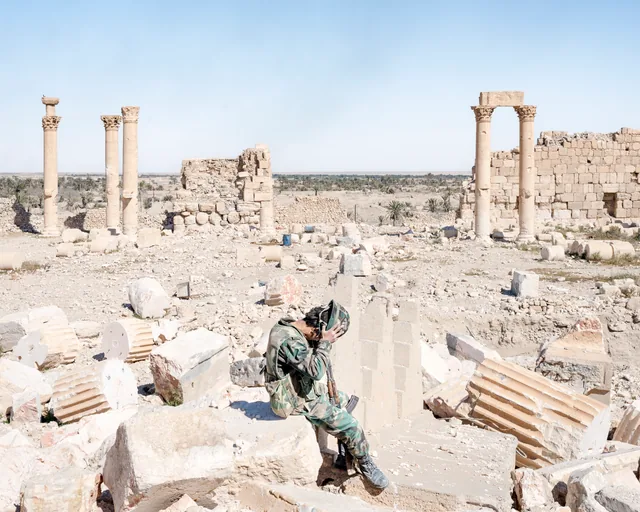
Palmyra, Syria condenses that method. A helmeted soldier sits among pale rubble beneath a blue sky; surviving columns establish the scale of the site while the concealed face withholds a complete account of the figure’s state. The contemporary caption places the photograph five days after the recapture of Palmyra and identifies the ruins with the former Temple of Bel. UNESCO records the monument’s destruction in August 2015 and the constrained, incompletely demined conditions of the site after the March 2016 change of control. TIME and AFP describe the permission, military shadowing, minder, mine warnings, and directed access that surrounded contemporary visits to the ruins.4
Those conditions belong to the photograph’s history. The route into Palmyra shaped where the camera could stand, what remained visible, and how the scene entered publication. The frame records a pause after destruction and after military recapture. It does not show the blast or the battle. Its surviving columns keep the site’s history open to material continuity even as the caption places the image within a landscape of loss.
Within the selected five-Work proposal, Meloni’s token is one of four works marked 2/ in Magnum Photos 75 metadata. Moisés Saman’s #44 is the sole 1/ work. Their relation was formed later by the donor, across the two curations.5 Meloni’s photograph closes the chronological sequence with a damaged site whose documentary afterlife remains active in captions, books, archives, and networked editions.
The public record establishes Meloni’s broader projects and the photograph’s captioned date and place. It has not established the exact frame’s inclusion in We Don’t Say Goodbye or the 2017 Visa exhibition, nor completed the archive-to-negative or contact-sheet crosswalk. Those absences leave the image’s afterlife open to further research without diminishing the precision of what the frame itself records.