

Artist
Larry Towell
1 in the permanent Collection
Artist record
- Collection relationship
- 1 in the permanent Collection
- Works represented
- 1 work
- Acquisition
- Conflict at Its Edges
- Artist and practice profile
- Read the artist profile
- Source record
- Open source record
Works by this artist
Artist and practice profile
6529NM-ART-0018
{
  "$schema": "https://6529networkmuseum.org/schemas/record-envelope-v1.json",
  "envelope": {
    "contentHash": {
      "algorithm": 1,
      "canonicalizationId": "0x886c7c89c308c459ca8a626e0ef36a5ea9f4c7a7b56aaf86c71a2ddf3b4f9044",
      "digest": "0x43993c7add95d01a07ce8067bb64ee5c2ae95dcac61ef6d12b6f38d1a9f94b16"
    },
    "effectiveAt": 1786233600,
    "recordType": "PUBLIC_ENTITY",
    "schemaId": "0xd8aef6592fe156c4c3c10e59de540f5cdf8b130eedca322e0e22b30764bee1a9",
    "signatureHash": {
      "algorithm": 2,
      "canonicalizationId": "0x886c7c89c308c459ca8a626e0ef36a5ea9f4c7a7b56aaf86c71a2ddf3b4f9044",
      "digest": "0x0000000000000000000000000000000000000000000000000000000000000000"
    },
    "signatureScheme": "0x0000000000000000000000000000000000000000000000000000000000000000",
    "subjectId": "0xd403c6a0b9bccd0e5fb49f270f02f6d83a81b8305b9b788d5bd2543a9cf21594",
    "uri": "https://6529networkmuseum.org/records/entities/6529NM-ART-0018.json"
  },
  "payload": {
    "canonical_route": "/museum/network/artists/larry-towell",
    "constructor": {
      "id": "codex-task:magnum-completed-accession-correction-2026-08-12",
      "observed_at": "2026-08-12T23:15:00Z",
      "role": "constructor"
    },
    "created_at": "2026-08-12T23:15:00Z",
    "effective_at": "2026-08-09T00:00:00Z",
    "entity_id": "6529NM-ART-0018",
    "entity_status": "published",
    "entity_type": "ARTIST",
    "evidence_refs": [
      {
        "evidence_class": "B",
        "label": "Proposed gift artist label",
        "observed_at": "2026-08-06T13:19:30.726Z",
        "uri": "https://6529.io/waves/5f207393-5418-4a75-8738-e40edb44a94d?drop=002bfa4f-8416-48bf-b35e-38f354e9a9f0"
      },
      {
        "evidence_class": "B",
        "label": "Museum artist research profile",
        "observed_at": "2026-08-09T00:00:00Z",
        "uri": "https://github.com/6529-Collections/6529networkmuseum/blob/main/records/proposed-gifts/6529NM-PG-2026-001/public/scholarship/artists/larry-towell.md"
      }
    ],
    "observed_at": "2026-08-09T00:00:00Z",
    "page_exposure": "canonical_page",
    "payload_sha256": "sha256:feb8cf415f7799744a259c515537d1c63e05386a688ebf21f9e2dbfd985fee79",
    "preferred_label": "Larry Towell",
    "profile": {
      "authority": {
        "authority_record_ids": [
          "6529NM-AGT-0019"
        ],
        "authority_status": "provisional",
        "evidence_refs": [
          {
            "evidence_class": "B",
            "label": "Proposed gift artist label",
            "observed_at": "2026-08-06T13:19:30.726Z",
            "uri": "https://6529.io/waves/5f207393-5418-4a75-8738-e40edb44a94d?drop=002bfa4f-8416-48bf-b35e-38f354e9a9f0"
          },
          {
            "evidence_class": "B",
            "label": "Museum artist research profile",
            "observed_at": "2026-08-09T00:00:00Z",
            "uri": "https://github.com/6529-Collections/6529networkmuseum/blob/main/records/proposed-gifts/6529NM-PG-2026-001/public/scholarship/artists/larry-towell.md"
          }
        ]
      },
      "name_variants": [
        {
          "evidence_refs": [
            {
              "evidence_class": "B",
              "label": "Name source",
              "observed_at": "2026-08-06T13:19:30.726Z",
              "uri": "https://6529.io/waves/5f207393-5418-4a75-8738-e40edb44a94d?drop=002bfa4f-8416-48bf-b35e-38f354e9a9f0"
            }
          ],
          "source_kind": "proposal",
          "value": "Larry Towell",
          "variant_role": "preferred"
        },
        {
          "evidence_refs": [
            {
              "evidence_class": "B",
              "label": "Raw issuer label",
              "observed_at": "2026-08-06T13:19:30.726Z",
              "uri": "https://6529.io/waves/5f207393-5418-4a75-8738-e40edb44a94d?drop=002bfa4f-8416-48bf-b35e-38f354e9a9f0"
            }
          ],
          "source_kind": "proposal",
          "value": "Larry Towell",
          "variant_role": "source_label"
        }
      ],
      "practice": {
        "areas": [
          "documentary photography",
          "land and family",
          "conflict and private life"
        ],
        "evidence_refs": [
          {
            "evidence_class": "B",
            "label": "Museum artist research profile",
            "observed_at": "2026-08-09T00:00:00Z",
            "uri": "https://github.com/6529-Collections/6529networkmuseum/blob/main/records/proposed-gifts/6529NM-PG-2026-001/public/scholarship/artists/larry-towell.md"
          }
        ],
        "summary": "Larry Towell's long-form black-and-white practice is grounded in land, family, conflict, and the pressures political systems exert on private life. The selected 1986 El Salvador photograph places armed presence beside domestic and religious space."
      },
      "profile_type": "ARTIST"
    },
    "public_slug": "larry-towell",
    "record_id": "6529NM-ART-0018",
    "record_status": "reviewed",
    "record_type": "PUBLIC_ENTITY",
    "record_version": "1.0.0",
    "references": [
      "6529NM-AGT-0019",
      "6529NM-PG-2026-001",
      "6529NM-PG-2026-001.OBJ-002"
    ],
    "review_status": "reviewed",
    "reviewer": {
      "id": "codex-reviewer:vera-molnar-a9-copy-correction-independent",
      "outcome": "approved",
      "reviewed_at": "2026-08-23T15:10:17.867Z",
      "reviewed_commit": "3eab50914a90c079fe0383624e760fc0a954e709",
      "reviewed_manifest_keccak": "0xd3b728ca1bdbbf99602d626df93b6903bbacf624f2ef71e064412654e71cf313",
      "reviewed_manifest_sha256": "sha256:f672c3503baa823cf4af5eac3bf0513b6b25de6e2674902273cb778f4e771080",
      "reviewer_ids": [
        "codex-reviewer:vera-molnar-a9-copy-correction-independent"
      ],
      "role": "reviewer"
    },
    "schema_id": "0xd8aef6592fe156c4c3c10e59de540f5cdf8b130eedca322e0e22b30764bee1a9",
    "source_record_ids": [
      "6529NM-AGT-0019",
      "6529NM-PG-2026-001",
      "6529NM-PG-2026-001.OBJ-002"
    ],
    "status_observation": {
      "evidence_refs": [
        {
          "evidence_class": "B",
          "label": "Proposed gift artist label",
          "observed_at": "2026-08-06T13:19:30.726Z",
          "uri": "https://6529.io/waves/5f207393-5418-4a75-8738-e40edb44a94d?drop=002bfa4f-8416-48bf-b35e-38f354e9a9f0"
        },
        {
          "evidence_class": "B",
          "label": "Museum artist research profile",
          "observed_at": "2026-08-09T00:00:00Z",
          "uri": "https://github.com/6529-Collections/6529networkmuseum/blob/main/records/proposed-gifts/6529NM-PG-2026-001/public/scholarship/artists/larry-towell.md"
        }
      ],
      "observed_at": "2026-08-09T00:00:00Z",
      "status_label": "published"
    },
    "subject_id": "6529NM-ART-0018",
    "visibility": "public"
  }
}
6529 Network Museum, Curatorial Research · Edition 1.0.0 · Published 9 August 2026 · Research through 9 August 2026 · Publication record and suggested citation
Artist profile
Selected Work: Government soldiers in a church, Suchitoto, El Salvador, 1986
Sources: S11, S20–S21, S33, S45–S47, S52
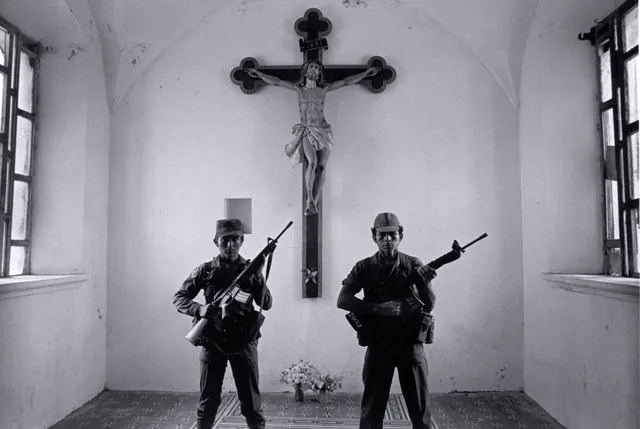
Larry Towell’s selected photograph is a small room made to carry a history larger than its walls. A crucifix establishes the upper axis, two soldiers occupy the lower field, and their rifles alter the church’s visual order. Towell’s Central American practice developed through this pressure between a particular place and the histories that pass through it. His photographs give duration a formal role: roads, interiors, families, institutions, and landscapes accumulate meaning across a body of work.
Formation and long-form practice
Towell’s public biography places his formation in rural Ontario, study at York University, volunteer work, music, writing, and photography. Magnum’s profile describes his work in Nicaragua, Guatemala, and El Salvador, alongside recurring concerns with landlessness, disappearance, books, exhibitions, and museum collections.1 These details describe a practice shaped by return and accumulation.
Central America became a formative field during the 1980s. Towell photographed the Contra war in Nicaragua, the relatives of people who had disappeared in Guatemala, and the civil war in El Salvador. The work moves between rural life, military power, displacement, religious institutions, and memory. A single frame can carry the evidence of a particular room while remaining connected to a much longer sequence of encounters.
Landlessness provides one of the clearest continuities in Towell’s practice. Land is physical ground, legal possession, family history, political promise, and the setting in which displacement becomes visible. In the selected photograph, the church belongs to a community as well as to an architectural tradition. Its walls and symbols hold that social ground while armed bodies occupy the space.
Exhibition, book, and photographic sequence
Towell’s Central American work reached public form through exhibitions and books. Larry Towell: Gifts of War, organized by the Art Gallery of Windsor, travelled between April 1988 and October 1989. The exhibition brought photographs and testimonies from Nicaragua, El Salvador, and Guatemala into a sequence concerned with civilian life, repression, and the effects of war. A separate Coach House Press publication, Gift of War, appeared in 1988.2
Towell’s CV lists Gift of War from 1988 and El Salvador from 1997. The library record for El Salvador identifies a 127-page book with an introduction by Mark Danner and a historical focus on violence, insurgency, and El Salvador between 1979 and 1992.2 These forms extend the life of a photograph. An exhibition establishes a spatial relation among images and testimony; a book controls order, scale, page turning, and intervals of silence.
The public record has not supplied a page, plate, or catalogue crosswalk placing token #145 in Gift of War, El Salvador, or a named exhibition. The selected frame belongs securely to Towell’s 1986 El Salvador period. Its precise publication history remains an archival question.
Place names and parallel records
The token metadata names the place as “Suchitito, El Salvador,” with archive reference TOL1986003W00045/. The Museum’s public title uses “Suchitoto,” the spelling supported by the Art Windsor-Essex and Stephen Bulger records. The source variant remains part of the object’s history and should stay visible beside the preferred public form.3
Art Windsor-Essex records a related gelatin silver print as El Salvador Series 1986–1987 (Soldiers in Church, Suchitoto, El Salvador), 1986, with collection number 2002. and dimensions of 35.0 × 28.0 cm. The record gives the Museum a strong material and title comparison. The public page supplies no Magnum archive number, so equivalence between that print and the token-linked rendition remains unconfirmed.4
The distinction matters because one photographic work can have several manifestations: a negative or scan, a gelatin silver print, a book reproduction, an exhibition image, and a token-linked JPEG. Their titles may converge while their object histories remain separate. Towell’s practice, with its emphasis on books and extended projects, makes those differences part of the work’s public life.
Magnum membership and institutional context
Magnum’s public biography gives Towell’s membership date as 1988. A Henri Cartier-Bresson Foundation dossier uses the phrase “since 1989.” Both dates remain attributed to their sources.5 The discrepancy has limited bearing on the photograph’s identity, while it illustrates the layered biography through which documentary work enters institutional history.
Towell’s relation to Magnum belongs alongside his independent bodies of work, books, exhibitions, and museum holdings. The agency provides one route of circulation; the photograph’s meaning also depends on the photographer’s sustained engagement with place, testimony, and the physical forms through which images endure.
The selected work and El Salvador
The visible photograph shows two armed soldiers standing inside a church. Each holds a rifle angled away from the body. A large crucifix rises between and above them. Windows admit light from both sides, and flowers appear low near the altar. The frontal composition makes the interior almost symmetrical, giving the viewer a clear measure of the soldiers’ distance from the crucifix and one another.
The issuer caption places the church near the Guazapa guerrilla stronghold and connects the persecution of the Catholic Church to liberation theology. That language belongs to the caption’s history. The image identifies a church interior, armed men, rifles, religious symbols, windows, and flowers. It leaves the church name, soldiers’ identities, unit, operation, and purpose unresolved.
United Nations peace-accord records provide the broad civil-war and settlement chronology required for a historical reading of the image. They do not identify this church or these soldiers.6 The public record therefore supports a regional context and an attributed caption while preserving the scene-specific questions.
Museum interpretation
Towell’s composition makes armed presence spatially measurable. The crucifix fixes a vertical axis; the soldiers interrupt it without displacing it. Their rifles extend the architectural lines into the lower field, turning military equipment into a second system of order.
The frontal arrangement gives the scene the clarity of a stage. The viewer can compare the soldiers’ positions, follow the rifles toward the floor, and register the small flowers beneath the crucifix. The church remains fully legible as a devotional interior while the soldiers change the room’s social meaning.
This visual order carries historical tension without resolving the event. The photograph can hold a military presence inside sacred architecture while leaving the exact reason for that presence unknown. The caption supplies Guazapa, persecution, and liberation theology as an attributed historical account. The frame supplies the evidence of bodies, weapons, architecture, and light.
The related Art Windsor-Essex print deepens the object’s material history. A gelatin silver print, a book page, an exhibition installation, and a token-linked JPEG each produce a different encounter with the same possible photographic work. The records currently support relation and comparison. They do not prove identity across every manifestation.
Within the selected group, Towell follows Seymour’s open border landscape with an enclosed interior. The conflict edge has become architectural: a room, a community, and a sacred image carry the pressure of armed power.