

Artist
David Seymour
1 in the permanent Collection
Artist record
- Collection relationship
- 1 in the permanent Collection
- Works represented
- 1 work
- Acquisition
- Conflict at Its Edges
- Artist and practice profile
- Read the artist profile
- Source record
- Open source record
Works by this artist
Artist and practice profile
6529NM-ART-0017
{
  "$schema": "https://6529networkmuseum.org/schemas/record-envelope-v1.json",
  "envelope": {
    "contentHash": {
      "algorithm": 1,
      "canonicalizationId": "0x886c7c89c308c459ca8a626e0ef36a5ea9f4c7a7b56aaf86c71a2ddf3b4f9044",
      "digest": "0x5006a0c251883c819473b294aa1033bfa11b077d1020433eec7f49b64c286b54"
    },
    "effectiveAt": 1786233600,
    "recordType": "PUBLIC_ENTITY",
    "schemaId": "0xd8aef6592fe156c4c3c10e59de540f5cdf8b130eedca322e0e22b30764bee1a9",
    "signatureHash": {
      "algorithm": 2,
      "canonicalizationId": "0x886c7c89c308c459ca8a626e0ef36a5ea9f4c7a7b56aaf86c71a2ddf3b4f9044",
      "digest": "0x0000000000000000000000000000000000000000000000000000000000000000"
    },
    "signatureScheme": "0x0000000000000000000000000000000000000000000000000000000000000000",
    "subjectId": "0x6d8b54940d19f84077abafbb31bf342919994edf65896094dfcfc2526fc31651",
    "uri": "https://6529networkmuseum.org/records/entities/6529NM-ART-0017.json"
  },
  "payload": {
    "canonical_route": "/museum/network/artists/david-seymour",
    "constructor": {
      "id": "codex-task:magnum-completed-accession-correction-2026-08-12",
      "observed_at": "2026-08-12T23:15:00Z",
      "role": "constructor"
    },
    "created_at": "2026-08-12T23:15:00Z",
    "effective_at": "2026-08-09T00:00:00Z",
    "entity_id": "6529NM-ART-0017",
    "entity_status": "published",
    "entity_type": "ARTIST",
    "evidence_refs": [
      {
        "evidence_class": "B",
        "label": "Proposed gift artist label",
        "observed_at": "2026-08-06T13:19:30.726Z",
        "uri": "https://6529.io/waves/5f207393-5418-4a75-8738-e40edb44a94d?drop=002bfa4f-8416-48bf-b35e-38f354e9a9f0"
      },
      {
        "evidence_class": "B",
        "label": "Museum artist research profile",
        "observed_at": "2026-08-09T00:00:00Z",
        "uri": "https://github.com/6529-Collections/6529networkmuseum/blob/main/records/proposed-gifts/6529NM-PG-2026-001/public/scholarship/artists/david-seymour.md"
      }
    ],
    "observed_at": "2026-08-09T00:00:00Z",
    "page_exposure": "canonical_page",
    "payload_sha256": "sha256:397e60e2e7f5964b6bdde147f364ab80f2ef3d066763d8188dee1a30421cfc79",
    "preferred_label": "David Seymour",
    "profile": {
      "authority": {
        "authority_record_ids": [
          "6529NM-AGT-0018"
        ],
        "authority_status": "provisional",
        "evidence_refs": [
          {
            "evidence_class": "B",
            "label": "Proposed gift artist label",
            "observed_at": "2026-08-06T13:19:30.726Z",
            "uri": "https://6529.io/waves/5f207393-5418-4a75-8738-e40edb44a94d?drop=002bfa4f-8416-48bf-b35e-38f354e9a9f0"
          },
          {
            "evidence_class": "B",
            "label": "Museum artist research profile",
            "observed_at": "2026-08-09T00:00:00Z",
            "uri": "https://github.com/6529-Collections/6529networkmuseum/blob/main/records/proposed-gifts/6529NM-PG-2026-001/public/scholarship/artists/david-seymour.md"
          }
        ]
      },
      "name_variants": [
        {
          "evidence_refs": [
            {
              "evidence_class": "B",
              "label": "Name source",
              "observed_at": "2026-08-06T13:19:30.726Z",
              "uri": "https://6529.io/waves/5f207393-5418-4a75-8738-e40edb44a94d?drop=002bfa4f-8416-48bf-b35e-38f354e9a9f0"
            }
          ],
          "source_kind": "proposal",
          "value": "David Seymour",
          "variant_role": "preferred"
        },
        {
          "evidence_refs": [
            {
              "evidence_class": "B",
              "label": "Raw issuer label",
              "observed_at": "2026-08-06T13:19:30.726Z",
              "uri": "https://6529.io/waves/5f207393-5418-4a75-8738-e40edb44a94d?drop=002bfa4f-8416-48bf-b35e-38f354e9a9f0"
            }
          ],
          "source_kind": "proposal",
          "value": "David Seymour",
          "variant_role": "source_label"
        }
      ],
      "practice": {
        "areas": [
          "documentary photography",
          "conflict and aftermath",
          "children and displacement"
        ],
        "evidence_refs": [
          {
            "evidence_class": "B",
            "label": "Museum artist research profile",
            "observed_at": "2026-08-09T00:00:00Z",
            "uri": "https://github.com/6529-Collections/6529networkmuseum/blob/main/records/proposed-gifts/6529NM-PG-2026-001/public/scholarship/artists/david-seymour.md"
          }
        ],
        "summary": "David Seymour's photographs often turn from the spectacle of war to its human aftermath, particularly children, displacement, and reconstruction. The selected 1952 Negev photograph belongs to this sustained attention to lives organized by borders and political upheaval."
      },
      "profile_type": "ARTIST"
    },
    "public_slug": "david-seymour",
    "record_id": "6529NM-ART-0017",
    "record_status": "reviewed",
    "record_type": "PUBLIC_ENTITY",
    "record_version": "1.0.0",
    "references": [
      "6529NM-AGT-0018",
      "6529NM-PG-2026-001",
      "6529NM-PG-2026-001.OBJ-001"
    ],
    "review_status": "reviewed",
    "reviewer": {
      "id": "codex-reviewer:vera-molnar-a9-copy-correction-independent",
      "outcome": "approved",
      "reviewed_at": "2026-08-23T15:10:17.867Z",
      "reviewed_commit": "3eab50914a90c079fe0383624e760fc0a954e709",
      "reviewed_manifest_keccak": "0xd3b728ca1bdbbf99602d626df93b6903bbacf624f2ef71e064412654e71cf313",
      "reviewed_manifest_sha256": "sha256:f672c3503baa823cf4af5eac3bf0513b6b25de6e2674902273cb778f4e771080",
      "reviewer_ids": [
        "codex-reviewer:vera-molnar-a9-copy-correction-independent"
      ],
      "role": "reviewer"
    },
    "schema_id": "0xd8aef6592fe156c4c3c10e59de540f5cdf8b130eedca322e0e22b30764bee1a9",
    "source_record_ids": [
      "6529NM-AGT-0018",
      "6529NM-PG-2026-001",
      "6529NM-PG-2026-001.OBJ-001"
    ],
    "status_observation": {
      "evidence_refs": [
        {
          "evidence_class": "B",
          "label": "Proposed gift artist label",
          "observed_at": "2026-08-06T13:19:30.726Z",
          "uri": "https://6529.io/waves/5f207393-5418-4a75-8738-e40edb44a94d?drop=002bfa4f-8416-48bf-b35e-38f354e9a9f0"
        },
        {
          "evidence_class": "B",
          "label": "Museum artist research profile",
          "observed_at": "2026-08-09T00:00:00Z",
          "uri": "https://github.com/6529-Collections/6529networkmuseum/blob/main/records/proposed-gifts/6529NM-PG-2026-001/public/scholarship/artists/david-seymour.md"
        }
      ],
      "observed_at": "2026-08-09T00:00:00Z",
      "status_label": "published"
    },
    "subject_id": "6529NM-ART-0017",
    "visibility": "public"
  }
}
6529 Network Museum, Curatorial Research · Edition 1.0.0 · Published 9 August 2026 · Research through 9 August 2026 · Publication record and suggested citation
Artist profile
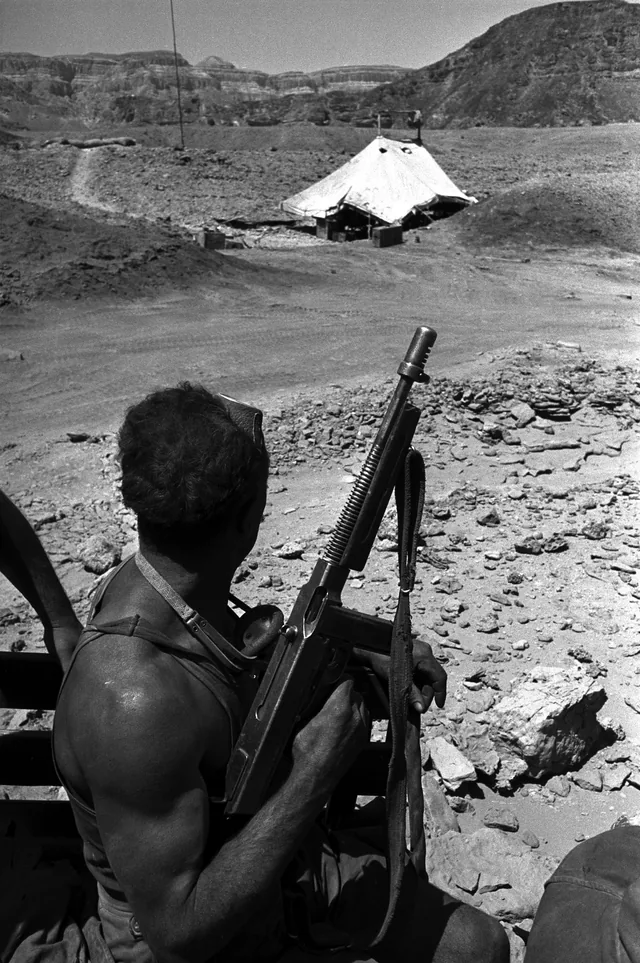
Selected Work: Patrolling the border between the Negev Desert and Jordan, 1952
Sources: S01–S02, S17–S19, S42–S43
A border enters David Seymour’s selected photograph through a caption and a posture. The image gives the viewer a turned body, a rifle, a pale shelter, and eroded terrain; the named line between the Negev and Jordan remains outside the frame. This relation between visible circumstance and historical description reaches back through Seymour’s work in the illustrated press, the Spanish Civil War, postwar reconstruction, and Israel. His photographs place political history close to bodies, families, labor, landscape, and the ordinary structures of survival.
From the illustrated press to postwar reconstruction
David Szymin was born in Warsaw in 1911 and became known professionally as Chim. His early work developed within the illustrated press and the political culture of interwar Europe. The Spanish Civil War gave him a subject in which public conflict and private life appeared together: civilians, families, displacement, and the physical consequences of fighting. The camera remained attentive to the person inside the event.
That attention continued after the Second World War. Seymour’s postwar commissions for UNICEF made children, displacement, injury, and reconstruction central to a major period of his practice. The pictures carry documentary information through gesture and circumstance: a child’s posture, a damaged home, a temporary shelter, or a family’s arrangement within a landscape. The human subject remains specific even when the surrounding history is vast.
The International Center of Photography describes this approach as humanistic reportage. Its account of Seymour’s work connects the Spanish Civil War, postwar reconstruction, the emergence of Israel, and the lives of people affected by political change. ICP’s related press material describes a form of photography in which informative detail can carry metaphor. The point lies in the pressure between the detail and the history around it. A single figure can hold a political situation without becoming its emblem.1
Israel as a sustained photographic field
Seymour travelled regularly to Israel from 1951 onward. ICP places this work within his attention to the new country, its settlers, public life, labor, and changing relation between people and land. The selected frame belongs to that sustained period of looking.
His Israel photographs connect public events with the material conditions surrounding them. Roads, settlements, fields, uniforms, work, religious observance, and open terrain become evidence of a country still being organized and contested. The camera records the visible world while the caption supplies a wider political geography. That division matters in the Negev photograph. The viewer sees a person standing in rough country; the archive and caption name a patrol and a border.
Seymour’s work in Israel also extends his earlier interest in reconstruction. A new state appears through the people inhabiting it, the institutions defining it, and the land through which its political claims are made. The selected image holds a military presence inside a landscape that appears almost empty. Its emptiness is visual; the caption gives it a dense historical charge.
Magnum and authored circulation
Seymour helped establish Magnum in 1947 and later served as the agency’s president after Robert Capa’s death. Magnum’s current institutional history names Henri Cartier-Bresson, Robert Capa, George Rodger, and Seymour as the four founders; other official biographies also record William Vandivert’s early involvement. Those formulations remain source-specific.2
For Seymour, Magnum’s importance lies in the route by which an authored photograph could move through cooperative editing, magazines, books, exhibitions, and archives. The photographer’s name remained attached to the image as its public forms changed. That history is present in the selected work, which now carries an archive reference and a token-linked rendition alongside the estate’s own image record.
Seymour died in 1956 while working during the Suez Crisis. His career therefore belongs to a compressed period in which the illustrated press, international reportage, humanitarian commissions, and photographer-led agency structures were being reshaped together. The selected photograph comes from the late phase of his Israel work, four years before his death.
The selected photograph
The image is vertically composed. A person occupies the lower foreground, seen from behind or in partial profile, with the face unavailable for identification. A long firearm and sling dominate the central foreground. Beyond the figure are a pale tent-like structure, open ground, loose rock, and layered hills or escarpments. A thin vertical pole or line appears near the middle-left. The frame contains no legible flag, border marker, insignia, map, or unit designation.
The rifle establishes the strongest diagonal in the picture. It joins the figure’s body to the shelter and the terrain beyond, turning equipment into a line of attention. Dark clothing, rock, and firearm form a compact lower mass; the pale structure opens a small interval; the hills recede in tonal bands. The viewer follows the patrol’s direction of looking without seeing the object of that attention.
The token record names the work Patrolling the border between the Negev Desert and Jordan, 1952, and gives the archive reference SED1952003W00003/. The David Seymour estate presents a visually matching frame as PAR116258. and adds the fuller place description “The King Solomon’s Mines area, Israel, 1952.” The two records strongly correspond in appearance. A public archival record linking the estate filename to the Magnum archive number remains absent.3
Border history and archival limits
The 1949 Israel–Jordan General Armistice Agreement established an armistice demarcation line in the region. United States Department of State records describe frontier incidents and the unsettled character of the boundary in 1952. These documents supply historical setting for a photograph captioned to a border patrol. They do not identify the person, patrol route, unit, exact site, or incident in the frame.4
The estate’s “King Solomon’s Mines area” phrase adds a second place register to the token’s shorter “Negev, Israel” wording. The distinction should remain visible. The public record supports a 1952 Negev/Israel caption and a strong visual correspondence between two image records. It leaves the exact coordinates, day, assignment, commissioner, first publication, negative, contact sheet, and archive-number semantics unresolved.
Museum interpretation
Seymour makes a border legible without showing a line. The political edge arrives through the figure’s stance, the firearm, the caption, and the receding terrain. Watchfulness becomes the photograph’s central action. The person looks outward; the viewer remains behind him, held at the same distance from whatever the patrol observes.
The image also gives the landscape an unusual responsibility. The hills do not illustrate a named event. They absorb the event’s pressure. Their exposed surfaces and sparse structures hold the body in a field where political geography has to be supplied by records outside the picture.
Within the selected five-Work group, Seymour provides the earliest photograph and the founding-generation Magnum perspective. Its restraint establishes a question that later works alter: how much history can a frame carry when the decisive boundary belongs to the caption, the archive, and the viewer’s knowledge?
Footnotes
-
Magnum Photos and International Center of Photography records, sources S17–S18. ↩
-
Magnum institutional history, cooperative description, and Seymour profile, sources S01–S02 and S17. ↩
-
United Nations Israel–Jordan armistice records and United States Department of State frontier records, sources S42–S43. ↩