

Project study
The room is an algorithm: Atomism and 923 EMPTY ROOMS
923 EMPTY ROOMS makes a room from relations rather than walls. In #713, acid-green marks, charcoal voids, and a luminous seam repeatedly suggest an interior without allowing it to settle. Casey Reas extends a...
Works in this study
- Related work923 EMPTY ROOMS #713Status Accessioned into the permanent CollectionStatus as ofGift of punk6529; Casey REAS; 923 EMPTY ROOMS #713; 6529 Network Museum, 6529NM.2026.001.06. Licensed CC BY-NC 4.0.
Read the complete studyOpen the full essay, notes, bibliography, and publication record.
- Final publication copy: version 2.4.0
- Institutional author: 6529 Network Museum
- Publication date: 2026-08-02
- Release status: final editorial copy, revised after cross-review
- Accession:
6529NM.2026. 001 - Museum object:
6529NM., 923 EMPTY ROOMS #713, 20232026. 001. 06 - Research cutoff: 2026-08-02 Scope note: This essay is a visitor-facing project study. It does not supersede the accession, rights, condition, custody, or preservation records.
923 EMPTY ROOMS makes a room from relations rather than walls. In #713, acid-green marks, charcoal voids, and a luminous seam repeatedly suggest an interior without allowing it to settle. Casey Reas extends a Vasarely-related combinatorial problem into an artwork distributed across colorforms, screens, cities, and viewers.
Gallery label
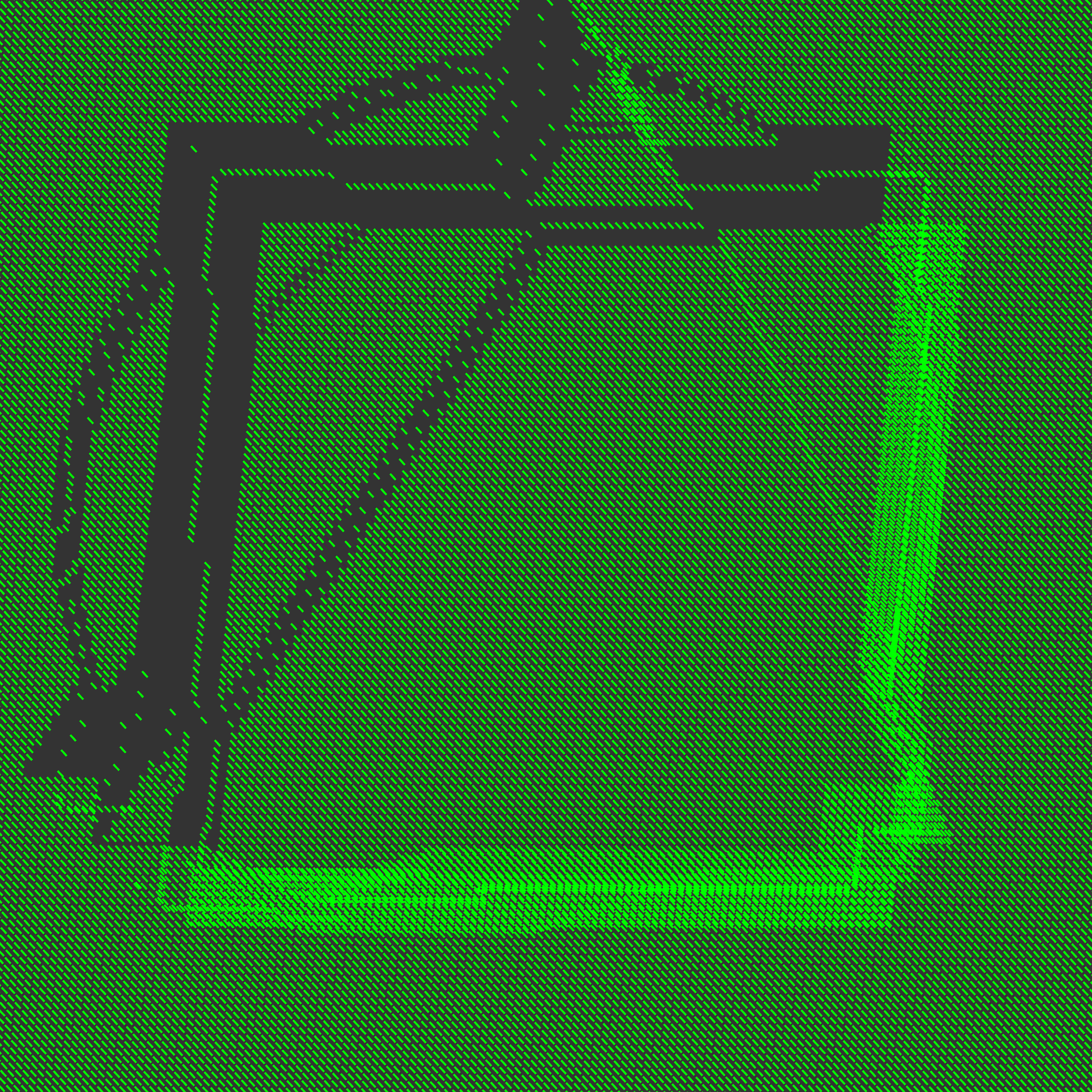
Casey Reas, 923 EMPTY ROOMS #713, 2023. Browser-based generative artwork; Art Blocks, edition of 924. Acid-green diagonal marks sweep across a charcoal field, breaking around voids that can look like a corner, a wall, or an opening. A bright lower ledge and narrow luminous seam at right create depth, then undo it. #713 belongs to a project built from six colorforms and presented through six cities. The work’s “room” is a perceptual event: a viewer makes and remakes space from a finite grammar of units, color, and movement.
Revision history: v2.0.0, 2026-08-02 — completed for first publication release; v2.0.1, 2026-08-02 — corrected the Los Angeles colorform mapping and reframed the city-distribution analysis as Museum interpretation; v2.1.0, 2026-08-03 — copy-edited the published interpretation for directness and cadence without changing its facts or evidence; v2.2.0, 2026-08-04 — deep copy-edited the public essay for curatorial cadence without changing its facts or evidence; v2.3.0, 2026-08-04 — completed the publication copy desk and recast distributed exhibition as a medium condition; v2.4.0, 2026-08-04 — removed the production-stage heading from the published opening without changing the interpretation or evidence.
A room made from relations
Acid-green diagonal marks swarm across the dark field of 923 EMPTY ROOMS #713, breaking around charcoal voids that suggest a corner, wall, or aperture. A bright ledge gathers at the lower edge; a narrow vertical seam glows at right. These cues repeatedly produce and dissolve an interior. The image pulses between room and raster, depth and flatness, screen glow and imaginary architecture.
Reas constructs the room as an event among six colorforms, a combinatorial order, a software display, six geographically distributed presentations, and a viewer organizing the field. Architecture begins in perception before it acquires physical enclosure.
The project extends Reas's engagement with modernist abstraction as a set of operations. Victor Vasarely's unrealized proposal for LACMA's Art and Technology Program imagined a grid-based machine generating many permutations from a limited vocabulary of form and color. Reas tested that proposal in METAVASARELY and An Empty Room and carried its unresolved questions into a distributed edition and six-city exhibition.
Vasarely’s unrealized machine and Reas’s refusal of automation
LACMA’s account of the 1967–71 proposal is revealing. Vasarely envisioned a machine of lights arranged in a grid that could generate millions of patterns related to his paintings. The projected expense made it impossible to build at the time.1 The episode matters because Vasarely treated form and color as a limited alphabet whose recombination might extend painting beyond the singular studio object. The proposal translated a visual language into an apparatus of permutation.
In a LACMA interview, Reas explains that he initially tried to construct a system that could make images that felt as though Vasarely might have made them. Looking closely at Vasarely’s paintings, he found exceptions and idiosyncrasies essential to their force. The system became more interesting as an instrument to perform than as a machine to automate Vasarely’s style.2 The shift locates visual grammar in deviations, choices, and situations that a grammar alone cannot exhaust.
An Empty Room, shown at LACMA in 2023 as part of Coded: Art Enters the Computer Age, 1952–1982, takes that discovery into Reas’s own language. Its title is already a small polemic: an empty room is not empty if a system of forms and relations can make space appear, withdraw, and reappear. The project’s dialogue with Vasarely does not present the later work as the proposal finally completed. LACMA presents METAVASARELY as the simulation of the unrealized proposal and An Empty Room as a separate software-art homage moving into unknown territory.3 Keeping the works distinct leaves historical transmission as a problem rather than a badge of inheritance.
Meredith Hoy’s analysis of Reas’s “painting as programming” names the larger issue. She argues that Reas’s practice unsettles the easy opposition between conceptual code and sensuous abstraction: its programs are executable systems, while their visible outcomes invite ambiguity, morphology, and painterly attention.4 In the Vasarely project, the tension appears as a disagreement with automation. The grid and palette promise a knowable totality; the performed image makes that totality slippery. A rule can generate a field, but it cannot determine all the meanings a field will acquire in a body, a gallery, or a screen.
Six colorforms, 923 rooms, 924 artworks
The later 923 EMPTY ROOMS makes that disagreement public at a larger scale. Bright Moments identifies six “fundamental colorforms”: Sun/Tokyo, Shard/Berlin, Cargo/London, Hive/New York, Pyramid/Mexico City, and Moon/Los Angeles. Their combinations define the project’s stated 923 rooms, while the edition is listed as 924 artworks.5 Art Blocks likewise identifies a fixed edition of 924 and a 2023 release.6 The Museum’s retained population data adds an exact technical clarification: invocations run from 0 through 923; invocation 0 is separately coded 999999; invocations 1 through 923 carry the documented combinatorial sequence. #713 is invocation 713 and maps to Code=.7
These numbers matter without forming a symbolic parable. The difference between 923 rooms and 924 artworks is a real feature of the project’s released structure; invocation zero carries no evidentiary basis for a hidden metaphysics. The code 555536 is an object-specific construction fact, not a psychological key. The interpretation lies in the way a finite list of combinations produces the experience of a much larger, unstable world.
The project’s combinatorics furnish a useful but limited metaphor for artistic possibility. With six kinds of unit and combinations with replacement, the system enumerates a defined field of arrangements. That field is exhaustive in one sense. A given room, however, is also a behavior on a particular screen, at a particular scale, with changed depth, speed, channels, line length, or background state. Bright Moments presents the colorforms as still life, diagram, and code.8 These are three ways of knowing a configuration: an image that appears as space, a diagram that abstracts relation, and code that makes relation legible as a sequence.
The six-city presentation sharpened this instability. The project was released and revealed across Tokyo, Berlin, London, New York, Mexico City, and Los Angeles over six days in August 2023.9 Its combinatorial universe was distributed through a schedule and particular exhibition sites. The published record does not establish a single audience experience or an equal pattern of access. In this essay, the unevenness is a Museum interpretation of how timed encounters in different places frame the work; the published record does not supply an audience account.
The six cities complicate any account of networked art that treats location as a neutral label. They are exhibition sites that organize access and attention. Mathematical exhaustiveness does not erase the singularity of encounter. 923 EMPTY ROOMS gains its tension from the distance between a complete enumeration and an incomplete experience.
#713: a perspective that will not hold
The Museum’s exact object, #713, gives this larger system a particularly forceful visual form. Its project metadata records the city association CDMX and a combination made from four Pyramids, one Cargo, and one Moon. Those terms describe the construction; they do not dictate the image’s meaning.10 What the eye meets is an uneven distribution of lime marks over a charcoal ground. The green diagonals do not behave like a decorative pattern. They create directional pressure, appearing to recede toward a dark central void while also scraping across the surface.
The lower edge is decisive. A bright horizontal accumulation can be read as a ledge, threshold, or low wall, but it never stabilizes the architecture. It acts as a luminous plane pressed against the screen. At the right, a thinner vertical seam amplifies the effect: the eye treats it as a corner, then loses the corner as the stippled field reasserts its flatness. The work offers perspectival cues without allowing a single vanishing point or volume to govern them.
This refusal distinguishes Reas’s “room” from an immersive simulation whose success would be measured by credible depth. The work produces the sensation of a space coming into view while keeping its compositional construction exposed. The green is a high-energy relation between mark and dark interval. The charcoal voids press against the raster and make it seem architectural. #713 looks less like an image of a room than a picture of the conditions under which a room becomes imaginable.
The live work extends that claim. The observed generator is a p5.js/WebGL work using an off-screen surface and custom shaders, with controls for scale, a diagram view, background state, color channels, city presets, depth, speed, line length, resolution, and saving a view.11 These controls make a viewer an operator, but not an all-powerful author. They disclose parameters that alter the presentation without revealing a complete causal map of the work. The diagram may clarify the system; the live visual field can still refuse legibility. The city presets make the distribution logic visible; they do not turn the work into a map.
The Museum’s recorded live observation found changing output, but the exact original screenshots and PNG bytes were not retained. That boundary governs how #713 can be described. A still records one state; it does not substitute for the shader-driven display. A later display must identify its own state and conditions rather than claim to reproduce an original accession screenshot. The work’s medium includes the difference between a momentary room and the software situation that allows rooms to keep appearing.
Atomism, architecture, and the scale of the unit
The title “Atomism” in Reas’s wider practice provides a useful frame, provided it is not treated as a brand name for modularity. The atom in these works is a unit whose identity changes with relation: a colorform appears as code, diagram, still life, light, plane, or feature of a larger field. Its visual scale shifts with context. It can read as a small repeated mark, a fragment of a solid, a piece of an architectural environment, or a parameter in a combinatorial list.
The historical link to Vasarely is most useful here. Vasarely’s grid treats a limited alphabet as a basis for extensive variation. Reas retains the ambition to make a visual language from discrete elements, but shifts the problem from static permutation to performance. The units produce a display in which flatness and volume struggle for priority. Both artists make a grammar of form visible; Reas also makes the act of running that grammar part of the work’s public experience.
The comparison also reveals a difference in medium politics. Vasarely’s unbuilt proposal imagined a substantial institutional machine; Reas’s 2023 project used contemporary software, browser display, online release, and geographically dispersed in-person presentation. The newer apparatus relocates material dependence into screens, renderers, networks, schedules, physical galleries, and token infrastructure. The room is networked, but it is not placeless.
One can therefore understand 923 EMPTY ROOMS as an architectural work without mistaking it for architecture. It does not provide shelter, circulation, or a coherent plan. It provides an experience of spatial imagination under computational constraints. The viewer’s body remains outside the scene, but the eye is made to perform a continual negotiation between visual surface and implied enclosure. The “empty” room is not a void. It is the place where that negotiation occurs.
The city is a display condition
The six-city presentation makes “distributed” a term for scheduled, place-specific encounters as well as online release. Bright Moments organized the colorforms through Tokyo, Berlin, London, New York, Mexico City, and Los Angeles on a six-day sequence.5 No one room contained every possible relation. A city supplied a present condition within a larger combinatorial program. This is consequential for #713, which belongs to the Mexico City/colorform context in the project's published account: its city affiliation locates a work in an exhibition structure without converting the green and charcoal image into a symbolic portrait of a place.8
Two simplifications should be avoided. The project is not “global” merely because it appeared in several locations, and the colorforms do not carry a coded civic essence. Reas’s operation is more material. The six sites, scheduled events, screens, and bodies in rooms create changing circumstances in which a finite visual grammar is encountered. Distribution helps establish the scale at which the grammar can be compared, remembered, and argued over.
The number structure intensifies this pressure. The public account distinguishes 923 possible combinations from a 924-work release; the retained population evidence identifies invocation zero as 999999.79 That apparently anomalous extra work is important because it prevents a tidy equation between a combinatorial set and its public edition. The project offers a system whose enumeration can be stated, but whose exhibition cannot be reduced to a list. Viewers meet one exact work in a screen and a city before they reconstruct the larger field; the field, in turn, changes how that work is read. #713’s lime diagonal raster and bright right-hand seam are not fragments lacking a final master image. They are a localized encounter with an operation that is deliberately larger than any one room.
The Museum’s reading therefore retains a counter-pressure. A staged sequence, numbered release, and finite list can suggest that the system has mastered all difference. #713 resists that conclusion. Its visual field reveals no clean hierarchy of parts and repeatedly lets a room form and collapse. The presentation creates conditions for access and comparison without compelling a single perception. The viewer still has to make depth from a flat image, decide whether the luminous seam is an edge or a breach, and accept that the answer will not stabilize. The project’s social scale gives that perceptual uncertainty a public setting.
Distributed exhibition is a medium condition to disclose and stage. A record names the six cities and the 923/924 structure; a display makes #713's difficult space available for sustained looking. These are related but distinct forms of access, and the visual event should not be reduced to an inventory.
The Museum object and the public collection
Within accession 6529NM., #713 occupies a decisive position. It moves the group beyond the individual image-making systems of CENTURY, Pre-Process, and Phototaxis toward an explicitly distributed exhibition logic. It shows that Reas’s systems are not only machines for generating pictures. They can organize rooms, cities, schedules, and collective comparison. At the same time, its unresolved visual space prevents the group from becoming a triumphal account of code’s totalizing power. The finite system remains perceptually unsettled.
The Museum has two related tasks. It should make #713 available as an exact object with its own visual presence: the sharp green field, the deep charcoal interruptions, the luminous seam that produces and dissolves a room. It should also make the project’s conditions intelligible: the six colorforms, six cities, documented 923/924 structure, browser controls, and relation to LACMA’s earlier dialogue with Vasarely. The system without the image becomes an infographic; the image without the system becomes a handsome but mute abstraction.
923 EMPTY ROOMS asks the viewer to remain in that interval. The work shows how code can count a world without containing the experience of it. #713’s room is never fully there, yet it is not merely absent. It is made again and again by the viewer’s effort to turn discrete relations into space.
Notes
Selected bibliography
- Art Blocks. “923 EMPTY ROOMS by Casey REAS.” Accessed 2026-08-02.
- Bright Moments. “923 Empty Rooms.” Accessed 2026-08-02.
- Ferree, Joel. “Introducing METAVASARELY and An Empty Room, a Two-Part Digital Work by Casey Reas.” LACMA Unframed, 2023.
- Hoy, Meredith. “Painting as Programming: Casey Reas and the Aesthetics of Generative Code.” ISEA 2011.
- LACMA. “Casey Reas: METAVASARELY and An Empty Room.” 2023.
- 6529 Network Museum. 923 EMPTY ROOMS #713 object, technical, visual-observation, and public records for accession
6529NM..2026. 001
Footnotes
-
LACMA, “Casey Reas: METAVASARELY and An Empty Room,” accessed 2026-08-02. ↩
-
Joel Ferree, “Introducing METAVASARELY and An Empty Room, a Two-Part Digital Work by Casey Reas,” LACMA Unframed, 2023. ↩
-
LACMA, “Casey Reas: METAVASARELY and An Empty Room.” ↩
-
Meredith Hoy, “Painting as Programming: Casey Reas and the Aesthetics of Generative Code,” ISEA 2011. ↩
-
Bright Moments, “923 Empty Rooms,” accessed 2026-08-02. ↩ ↩2
-
Art Blocks, “923 EMPTY ROOMS by Casey REAS,” accessed 2026-08-02. ↩
-
6529NM., reviewed object record. ↩ ↩22026. 001. 06 -
Bright Moments, “923 Empty Rooms.” ↩ ↩2
-
923 EMPTY ROOMS #, public object record. ↩713
Research context
Research context
- Related acquisitionThe System in Seven StatesStatus Accessioned into the permanent CollectionStatus as of