

Museum works
923 EMPTY ROOMS #713
Casey Reas / 923 EMPTY ROOMS · not established in the accession projection
Works
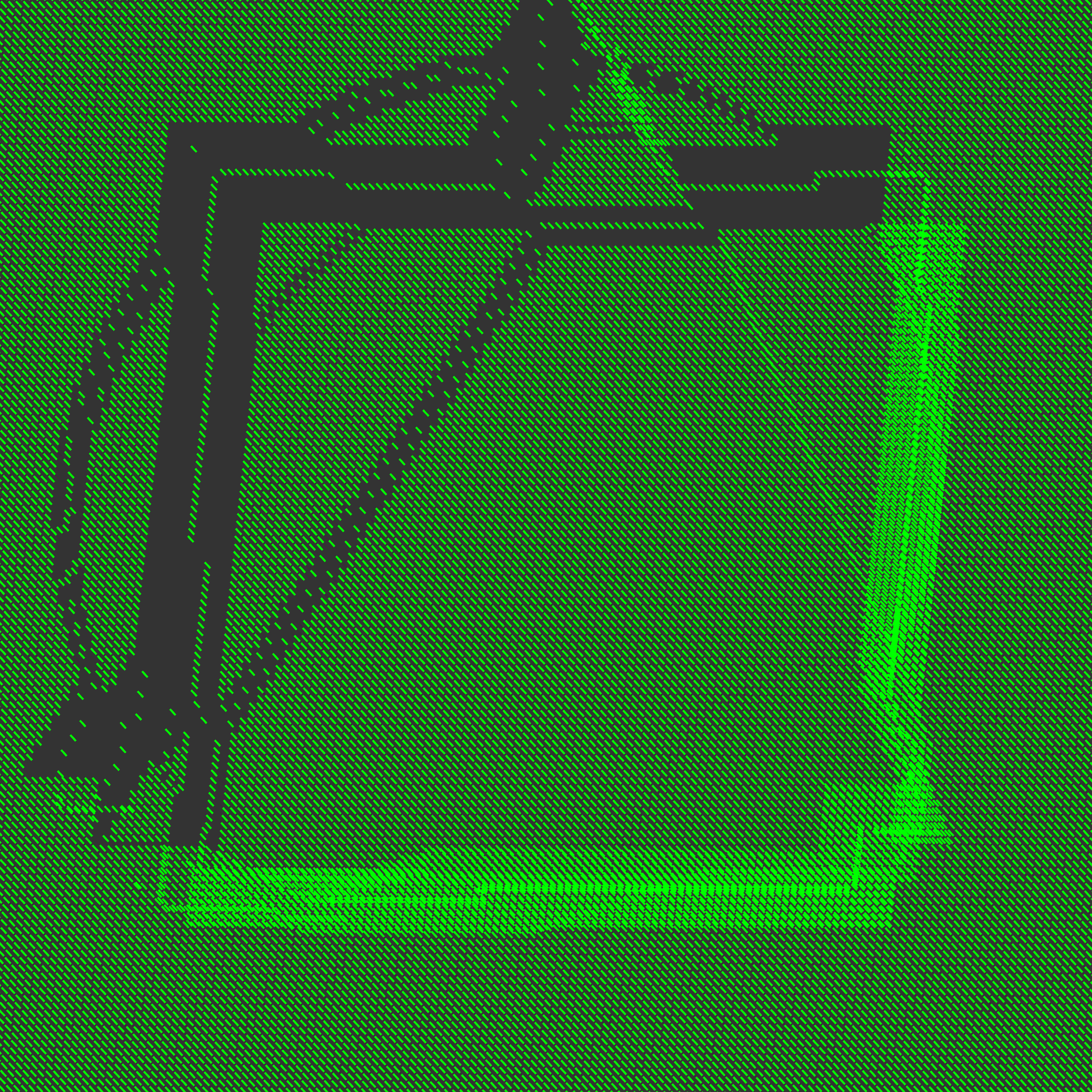
The image above is a 2400 × 2400 documentation still. The official generator presents the live work.
About this work
- Accession: 6529NM.2026.001.06
- Version: 1.5.0
- Publication date: 2026-08-02
- Institutional author: 6529 Network Museum
- Publication status: Published manuscript
- Credit: Gift of punk6529
- Research cutoff: 2 August 2026
Label
No walls enclose 923 EMPTY ROOMS #713. Its room appears through interruption: acid-green dashes stream diagonally across charcoal, then break around dark planes that imply a corner, a floor, or an opening. A bright vertical seam at the right and a low green ledge strengthen the perspective without completing it. In motion, the dashes shift and the shallow depth seems to pulse.
The token’s code combines six forms—four Pyramids, one Cargo, and one Moon—and identifies CDMX as its city and Pyramid as its primary form.1 An artist-defined diagram mode is documented as another view of the forms underlying the optically dense room.2 Reas developed the project from An Empty Room, commissioned by LACMA in dialogue with Victor Vasarely’s unrealized proposal for the museum’s Art and Technology program.3 The token belongs to a distinct work released in a six-day sequence across six Bright Moments galleries and cities. Its architecture belongs nowhere physically: it is assembled by the eye from moving line, withheld geometry, and light.
Extended entry
923 EMPTY ROOMS #713 causes an empty room to appear through interruption. The square is filled with short acid-green strokes, set at a common diagonal and repeated like a luminous raster. They cross a charcoal field in uneven concentrations. Broad dark interruptions cut through the pattern: a sloping void near the center, deeper black planes toward the edges, and quieter regions in which the green nearly disappears. At the right, a bright vertical seam meets a low horizontal ledge. From those few cues, the eye builds an enclosure—a corner, a receding wall, perhaps a window—although no continuous contour confirms it.
The room is therefore made from negative information. Green describes a surface only until a charcoal cut removes it. The black zones read as objects, apertures, or shadows according to what surrounds them. A diagonal band can become a wall plane; a narrow vertical can become emitted light; the lower edge can become a floor. The work exploits the learned conventions of perspective while denying their usual scaffolding. Depth is not modeled by a visible wireframe or rendered volume. It is inferred from interruptions in a field of marks.
The artist and platform document the live manifestation as an animated, browser-executed field with controls for speed, depth, line length, resolution, color channels, city presets, and diagram view.2 Those capabilities establish that the official still captures only one condition of an optical system. No camera needs to enter the room and no depicted object needs to cross it; changes in the line field can make an apparent enclosure sharpen or loosen. The Museum’s retained observation records changed frames after a controlled wait, but it does not preserve the screenshot bytes or support a more exact claim about which dashes, seams, or ledges moved.4
The artist-defined diagram view discloses another level of the work’s notation—the elementary forms from which the less literal room is generated.2 Moving between the documented views exposes the distance Reas constructs between compositional ingredients and perceptual result. The Museum’s retained observation did not activate the diagram control, so this entry makes no claim about its colors, positions, or appearance for #713.4
The recorded code for #713 is 555536. Its six forms comprise four Pyramids, one Cargo, and one Moon; the primary form and city are Pyramid and CDMX.1 Across the project, six form names correspond to six cities: Sun to Tokyo, Shard to Berlin, Cargo to London, Hive to New York, Pyramid to CDMX, and Moon to Los Angeles. The associations locate each work within the project's distributed exhibition structure, but they do not make #713 an illustration of Mexico City. Nothing in its green raster pictures a recognizable site. “CDMX” identifies one branch of a formal and presentational system released across six galleries and cities over six days: Tokyo on 14 August 2023, Berlin on 15 August, London on 16 August, New York on 17 August, Mexico City on 18 August, and Los Angeles on 19 August.2
The project evolved from Reas’s An Empty Room, commissioned by the Los Angeles County Museum of Art for the 2023 exhibition Coded: Art Enters the Computer Age, 1952–1982. That earlier work engaged Victor Vasarely’s unrealized proposal for LACMA’s Art and Technology program.3 The lineage is exact but must not be collapsed. An Empty Room was the LACMA commission; 923 EMPTY ROOMS #713 is not. Reas carried questions of simulation, abstraction, and machine-controlled visual space into a separate 923-room artwork released by Art Blocks and Bright Moments.
This history places #713 in a conversation about how an abstract vocabulary can exceed an isolated picture. Vasarely imagined color and form operating architecturally and technologically; Reas works with browser execution, token-derived configuration, and a networked exhibition across multiple cities. #713's historical relation is visible on its surface: elementary geometry becomes interference, uncertain architecture, and changing light.
The contract contains 924 invocations, numbered 0 through 923. Invocation 0 is separately coded 999999; invocations 1 through 923 realize the project's documented combinations.1 #713 is invocation 713, token 1000713, within that 923-work combinatorial body.1 The project title, combination count, and edition size therefore describe different structures. #713 is a token-bound configuration with its own forms, channels, city relation, and controls.
The controls let a viewer test how little information is required for the room to persist and which changes make it dissolve back into a field of dashes.
Within the 6529 Network Museum’s Reas accession, #713 brings simulated architecture and distributed exhibition into a group otherwise dominated by compositional cutting, behavioral traces, and continuous form. It follows Phototaxis #308, whose lines preserve the histories of unseen machines, by making line itself an environmental skin. It precedes Ex Nihilo (Cosmos) #248, where an ideal solid hovers at the edge of legibility. In #713, legibility is spatial: a room with no fixed walls, made present by the exact places where green light stops.
Object and manifestation
- Work: Casey Reas, 923 EMPTY ROOMS #713, 2023; Art Blocks x Bright Moments, project 1; token 1000713; invocation 713.
- Medium: Browser-executed generative software in p5.js with token-derived state; live screen manifestation and static documentation image; ERC-721 chain identity and transfer history recorded on Ethereum; legal title and rights recorded separately.15
- Recorded configuration: Code 555536; City: CDMX; Primary Form: Pyramid; four Pyramids, one Cargo, one Moon; Background: Gray; Green: true; Red: false; Blue: false.1
- Live behavior beyond the still: Artist- and platform-documented animated line field and diagram, channel, background, depth, speed, line-length, resolution, and city-preset controls. The Museum’s retained observation confirms frame change but did not activate controls.24
- Rights and condition: Retained object metadata reports CC BY-NC 4.0; the accession technical review outcome is
pass_.6with_ conditions
Museum record and research
- Status:
accessioned; permanent-collection object in6529NM..2026. 001 - Interpretive boundary: Museum interpretation [E] of one documented state. The official still documents one state of the executable software work.
- Rights and condition: See the title and rights review. Technical condition passes with amber preservation conditions documented in the object-specific condition record.
- Open research: The transparent linked descriptor publishes the Museum's reproducible project-level feature analysis. It uses no OpenSea or marketplace rarity metric and makes no claim that feature frequency determines artistic quality.
- Further context: Read the artist and practice profile, collection essay, and visual-observation record.
Notes and sources
Revision history
- 1.5.0 — 4 August 2026: Completed the publication copy desk, clarified chain-history boundaries, and tightened the close looking.
- 1.4.0 — 4 August 2026: Reworked residual visitor-facing prose for directness and removed repeated procedural contrasts; identity, rights, condition, provenance, and evidentiary assertions unchanged.
- 1.3.0 — 3 August 2026: Copy-edited the object interpretation for directness and clarity; no identity, rights, condition, provenance, or evidentiary assertion changed.
- 1.2.0 — 2 August 2026: Final publication metadata applied; invocation-zero evidence rebound to the canonical object record after independent review.
- 1.1.0 — 2 August 2026: Removed unsupported witnessed motion and diagram claims; corrected the release to six cities over six days, added exact LACMA commission sources, and aligned notes, rights, and condition references.
- 1.0.0 — 2 August 2026: Initial object-specific manuscript.
Footnotes
-
The canonical object record establishes the 924-token invocation structure, separately coded invocation-zero value 999999, and #713’s invocation and code; retained raw platform metadata supplies the exact token identity and feature values quoted above. ↩ ↩2 ↩3 ↩4 ↩5 ↩6
-
Bright Moments project presentation for 923 Empty Rooms, including the dated six-city sequence, project forms, exhibition structure, and interactive modes; and the project description retained in the raw platform metadata. ↩ ↩2 ↩3 ↩4 ↩5
-
LACMA, “Introducing Metavasarely and An Empty Room: A Two-Part Digital Work by Casey Reas”, 13 February 2023; LACMA, An Empty Room collection/project record; and Coded: Art Enters the Computer Age, 1952–1982. These sources establish the LACMA commission and Vasarely context; they do not identify #713 as the commissioned object. ↩ ↩2
-
Controlled visual-observation record. The record documents changed screenshot hashes after a controlled wait; it does not document use of the diagram or other controls, and the screenshot bytes were not retained. ↩ ↩2 ↩3
-
Exact rights record and technical and condition record. The license statement is reported by retained Art Blocks metadata; the condition record specifies an accession outcome of
pass_. ↩with_ conditions
Title, rights, and accession review
Accession lot: 6529NM.
Decision date: 2026-08-02
Acquisition method: gift
Donor credit: punk6529
Objects reviewed: seven Casey REAS Art Blocks tokens, 6529NM. through .
Institutional author: 6529 Network Museum, Registrar
Decision authority: direct Museum-authorized collection authority recorded in 6529NM.
Determination
The 6529 Network Museum determines that the seven scheduled tokens are eligible for and accepted into the permanent collection. The donor made a full gift: the Museum accepts the donor's entire ownership interest in the tokens and every donor-held interest that is transferable with them, without consideration and without a retained donor interest. The common Ethereum transfer into networkmuseum., the exact contract/token schedule, the Museum's formal gift acceptance, and this reviewed title declaration together establish a sufficient title basis for accession.
This determination does not collapse token ownership into copyright ownership. The Museum owns the seven tokenized collection objects. No copyright assignment from Casey REAS is asserted or inferred. Copyright and similar rights remain with the applicable licensor or rights holder except to the extent exercised under the public license attached to each work's retained Art Blocks metadata.
The Museum accepts the ordinary residual risk that a public blockchain cannot disclose every possible private claim, security interest, incapacity, or off-chain dispute. No contrary claim, competing on-chain owner, consideration, donor reservation, or object-identity conflict is present in the reviewed record. That residual limitation is documented and accepted; it is not an open accession gate.
Evidence and title analysis
The title conclusion rests on four mutually reinforcing records:
- The donor's instruction, treated by the Museum as a full and intentional gift of all donor-held interests in the seven tokens.
- The formally accepted Gift Acceptance and Accession Authorization, made under the adopted Art Blocks preapproval and Donation Acceptance Policy.
- Ethereum transaction
0xbdde33b3, whose seven ERC-7212d4b7033 5b10cbd3 7c0b00a0 27844f14 c900d82a a4f75b7a 7b390498 Transferlogs deliver the exact scheduled assets to the Museum custody address. - The object-level chain identities, transaction log indices, and custody findings in the machine records and retained raw RPC receipt.
The transfer transaction is both custody evidence and performance of the gift. The institutional title declaration does not pretend to be a donor-signed deed; it records the Museum's reviewed conclusion from the donor's full-gift declaration, completed delivery, formal acceptance, and exact object schedule. The Museum considers that evidence sufficient for these no-consideration token gifts under its donation pathway.
The provenance record is complete for the accession event and exact receipt. Earlier token history may be enriched through continuing scholarship, but the absence of a prose ownership history for every prior wallet is not an accession blocker where the object identity, donor gift, delivery, and current custody are verified and no adverse claim is known.
Copyright and public-license analysis
All seven retained Art Blocks metadata responses identify the artist as Casey REAS and state CC BY-. The Museum treats those labels as object-specific source evidence that the licensed material is offered under the Creative Commons Attribution-NonCommercial 4.0 International Public License. Under the official legal code, the license grants worldwide, royalty-free, non-exclusive, irrevocable permission to reproduce and share the licensed material and to produce, reproduce, and share adapted material for noncommercial purposes. It permits all media and formats and technical modifications needed to exercise those rights. The official deed summarizes the same permissions and principal conditions.
The Museum therefore makes the following affirmative use determinations:
| Use | Determination | Conditions and boundary |
|---|---|---|
| UseExhibition and public display | DeterminationGranted with conditions | Conditions and boundaryMuseum use must be noncommercial, attributed, linked to the license and source where practicable, and must not imply artist endorsement. |
| UseReproduction and documentation | DeterminationGranted with conditions | Conditions and boundaryNoncommercial captures, thumbnails, stills, video documentation, and study copies may be made and shared with the required notices. |
| UsePublication | DeterminationGranted with conditions | Conditions and boundaryNoncommercial collection pages, catalogues, scholarship, educational material, and social communication are permitted with attribution and license notice. |
| UsePrint | DeterminationGranted with conditions | Conditions and boundaryNoncommercial labels, study prints, conservation references, and publications are permitted; commercial merchandise is not authorized by this record. |
| UseDerivative and adapted use | DeterminationGranted with conditions | Conditions and boundaryNoncommercial adaptations are permitted; changes and prior modifications must be identified, and an adapter's terms may not prevent compliance with CC BY-NC 4.0. |
| UsePreservation copying | DeterminationGranted with conditions | Conditions and boundaryThe Museum may retain source, generator, dependency, render, migration, emulation, and recovery copies for noncommercial stewardship and may make necessary technical modifications. |
| UseMigration and emulation | DeterminationGranted with conditions | Conditions and boundaryTechnical modifications necessary for lawful noncommercial use are permitted; material changes must be documented when the result is shared. |
| UseAccessibility | DeterminationGranted with conditions | Conditions and boundaryNoncommercial accessible renditions and interpretive adaptations are permitted with attribution and change marking. |
| UseAI training and computational research | DeterminationGranted with conditions | Conditions and boundaryTo the extent copyright permission is required, the Museum may reproduce or adapt the licensed material for its own noncommercial research, cataloguing, conservation, and analysis. This record does not authorize commercial model training or waive rights outside the license. |
Commercial use is not granted by CC BY-NC 4.0 and is not approved by this review. Patent and trademark rights are not licensed. Moral, publicity, privacy, and similar rights are not broadly licensed, although the legal code contains a limited waiver or non-assertion to the extent necessary to exercise the licensed rights. The license supplies no warranty of title or non-infringement. Uses independently permitted by an exception or limitation remain outside the license's conditions.
Attribution and use protocol
Whenever the Museum shares a work or an adapted version, the accompanying credit must, so far as supplied and reasonably practicable:
- identify Casey REAS as creator and preserve any other supplied attribution party;
- identify the work and its Museum accession number;
- state
CC BY-and link toNC 4. 0 https:;/ / creativecommons. org/ licenses/ by- nc/ 4. 0/ - link to the source object or official project record where reasonably practicable;
- retain supplied copyright and warranty-disclaimer notices;
- state whether the Museum modified the material and preserve notice of earlier modifications; and
- avoid any suggestion that Casey REAS, Art Blocks, or another attribution party endorses the Museum or a particular use.
Recommended collection credit: Casey REAS, [title], [year]; on- Add Museum documentation capture or a precise change statement to derivatives and surrogates.
Registrar and risk conclusions
- Identity and authenticity: pass. Exact CAIP-19 identities, token hashes where supplied, Art Blocks project data, raw metadata bytes, and the common transfer receipt are fixed in the evidence package.
- Donor authority and title: pass with accepted residual risk. The Museum relies on the donor's full-gift declaration and completed delivery; no adverse claim or donor reservation is recorded.
- Provenance: pass for accession. The accession transfer is fully documented in the Stream-compatible provenance schedule; earlier chain history remains ordinary cataloguing enrichment.
- Rights: pass with conditions. The Museum owns the tokens, not the artist's copyright; the object-specific CC BY-NC 4.0 grant supports the noncommercial museum uses listed above.
- Compliance: pass. The gift involved no consideration, no restricted material, no personal-data payload, and no identified sanctions, dispute, or encumbrance indicator in the reviewed record. The limits of public wallet evidence are accepted rather than mislabeled as certainty.
- Curatorial case: pass. The artist profile, collection essay, and object records establish the significance of the artist, the projects, the seven works, and the collection's fit with the Museum's mission without converting interpretation into artist intent.
Accession outcome
Title, rights, identity, provenance, curatorial significance, condition, and technical evidence are sufficient for accession. The lot is approved for the permanent collection as accessioned. Long-term software preservation, dependency capture, multi-environment rendering, periodic custody verification, and future provenance enrichment remain active stewardship duties. They do not postpone the accession decision.
The work in motion
View the live work
Gift of punk6529; Casey REAS; 923 EMPTY ROOMS #713; 6529 Network Museum, 6529NM.2026.001.06. CC BY-NC 4.0
Open official source- Medium
- On-chain generative software associated with an ERC-721 token on Ethereum; Art Blocks records a token hash. Determinism of live behavior has not yet been independently verified.
- Credit and rights
- Gift of punk6529; Casey REAS; 923 EMPTY ROOMS #713; 6529 Network Museum, 6529NM.2026.001.06.
Collection context
- Part of923 EMPTY ROOMS
- Acquired throughThe System in Seven StatesStatus Accessioned into the permanent CollectionStatus as of