

Work entry
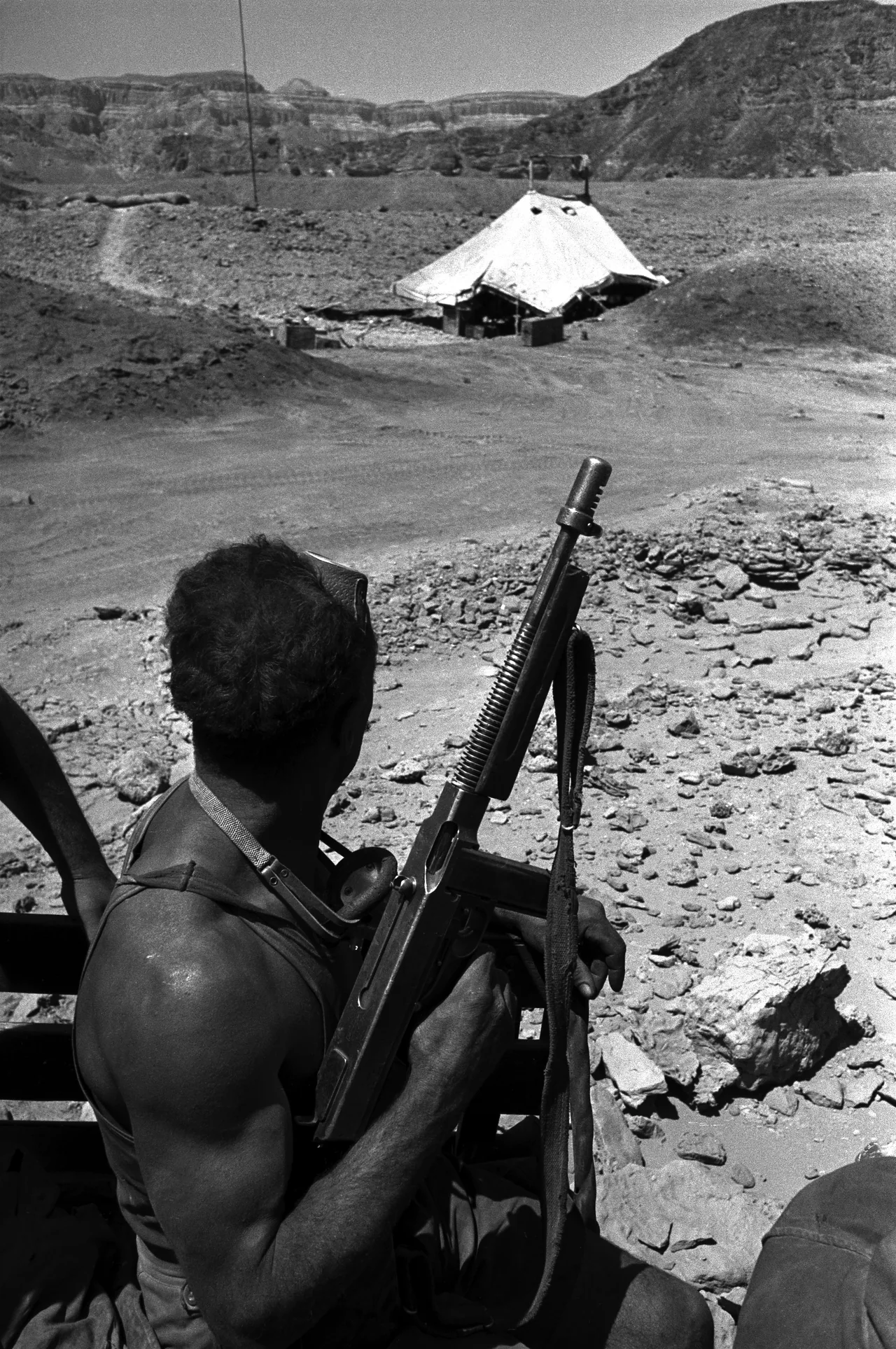
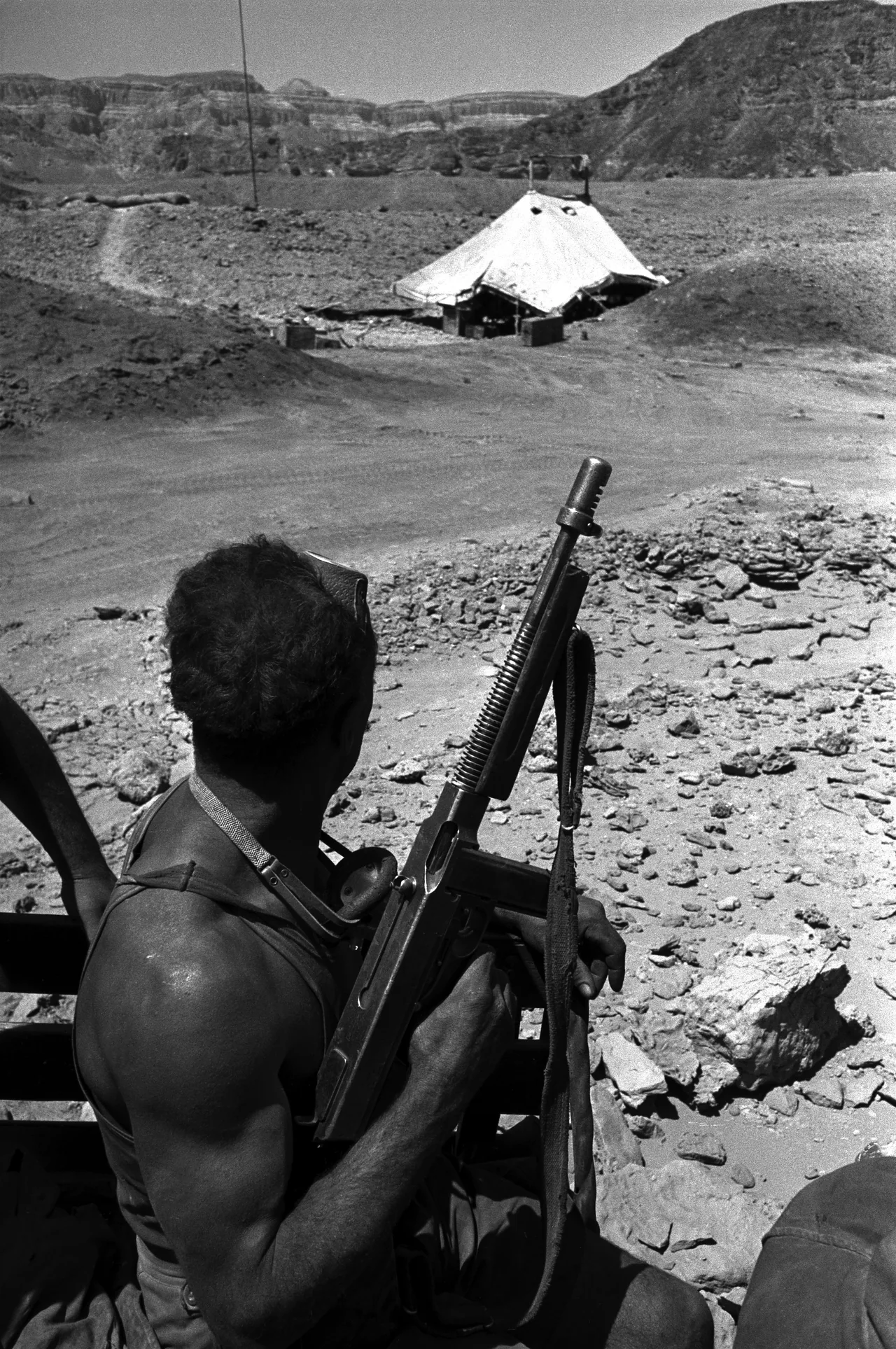
David Seymour (Chim), *Patrolling the border between the Negev Desert and Jordan*
6529 Network Museum, Curatorial Research · Edition 1.0.0 · Published 9 August 2026 · Research through 9 August 2026 · Publication record and suggested citation
Works in this study
 Related workPatrolling the border between the Negev Desert and JordanStatus Accessioned into the permanent CollectionStatus as ofDavid Seymour, Negev, 1952. © David Seymour/Magnum Photos 2022.
Read the complete studyOpen the full essay, notes, bibliography, and publication record.
6529 Network Museum, Curatorial Research · Edition 1.0.0 · Published 9 August 2026 · Research through 9 August 2026 · Publication record and suggested citation
Short label: Border patrol, 1952 · Negev, Israel. Accessioned gift in the permanent Collection under 6529NM.; the Wave proposal remains part of the work’s recorded origin.
Looking at the Work
The photograph is black and white and vertically composed. A person occupies the lower foreground, seen from behind or in partial profile. The face is unavailable for identification. A long firearm, sling, or harness dominates the central foreground, with dark cropped forms entering at the lower edges.
Beyond the figure are a pale tent-like or canopy-like structure, open ground, loose rock, and layered, eroded hills. A thin vertical pole or line appears near the middle-left. The landscape recedes through tonal bands. No flag, border marker, map, insignia, unit marking, or named incident is legible in the image.
The rifle creates the strongest diagonal. It joins the body to the shelter and the distant terrain, making the figure’s direction of attention legible while leaving its object unseen. Dark rock, clothing, and firearm form a compact lower mass; the pale structure opens a narrow interval before the hills carry the eye toward the horizon.
Caption and archive record
The token record identifies the work as Patrolling the border between the Negev Desert and Jordan, 1952, and gives the Magnum archive reference SED1952003W00003/. Token metadata places the work in the Negev, Israel, as Magnum Photos 75 #127, edition 1/1, curation 2/.1
The David Seymour estate presents a visually matching frame as PAR116258. and captions it “The King Solomon’s Mines area, Israel, 1952.” The estate image and the token-linked JPEG share the same composition and visible arrangement. The public records provide a strong visual match. A reviewed crosswalk between PAR116258. and SED1952003W00003/ remains unavailable.2
The two captions carry different levels of place information. “Negev, Israel” is the token’s shorter location field. “The King Solomon’s Mines area” is the estate’s fuller description. Both should remain attributed to their sources. The exact site, coordinates, day, patrol route, and archive-number suffix semantics remain open.
Historical context
The 1949 Israel–Jordan General Armistice Agreement established an armistice demarcation line for the region. United States Department of State records describe frontier incidents and the unsettled character of the boundary in 1952.3 This history gives the border caption a substantial political setting.
The documents describe regional conditions. They do not identify the person, military unit, assignment, commissioner, or incident represented here. The photograph supplies a body in terrain; the caption and historical records supply the geopolitical frame. Those forms of evidence should remain adjacent without being merged.
Museum interpretation
Seymour makes the border present through absence. No line crosses the ground. The frontier appears through the armed figure’s stance, the direction of the rifle, the distance between the shelter and the hills, and the title attached to the image.
The turned body places the viewer behind the patrol. The figure’s face remains outside the encounter, while the landscape becomes the field of attention. This gives the photograph a quiet tension: the viewer sees the conditions of watchfulness and the object of watchfulness remains elsewhere.
The image also resists a simple heroic reading. The figure is small against the terrain, and the rifle functions as both equipment and compositional hinge. The landscape controls the scale. The human body establishes the viewpoint; the hills determine the image’s duration.
The estate’s fuller place caption introduces the phrase “King Solomon’s Mines area,” while the token record gives the broader Negev location. The distinction keeps the photograph’s historical geography open. It also shows how an archive can add specificity that the pixels cannot independently verify.
Within the selected five-Work group, Seymour supplies the earliest image and a founding-generation Magnum perspective. The work begins the sequence with a political edge that is felt through posture, terrain, and caption.
Record note
| Field | Current record |
|---|---|
| FieldToken identity | Current recordeip155:; Magnum Photos 75 #127; edition 1/1; curation 2/. S10 |
| FieldArchive reference | Current recordSED1952003W00003/. S10 |
| FieldToken-linked rendition | Current recordJPEG, 3,056 × 4,600 pixels, 2,518,674 observed bytes; SHA-256 65abf8b6. S10 |
| FieldMuseum status | Current recordCompleted gift; accessioned into the permanent Collection as 6529NM.. S37 |
| FieldCredit and rights | Current record© David Seymour/Magnum Photos 2022 · All Rights Reserved. The Museum interprets ordinary credited institutional display, publication, and accessibility in accession, Collection, and scholarship contexts as permissible. This does not transfer copyright or grant commercial or general reproduction, derivative, licensing, download, or AI-training rights. S10, S38 |
The exact assignment, first publication, negative, contact sheet, estate-to-Magnum crosswalk, and future rights authority remain research questions. The upstream JPEG is an observed token-linked rendition; the repository retains its URL and fixity record, with no original negative or preservation master.
Footnotes
Research context
Research context
- Related acquisitionConflict at Its EdgesStatus Accessioned into the permanent CollectionStatus as of
- Related organizationMagnum Photos