

Essay
Acquisition narrative: *Conflict at Its Edges*
6529 Network Museum, Curatorial Research · Edition 1.0.0 · Published 9 August 2026 · Research through 9 August 2026 · Publication record and suggested citation
Read the complete studyOpen the full essay, notes, bibliography, and publication record.
6529 Network Museum, Curatorial Research · Edition 1.0.0 · Published 9 August 2026 · Research through 9 August 2026 · Publication record and suggested citation
How the selected offer was formed
The selected offer consists of five token-linked photographs published through
Magnum Photos 75. The public proposal credits punk6529 as offeror and presents
the five under the title Conflict at Its Edges. The artists made five
independent Works; the proposal places them in relation. The completed
accession record documents the donor’s authority and the gift of all five Works
under accession 6529NM..
That relation crosses two Magnum 75 curations. Moisés Saman’s #44 is marked 1/, while David Seymour #127, Larry Towell #145, Micha Bar-Am #97, and Lorenzo Meloni #104 are marked 2/. The split is exact and publicly checkable. It records the upstream selection histories of the tokens; it does not explain why the offeror selected these five. The reviewed public records contain no statement or evidence that Magnum Photos, Alejandro Cartagena, Azu Nwagbogu, or any of the five artists endorsed the resulting group.1
The current status is completed gift; accessioned into the permanent
Collection as 6529NM.. This scholarship, the five object records,
rights and technical review, provenance work, public presentation, and
accession certificate form the current accession package. The five Works
remain individually catalogued; provenance, source-image, rights, and
preservation stewardship continue after accession.
The relation among the photographs
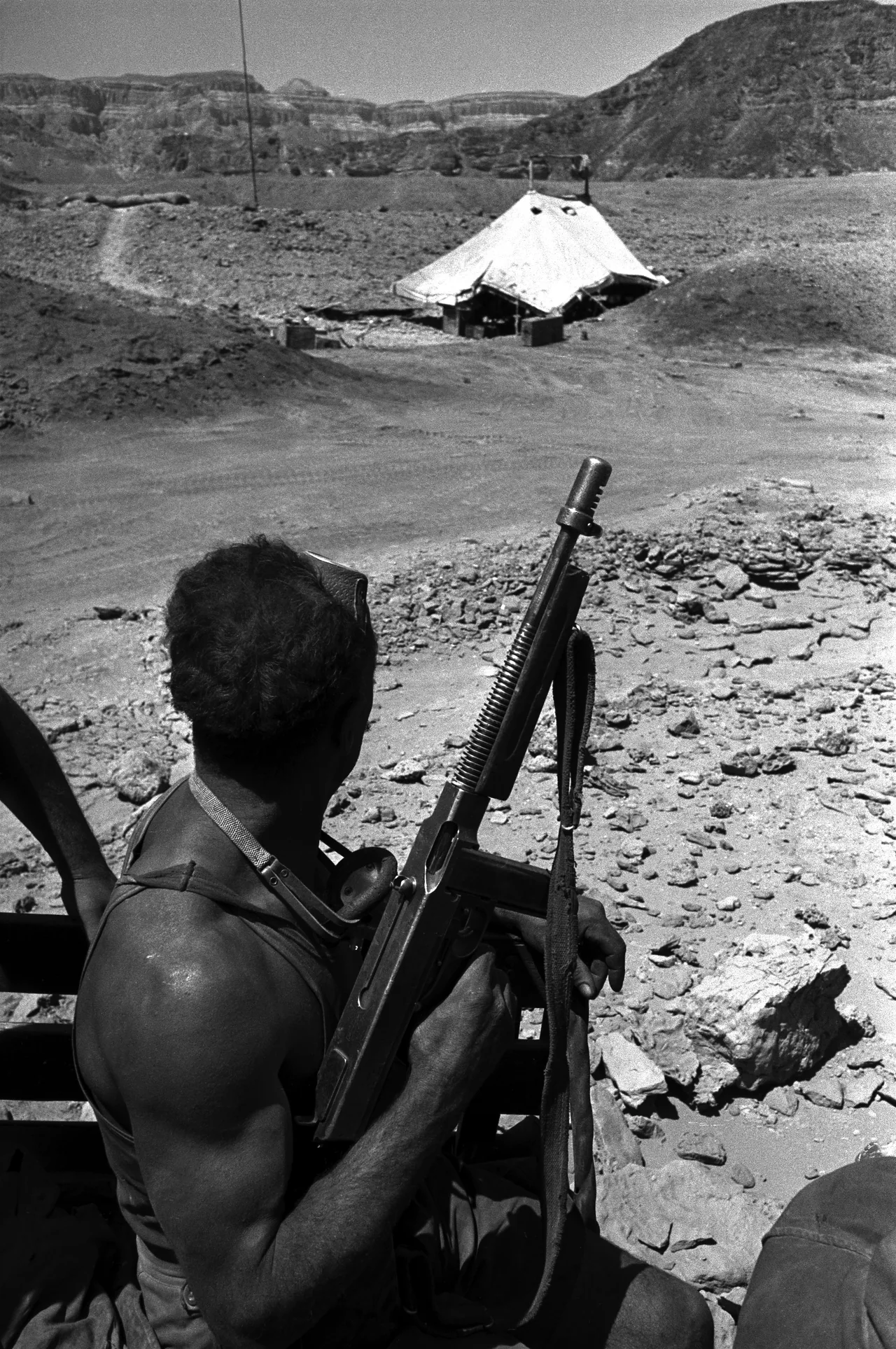
The group begins with a border that the photograph cannot mark directly. Seymour’s patrol occupies a narrow strip of the Negev landscape; the caption supplies the political geography while the image gives terrain, posture, weapon, and distance.
Towell moves the question indoors. Two soldiers stand beneath a crucifix, and the church’s symmetry turns armed presence into a problem of worship, access, and captioned place. The image identifies a room and a historical pressure while leaving the church, unit, and operation unresolved.
Bar-Am photographs a public site through smoke. A canister, moving figure, stone wall, and metal barrier make visibility itself unstable. The Western Wall supplies religious and political context; the exact day and person remain matters for the archive.
Saman brings the question into a shallow domestic space. An apparently young person stands beside a marked wall beneath a caged lamp. The issuer caption includes an official account of air strikes and injury while explicitly describing that account as impossible to verify. The photograph records the wall and the person; the caption records the conditions under which the damage was narrated. The reviewed public record supplies no age, identity, or consent documentation for the person shown.
Meloni closes the chronological sequence at Palmyra. A soldier presses a helmet to his face among rubble and surviving columns. The image follows the destruction of the Temple of Bel and the military recapture of the site. Its access history includes government permission, military shadowing, a minder, mine warnings, and directed entry. The soldier's obscured gesture resists a settled psychological reading while the ruins carry a documented public history.2
Taken together, the five Works concern borders, access, captions, damaged sites, and documentary afterlives. The relation is strongest when each term remains concrete. Borders appear through named places and incomplete coordinates. Access appears through armed presence, controlled routes, military presence, and the conditions of looking. Captions carry claims that the frame cannot independently verify. Damaged sites hold material traces whose causes and histories exceed the image. Documentary afterlives unfold through archives, books, estates, museums, metadata, tokens, and later acts of grouping.
The case for acceptance
Acceptance would give the Museum a carefully bounded study of how photographic evidence travels. Every Work can remain individually legible while the group permits comparison across generations of Magnum practice, documentary situations, and forms of circulation.
The proposed relation also joins photographic history to the specific material history of Magnum Photos 75. The photographs predate blockchain publication by decades. Their 2022 tokens add sequence values, curation fields, metadata objects, Arweave image pointers, edition language, and transfer histories. Those records become part of the photographs’ public afterlives. They offer a way to study what networked publication preserves, what it leaves unresolved, and how an edition can sit beside older histories of caption, print, archive, and copyright.3
The group is small enough for the Museum to keep those distinctions visible. A larger anthology could make uncertainty statistical or anonymous. Five Works allow the public to follow the exact archive reference, the caption’s authority, the access account, the image’s visible evidence, and the unanswered question attached to each frame.
The countercase
The proposal asks the Museum to make a relation that the upstream project did not make. That act carries risk. The six-decade span can flatten differences among postwar border surveillance, civil-war armed presence, religious protest, state-managed press access, and the aftermath of the Islamic State’s destruction. The title may encourage viewers to read all five photographs through a generalized atmosphere of conflict.
The donor’s group also crosses curatorial intentions. Saman’s token belongs to the first Magnum 75 register associated with Alejandro Cartagena; the other four belong to the second register presented in dialogue with Azu Nwagbogu. Their juxtaposition may generate a productive argument, though the reviewed public records contain no statement or evidence from either curator endorsing the five-Work relation.
The evidentiary record remains uneven. Seymour’s archive-to-estate crosswalk is incomplete. Towell’s church and assignment remain unidentified. Bar-Am’s archive suffix and event date require clarification. Saman’s damage account remains qualified, and the reviewed public record supplies no age, identity, or consent documentation for the apparently young person shown. Meloni’s route into Palmyra is documented through contemporary reporting without a frame-specific permission record.
Rights and stewardship create a continuing limit. The token notices read All Rights Reserved; the accession record interprets ordinary credited
institutional display, publication, and accessibility in accession, Collection,
and scholarship contexts as permissible. That interpretation does not transfer
copyright or grant commercial or general reproduction, derivative, licensing,
download, or AI-training rights. The historical Wave URLs remain proposal
evidence, while governed token-linked presentation locators may be used under
the accession display authority. No preservation master is claimed by this
public record for the five photographs.4
Response
These objections describe the group’s proper form. The five photographs remain five Works. The title is presented as a proposal-origin curatorial proposition, with its sources and limits visible. Each caption remains attributed; each archive discrepancy remains legible; Saman’s subject requires a safeguarding boundary; and any use beyond the Museum’s current credited institutional display, publication, and accessibility interpretation requires separate rights analysis. The publication continues to disclose the two Magnum 75 curations, the absence of a recorded endorsement of the resulting group, and the unresolved questions that materially affect interpretation.
The acquisition record would preserve the proposal’s five-object relation while keeping each Work’s title, caption, token manifestation, rights, provenance, and custody history separate. The relation becomes a curatorial hypothesis with a stable object list. It proposes a comparison among exact Works and makes no new classification. It asks how a photograph acquires historical weight through the relation among frame, caption, access, place, archive, and later circulation.
What accession makes possible
The accession supports exhibitions, object publications, and research into the afterlives of documentary photography in a networked edition. Its public value depends on keeping the individual histories intact. The Museum records donor authority, legal title, custody, and provenance separately for each token manifestation; applies the accession rights determination to ordinary credited institutional display, publication, and accessibility; and handles Saman’s photograph through an appropriate safeguarding boundary. New uses outside that scope require fresh rights analysis.
The intellectual work would continue after acceptance. New caption sheets, archive crosswalks, permission records, or artist and Magnum correspondence could change the account. Those changes should enter the publication as dated amendments while preserving the prior record.
Conflict at Its Edges enters the permanent Collection because its five photographs make the institutions around documentary evidence visible. Its value will depend on whether the Museum can hold the donor’s relation firmly enough to study and lightly enough to revise.
Footnotes
-
Exact Magnum 75 metadata and proposal record, S04–S05, S10–S14, and S37. ↩
-
Five Work records and caption/context sources, S10–S14, S19, S23–S25, S27–S32, and S41. ↩
-
Magnum Photos 75 project and ICP institutional history, S04, S10–S14, and S39. ↩
-
Rights, token, and historical Wave media records, S09, S10–S14, S37, and S38. ↩
Research context
Research context
- Related acquisitionConflict at Its EdgesStatus Accessioned into the permanent CollectionStatus as of
- Related organizationMagnum Photos