

Artist study
Vera Molnár: Order, Variation, and the Line
Vera Molnár (1924–2023) built images from a deliberately limited vocabulary: squares, lines, circles, grids, and letters. She repeated these forms under changing rules. A regular field might loosen, a line might...
Read the complete studyOpen the full essay, notes, bibliography, and publication record.
Vera Molnár (1924–2023) built images from a deliberately limited vocabulary: squares, lines, circles, grids, and letters. She repeated these forms under changing rules. A regular field might loosen, a line might drift, or one interval might break a sequence. Each disturbance sharpened the viewer’s sense of the order around it.
Born in Budapest, Molnár studied painting, art history, and aesthetics at the Hungarian University of Fine Arts before moving to Paris in 1947. Her early work grew from postwar geometric abstraction, though procedure soon became as important as form. She sought ways to test a composition repeatedly, hold some conditions steady, and alter others.
The imagined machine
In 1959 Molnár began to describe a machine imaginaire. Before she had access to a computer, she worked as though she were giving one instructions. A procedure could specify the permitted shapes, their placement, and the changes allowed from one drawing to the next. In Molnár’s account, this imagined machine made each decision explicit while allowing a sequence to produce configurations she had not drawn in advance.
Molnár participated in the formation of the Centre de Recherche d’Art Visuel and the Groupe de Recherche d’Art Visuel. In 1967 she co-founded Art et Informatique. The following year she began making computer-generated drawings at the Orsay computing centre. Plotters carried the logic of her hand-drawn procedures into serial experiments where a rule could be held steady while one condition changed.
Works including Interruptions (1969), Déambulation entre ordre et chaos (1975), 160 carrés poussés à bout (1976), and Des lignes, pas des carrés (1976) make their systems perceptible through variation. Repetition becomes an instrument for looking: the eye measures density, rhythm, alignment, and difference from one state to the next.
A practice across media
Molnár worked across painting, drawing, plotter output, photography, polyptychs, sculpture, installation, stained glass, tapestry, ceramics, and digital collaboration. Her diaries, begun in 1976, record diagrams, photographs, notes, and the development of works across these forms. Computers entered an established practice of rule, seriality, and geometric abstraction, then expanded its speed and range.
Letters became especially productive because they could be read and seen at once. A glyph carries language, proportion, contour, and cultural memory. Molnár could repeat it until recognition weakened, then recover it through a small shift in scale or position. Later works involving Dürer’s monogram, handwriting, and the letters N, F, and T extend this movement between sign and image.
The Museum of Modern Art and the National Gallery of Art hold works from Molnár’s pre-computer and computational periods. The 2022 Venice Biennale presented her early computer drawings. Centre Pompidou’s 2024 retrospective, Speak to the Eye, followed her work from geometric abstraction through plotters, photography, sculpture, installation, and late digital projects.
Themes and Variations
Themes and Variations is a late project in Molnár’s practice. Drawn studies of the letters N, F, and T supplied its starting forms. The project credits Martin Grasser as collaborating artist and coder. Its system translates those studies into programmable relations among position, scale, weight, repetition, colour, and density.
The project carries Molnár’s method into a browser-rendered generative system. Its fixed script and each token’s hash determine one output within an edition of 500. The edition and token history are recorded on Ethereum; the image appears through software. Across the series, letters remain legible, become geometric structures, dissolve into texture, and return as marks carrying an unstable memory of language.
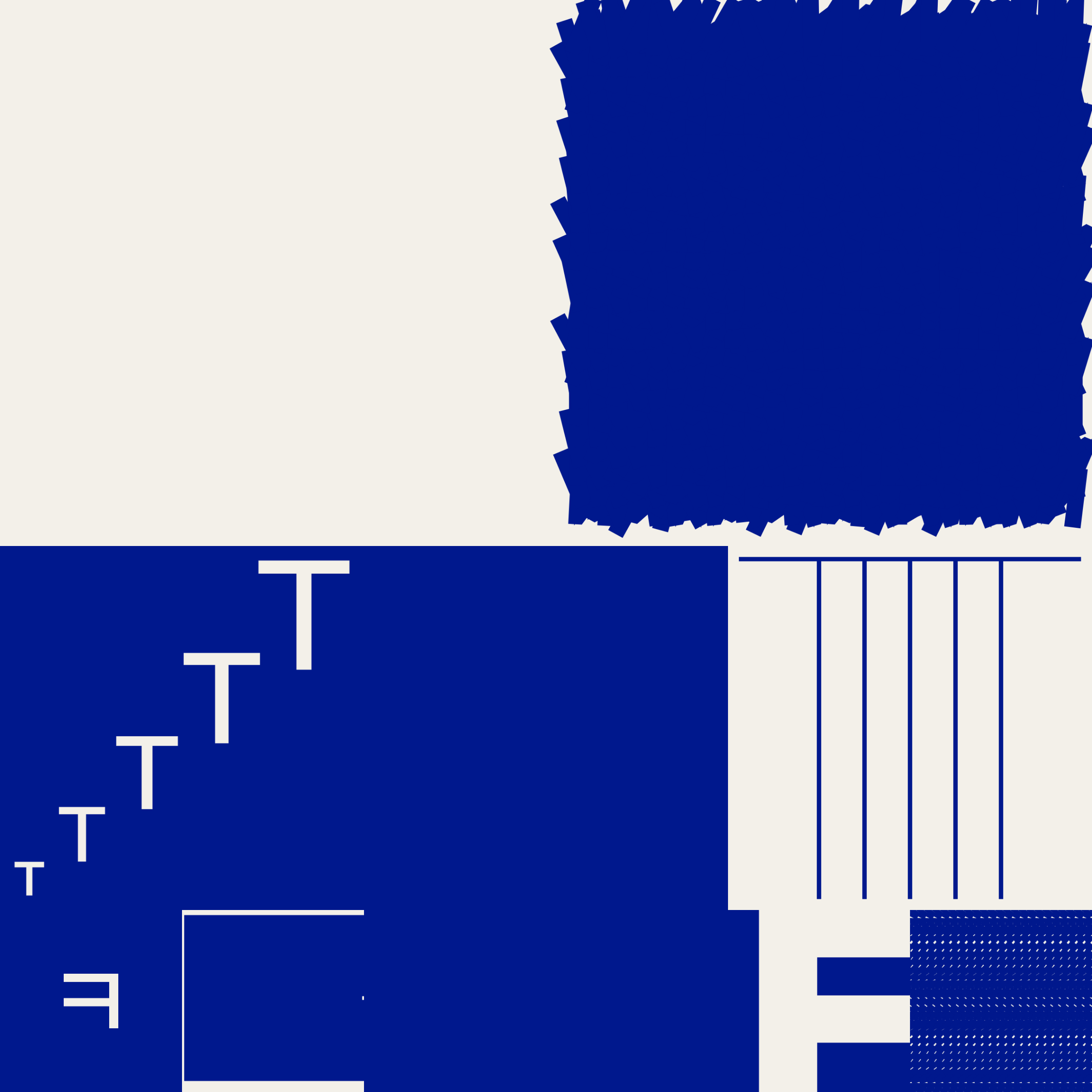
The 6529 Network Museum holds Themes and Variations #210. Its six-by-six field combines cobalt blue and warm white, repeated T forms, a small F, linear scaffolds, and a dense panel of marks. The work gives the Collection a late example of Molnár’s sustained inquiry into how rules generate difference.
Sources
Institutional sources
Centre Pompidou, Speak to the Eye; Centre Pompidou, “Vera Molnár, aux sources du code”; Museum of Modern Art artist record; National Gallery of Art artist record; La Biennale di Venezia, 2022.
Project sources
Art Blocks project record; Sotheby’s project essay.
Publication details
Published by the 6529 Network Museum, version 1, 23 August 2026. Research cutoff: 23 August 2026.
Suggested citation: 6529 Network Museum, “Vera Molnár: Order, Variation, and the Line,” version 1, 23 August 2026.
Research context
Research context
- Related artistVera Molnár