

Project study
Pre-Process: An Unfinished Origin in Motion
6529 Network Museum — project essay Version: 2.4.0 Publication status: Revised publication copy Publication date: 2026-08-02 Institutional authorship: 6529 Network Museum Research cutoff: 2026-08-02 Museum work...
Works in this study
- Related workPre-Process #63Status Accessioned into the permanent CollectionStatus as ofGift of punk6529; Casey REAS; Pre-Process #63; 6529 Network Museum, 6529NM.2026.001.04. Licensed CC BY-NC 4.0.
Read the complete studyOpen the full essay, notes, bibliography, and publication record.
6529 Network Museum — project essay Version: 2.4.0 Publication status: Revised publication copy Publication date: 2026-08-02 Institutional authorship: 6529 Network Museum Research cutoff: 2026-08-02 Museum work discussed: Pre-Process #63 (Casey REAS, originated 2003; completed and released 2022), accessioned as 6529NM.2026.001.04
Pre-Process returns to an unfinished 2003 system after nearly two decades in which Casey Reas tested what its rules could do. The 2022 edition makes that return public through 120 finite permutations; its central subject remains unresolved behavior: one hundred circles move, collide, turn away from overlap, and never arrive at equilibrium. In the 6529 Network Museum's #63, the resulting black-and-white field reads as a score under pressure. Its rows, axes, translucent sweeps, and collisions make an early grammar of Reas's practice visible.
An origin that had to wait
The prefix in Pre-Process can suggest preparation, a sketch preceding the “real” work, or an archival fragment valued mainly for its biography. Reas gives the work a more exact position. He began its ideas in 2003; an early version appeared in the 2005 exhibition Process/Drawing at bitforms but remained not for sale because it was unfinished; the system became a foundation for the Process Compendium body of work developed from 2004 to 2010; and only in 2022 did he complete and release Pre-Process as a 120-work Art Blocks edition.1 A new edition structure let Reas complete an old question while acknowledging that the question had changed.
That chronology gives the title its tension. Pre-Process is before Process historically, yet it comes after Process in its present form. It is an antecedent remade by what followed. Reas has called it a “Rosetta Stone” for his practice, a phrase that could turn the artwork into explanatory evidence for a career. The metaphor works best as a way of making relations legible among languages. Pre-Process reveals how Reas’s later vocabulary of Forms, Behaviors, and Elements emerged from material experimentation, while retaining the force of an experiment because it still has to run.
The 2022 return revises the conditions under which an unfinished software work can be encountered. At the 2005 exhibition, Reas describes the material as a collection of unresolved software sketches. By 2022, he could identify 120 significant permutations across three axes—surface, origin, and growth—and offer the complete set as a public field of exploration.2 The finite edition establishes selected visible conditions under which the behavior can appear. Each edition state is a threshold into the system.
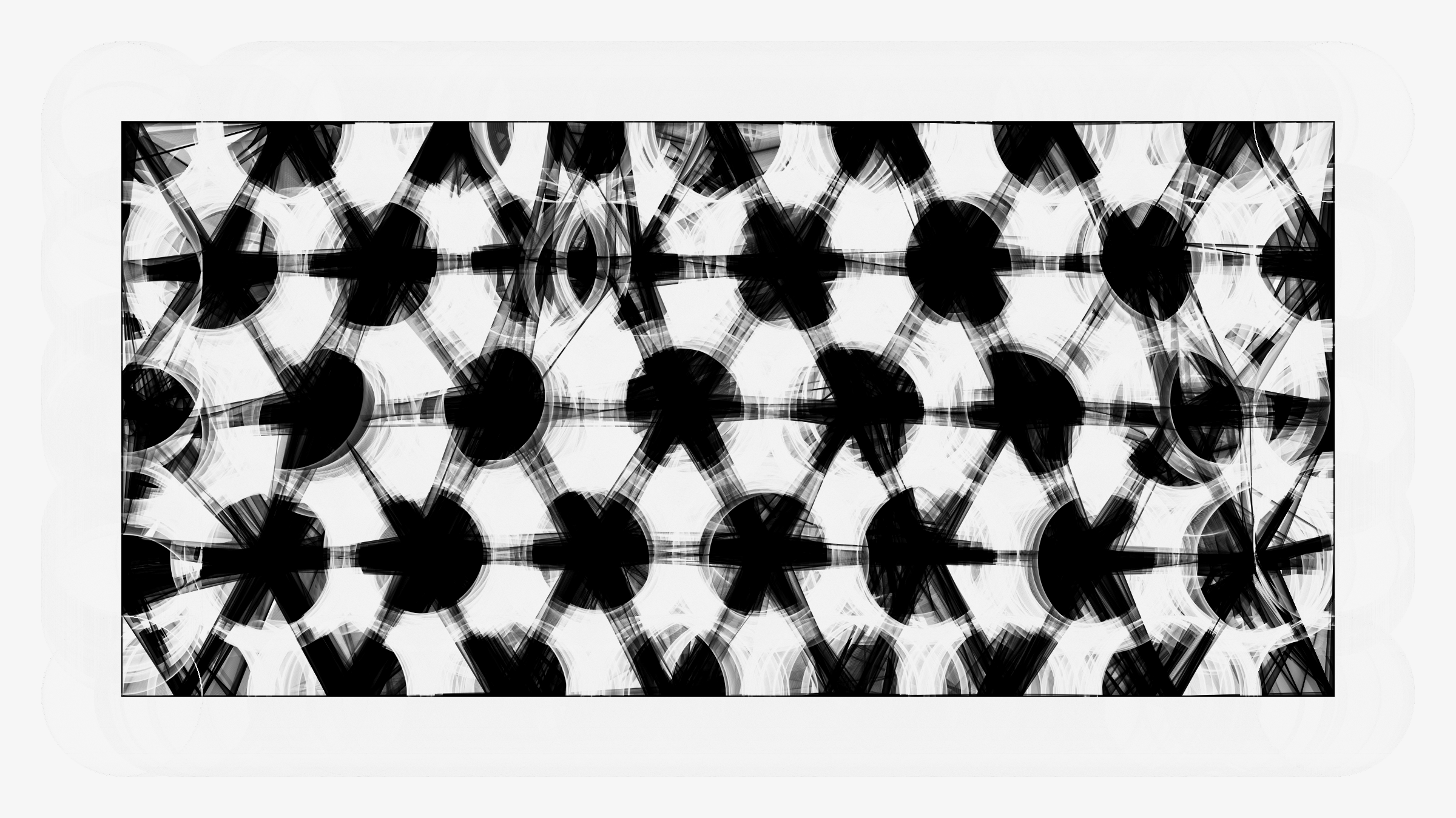
Object #63 is one exact token-bound base configuration: token 383000063, with the Art Blocks record identifying a 1.78 aspect ratio, Growth 4, Origin 1, and Surface 8.3 These fields identify the recorded edition configuration while leaving the image's interpretation and every later frame open. The work appears as a wide black-and-white field in which order is proposed, tested, and repeatedly disturbed.
From instruction to execution—and back again
Pre-Process emerges from Reas's engagement with instruction-based art. In 2001 Christiane Paul invited him to create {Software} Structures for the Whitney's Artport. Reas began with texts describing dynamic relations among elements, then realized them through multiple software implementations.4 Sol LeWitt's wall drawings supplied a decisive precedent: written instructions originate works whose execution remains contingent on people, materials, and architecture. Reas's English descriptions likewise preserve interpretive latitude, while software specifies operations at a different degree of precision and speed.5
Computer execution redistributes interpretation across the writing of code, the chosen implementation, the runtime, and the display. The English instruction remains the viewer's first access to the system; the screen turns that situation into a changing image.
The Whitney's 2018 presentation of {Software} Structure #003 A and B makes the relation tangible. The same hundred moving circles produce one image of instantaneous intersections and another cumulative field of continually revised contact.6 Pre-Process inherits the gap between an economical rule and consequences too dense to grasp at once. Its circles and behaviors can be named plainly; their aggregate must be encountered.
Reas’s relation to conceptual art also diverges from a dematerialized ideal. In the 2022 Art Blocks interview, he situates his work between conceptual systems and the visual histories of painting and drawing, while describing a desire for unexpected aesthetic experience beyond personal bias.7 Meredith Hoy, writing about Reas’s earlier work, argues that this practice unsettles the apparent opposition between conceptual procedure and painterly surface. Her term “painting as programming” describes a practice in which visual richness is inseparable from computational operations; the screen does not become a canvas, and the operations are not a decorative veil.8
Pre-Process sharpens the issue through black and white. Without a palette to carry mood or distinction, the viewer encounters circles, axes, trace, density, opacity, and interval as the field’s active materials. The restricted palette exposes the relation between elementary rule and visual consequence. The image becomes an argument about how a minimal vocabulary can become difficult, spatial, and charged.
The grammar: one hundred elements, 120 conditions
Reas describes each Pre-Process realization as a system of one hundred circle “Elements.” The specification is almost ascetic: circle form; movement in a straight line; constraint to the surface; change of direction while touching another element; movement away from overlap.9 These statements establish the material condition from which the work’s visual complexity grows. A circle moving alone would be an elementary figure. One hundred circles sharing a finite surface produce a social field: their behavior is intelligible locally, but the total configuration exceeds any one element’s intention.
The 120 edition states make this field visible through a rigorous combinatorics: eight surfaces multiplied by three origins and five growth configurations. Reas describes the origins as center, horizontal line, and random positions; the surfaces change how elements are rendered; the growth configurations alter relative sizes. The count is structural rather than market-driven. It has the force of a musical constraint or a printmaker’s state: a limited set of conditions makes comparison possible without dictating what a viewer must see.
The selected permutations are exhaustive, while performance remains temporally open. #63's token metadata records one base relation among surface, origin, and growth; the live program then produces successive frames, and its documented controls can restart the run or select another rendered surface for the session. Neither action changes the token's identity or its recorded base configuration. The edition combines a bounded list of configurations with a visual history that unfolds through motion and encounter. Reas's phrase about authorship being the creation of potential for variation and difference becomes more precise here: he composes the conditions under which difference will become perceptible.10
The word “process” does not promise transparency. A process can be described and still overwhelm the means of description. The rules of Pre-Process remain only partly legible in any particular image. The field gives evidence of motion, contact, and dispersal without turning a viewer into a debugger. The work makes its procedures available as pressure, rhythm, congestion, and release.
#63: a score made visible through resistance
The first field
Pre-Process #63 appears first as a panoramic black-and-white field arranged in three loose horizontal registers. Dark circular masses gather along repeated axes; pale ground remains visible between them; translucent arcs sweep across and through the rows. The 1.78 format is consequential. It gives the elements room to distribute laterally, so that the work reads less like a centered diagram than a stage on which several related events occur at once.11
The horizontals establish a preliminary order. They suggest staff lines, lanes, or a ruled page, but none of those analogies holds for long. The circles are not notation marks waiting to be read; they have weight and uneven spacing. Some cluster into dark nodes. Others are set apart enough to make a gap feel intentional. The axes do not imprison the forms. They offer a coordinate system against which displacement becomes visible.
Object #63 begins with a proposition of clarity. The eye can register bands, rows, circles, and intervals before it has to reckon with what the system is doing over time. That clarity makes the later complications perceptible. A field that began as indiscriminate density could not show disorder arriving; #63 lets order be the condition under pressure.
Collision as drawing
The translucent sweeps change the status of the field. They record accumulation. Where a dark mass seems to hold a position, a pale or gray sweep suggests passage across that position; where sweeps overlap, the image thickens without becoming fully opaque. The program’s documented contact and anti-overlap rules make it reasonable to understand these marks as consequences of elements meeting, changing direction, and moving away. The image turns collision into drawing rather than diagramming discrete causes.12
Object #63's rhythm comes from this relation. The dark circles establish beats; the arcs act as duration, carrying an encounter beyond the instant at which two forms touch. At several points the sweep appears to cross an axis and then curve away, producing a visual hesitation: is the line a boundary, a route, or a trace left by a route? The work leaves the question open because its subject is the persistence of relation after contact. An element's movement may be governed by simple behaviors, but the visible field remembers their accumulation as a complex event.
Dark mass and translucent trace are both active. The masses make time appear concentrated; the traces make time appear distributed. Seen at a distance, the field can look nearly architectural, as though dark columns and pale arches were assembling a plan. At closer range, the apparent structure becomes unstable. The “columns” are circles caught in temporary relation; the “arches” are moving evidence rather than supports. #63 turns a behavioral system into a picture of order that cannot quite hold.
A panoramic, not an omniscient view
The breadth of #63 matters here as well. A square format might encourage the eye to search for a central equilibrium. Its horizontal expanse instead makes attention travel from one cluster to another. A dense zone at one side does not explain a sparse zone elsewhere. The viewer reads locally, then tries to assemble a total. That act of assembly fails just enough to remain active.
The comparison distinguishes #63 from a static information visualization. A visualization ordinarily aims to make relations available for efficient inspection. #63 uses related visual means—repetition, axes, groupings, traces—but withholds a stable overview. Its wide format gives the impression of a system laid out for analysis, then makes analysis temporal and partial. The viewer sees a field of relations, but never from outside the field.
The work’s changing manifestation deepens that condition. The current official generator is browser-based p5.js software; the Museum’s dated live observation found two full-viewport states with different hashes after a minimum wait, while the project documentation describes a system that moves toward but never reaches equilibrium.13 The observation does not establish the exact path of any individual element or a complete temporal sequence. It establishes a curatorial limit: the still under discussion is a state, not a conclusion. A display that freezes #63 at its opening image would preserve its graphic intelligence while removing the resistance that gives the image its force.
How to display an unfinished origin
The project record describes Pre-Process as computer-based, silent, black-and-white software that can be presented horizontally or vertically at variable dimensions.14 #63’s exact state strongly rewards a horizontal presentation. Its three-register structure depends on lateral interval; a narrow vertical crop would turn the work’s distributed attention into stacked congestion. That is an interpretive recommendation, not an artist’s fixed installation mandate. The point is to let the work’s aspect ratio and field logic govern the display decision rather than treating any responsive screen as interchangeable.
Object #63 needs time. A still label or preview image can introduce the work, but a public encounter should make clear that the program is running. The documented controls belong to the live interface: mouse press and Space restart the run; keys 1–8 select a rendered surface and restart it; P pauses or resumes it. They affect a viewing session without changing the token's identity or its recorded base configuration, and the Museum's initial observation did not exhaustively exercise them.15 A gallery should distinguish an unattended live manifestation from a scheduled or supervised interactive mode, with the state of interaction visible to visitors.
Pre-Process changes authorship’s public appearance. The artist establishes the forms, behaviors, and permissible transformations; the program carries them through time; a viewer may reset or alter surface conditions within the work’s available system. The viewer encounters and, in limited ways, re-initiates an artwork whose incompletion is an aesthetic condition.
Display raises a conservation question that belongs to the encounter without dominating it. The accession record identifies token identity, project script, and metadata as documented, while self-contained generator packaging and cross-environment rendering remain active preservation work.16 The work is display-ready with conditions. A Museum presentation should distinguish a live browser manifestation from a recorded or static documentation surrogate, and from the code/token relations that make either possible. In Pre-Process, that separation is more than good recordkeeping. The artwork itself teaches viewers that an image has a history of execution.
Counter-pressure: clarity is not comprehension
Reas’s systems invite an easy educational narrative: simple rules become complex forms; code becomes accessible; visual order reveals the hidden logic of software. Reas’s teaching, publishing, and work on Processing have made the terms of creative coding more available to artists and students.17 The clarity of the score does not make the image easy. #63’s wide field repeatedly refuses the fantasy of a total view. Its rows suggest analysis, while its arcs and overlaps prevent the analysis from settling.
Hoy’s reading of Reas helps preserve that difficulty. She argues against the idea that generative work must either reveal its algorithmic operations or surrender to surface, locating Reas between coded procedure and a distinctly painterly morphology.18 #63 demonstrates the point without looking painterly in any conventional brushwork sense. Its palette is restricted, its components are elementary, and its format can seem almost technical. The image has opacity, tempo, and a visual surplus that cannot be translated back into a list of behaviors.
Nora N. Khan’s review of Reas’s Still Life works provides a sharper counter-pressure. The review considers a later, more chromatically and sonically intense body of software paintings rather than Pre-Process. Her description of losing a perceived pattern as a field changes is pertinent to a Reas method that risks being praised only for immersion or formal elegance.19 #63 is quieter than the works Khan reviewed, and its silence is important. Still, it can produce its own form of agitation. The viewer recognizes repetition, seeks a pattern, then finds that the pattern has become a record of contact and deviation. The work does not punish understanding; it makes understanding a duration rather than an instant.
Its institutional reception has also shaped how this difficulty can be seen. The Whitney’s 2018 Programmed exhibition placed Reas’s {Software} Structures among works by LeWitt, Manfred Mohr, Channa Horwitz, and others, explicitly joining instructions, rules, algorithms, and contemporary computational art.20 That context joins conceptual and computational histories without making Pre-Process inevitable. The work’s 2003 origin, 2005 partial appearance, and 2022 completion show a history made through delays, unresolved experiments, and changing platforms as much as through a clean progression of ideas.
The Museum’s #63: an encounter
The 6529 Network Museum’s Pre-Process #63 gives the seven-object accession a precise entry into Reas’s early grammar without turning that grammar into doctrine. The three CENTURY works in the group begin with a modernist field that can be sliced and recomposed. #63 begins lower down, with circles whose local behaviors make a field through contact. It moves the Museum’s argument from the visible seam to the visible consequence of an encounter.
The comparison has clear limits. #63 offers one 2022 realization of a system whose earlier sketches became newly legible after Process had changed the artist’s understanding of text, code, execution, and visual form. Its particular panoramic image gives that history a precise sensory address: dark masses taking temporary places, axes that promise order, translucent sweeps that make every order a record of motion.
To encounter #63 is to recognize what “pre” names: the moment before a method is fully articulated, when the system is still discovering its own language. Reas’s later completion does not erase that uncertainty. It lets the uncertainty continue to move.
Notes
Selected bibliography
Primary and official sources
- Art Blocks. “In Conversation with Casey REAS on Pre-Process.” Interview by Jordan Kantor. 28 November 2022. https://www.artblocks.io/articles/in-conversation-with-casey-reas-on-pre-process.
- Art Blocks. “Pre-Process by Casey REAS.” https://www.artblocks.io/collection/pre-process-by-casey-reas.
- Reas, Casey. Process Compendium 2004–2010. Los Angeles: REAS Studio, 2010.
- Whitney Museum of American Art. “Casey Reas: Software Structures.” https://whitney.org/exhibitions/software-structures.
- 6529 Network Museum. Object record 6529NM.2026.001.04; visual observation record; Casey Reas art-historical and technical dossier.
Scholarship and criticism
- Hoy, Meredith. “Painting as Programming: Casey Reas and the Aesthetics of Generative Code.” ISEA2011. https://www.isea-symposium-archives.org/presentation/painting-as-programming-casey-reas-and-the-aesthetics-of-generative-code/.
- Khan, Nora N. “Casey Reas’s Disconcerting Software Paintings.” The Village Voice, 13 October 2016. https://www.villagevoice.com/casey-reass-disconcerting-software-paintings/.
- Paul, Christiane, ed. Programmed: Rules, Codes, and Choreographies in Art, 1965–2018. New York: Whitney Museum of American Art, 2018.
Historical context
- Burnham, Jack. Software, Information Technology: Its New Meaning for Art. Exhibition catalogue. New York: The Jewish Museum, 1970.
- LeWitt, Sol. “Sentences on Conceptual Art.” 0 to 9 3 (1969): 3–5.
Revision note
- 2.4.0 — 4 August 2026: Removed the production-stage heading from the published opening; the project interpretation and evidence are unchanged.
- 2.3.0 — 4 August 2026: Completed the publication copy desk and replaced a schematic opposition with a direct account of the edition's bounded configurations and temporal history.
- 2.2.0 — 4 August 2026: Deep copy-edited the public interpretation for curatorial cadence and directness without changing its facts or evidence.
- 2.1.0 — 3 August 2026: Copy-edited the published interpretation for directness and cadence without changing its facts or evidence.
- 2.0.0 — 2 August 2026: Initial completed project essay. It adds project-level context and does not supersede the accession, title, rights, technical, preservation, or existing short public object record.
Footnotes
-
Casey REAS, “In Conversation with Casey REAS on Pre-Process,” interview by Jordan Kantor, Art Blocks, 28 November 2022, https://www.artblocks.io/articles/in-conversation-with-casey-reas-on-pre-process. ↩
-
Reas, “In Conversation with Casey REAS on Pre-Process.” The 120 count is eight surfaces × three origins × five growth configurations; it is discussed here as artist-defined project structure, not as a quality or scarcity metric. ↩
-
6529 Network Museum, Pre-Process #63, 2022, object record and public record, accessed 2026-08-02. ↩
-
Casey Reas, “Process,” REAS.com, accessed 2026-08-03, https://reas.com/process, for Christiane Paul's 2001 invitation and the creation of {Software} Structures; Whitney Museum of American Art, “Casey Reas: Software Structures,” accessed 2026-08-02, https://whitney.org/exhibitions/software-structures, for the project's 2004 public launch. ↩
-
Whitney Museum of American Art, “Casey Reas, {Software} Structures #003 A and B, 2004,” 28 September 2018, https://whitney.org/media/39184. ↩
-
Whitney Museum of American Art, “Programmed: Rules, Codes, and Choreographies in Art, 1965–2018,” accessed 2026-08-02, https://whitney.org/exhibitions/programmed/art?section=1&subsection=14. ↩
-
Reas, “In Conversation with Casey REAS on Pre-Process.” ↩
-
Meredith Hoy, “Painting as Programming: Casey Reas and the Aesthetics of Generative Code,” ISEA2011, https://www.isea-symposium-archives.org/presentation/painting-as-programming-casey-reas-and-the-aesthetics-of-generative-code/. ↩
-
Reas, “In Conversation with Casey REAS on Pre-Process.” ↩
-
Reas, “In Conversation with Casey REAS on Pre-Process.” ↩
-
6529 Network Museum, Pre-Process #63, object record, public record, and visual observation record, accessed 2026-08-02. ↩
-
Reas, “In Conversation with Casey REAS on Pre-Process”; 6529 Network Museum, visual observation record. The description of #63’s exact visible field is Museum close looking grounded in the dated exact-object observation; it does not assign a semantic meaning to feature labels. ↩
-
6529 Network Museum, visual observation record, 2026-08-02; 6529 Network Museum, Casey Reas accession research: art-historical and technical dossier, “Pre-Process.” ↩
-
6529 Network Museum, Casey Reas accession research: art-historical and technical dossier, “Pre-Process”; 6529 Network Museum, Pre-Process #63 object record. ↩
-
6529 Network Museum, Pre-Process #63 object record. The documented controls are part of the project’s current generator/interface record; the Museum’s first capture did not establish every interaction state. ↩
-
6529 Network Museum, Pre-Process #63 object record; 6529 Network Museum, technical and condition review. ↩
-
Casey Reas and Ben Fry, “Processing: Programming for the Media Arts,” AI & Society 20, no. 4 (2006): 526–538, https://doi.org/10.1007/s00146-006-0050-9; Casey Reas, “{Software} Structures,” Whitney Artport, 2004, https://artport.whitney.org/commissions/software-structures/text.html. ↩
-
Hoy, “Painting as Programming.” ↩
-
Nora N. Khan, “Casey Reas’s Disconcerting Software Paintings,” The Village Voice, 13 October 2016, https://www.villagevoice.com/casey-reass-disconcerting-software-paintings/. Khan’s review concerns the 2016 Still Life exhibition, not Pre-Process; it is used as criticism of a recurring problem in Reas’s moving visual fields, not as source evidence for this object. ↩
-
Whitney Museum of American Art, “Programmed: Rules, Codes, and Choreographies in Art, 1965–2018,” https://whitney.org/exhibitions/programmed. ↩
Research context
Research context
- Related acquisitionThe System in Seven StatesStatus Accessioned into the permanent CollectionStatus as of