

Essay
Gift into Public Trust
On 1 August 2026, punk6529 gave the 6529 Network Museum seven works by Casey Reas spanning five projects and a quarter-century of artistic inquiry. The gift entered the permanent collection the following day as...
Read the complete studyOpen the full essay, notes, bibliography, and publication record.
The Casey Reas Accession
On 1 August 2026, punk6529 gave the 6529 Network Museum seven works by Casey Reas spanning five projects and a quarter-century of artistic inquiry. The gift entered the permanent collection the following day as 6529NM.. Seven software artworks thereby became a public study group: to be preserved as executable works, examined together, and documented through an accession record. This narrative follows a private holding into public stewardship.
I. The gift
At 13:25:47 UTC on 1 August 2026, seven already-minted Art Blocks works by Casey Reas arrived at networkmuseum., the custody address of the 6529 Network Museum. The Ethereum transaction—0xbdde33b3, included in block 25660311—delivered three works from CENTURY and one work each from Pre-Process, Phototaxis, 923 EMPTY ROOMS, and Ex Nihilo (Cosmos).1
The transfer established delivery, not accession. Wallet custody can result from a gift, loan, mistaken transfer, airdrop, or operational movement. The Museum separately documented donor authority, title, rights, provenance, technical condition, and the basis for acceptance. It formally accepted punk6529's full gift effective at 22:55 UTC on 1 August and accessioned the seven works into the permanent collection on 2 August 2026.2
The public credit is “Gift of punk6529.” The donor transferred the seven tokens and the donor's full transferable interest in them without consideration and retained no ownership interest. The gift did not transfer Casey Reas's copyright. Token title and intellectual-property rights remain separate facts.3
Digital art makes the separation especially visible. A token can carry unique chain identity and ownership history while images, code, and presentation remain governed by copyright and license. The retained metadata for all seven works states CC BY-NC 4.0. Subject to its conditions, that license supports the Museum's noncommercial exhibition, publication, documentation, adaptation, preservation, migration or emulation, accessibility work, and internal noncommercial computational research. Commercial use is not approved.4
The accession consists of:
| Museum object | Work | Native chain identity |
|---|---|---|
Museum object6529NM. | WorkCENTURY #31 | Native chain identityeip155: |
Museum object6529NM. | WorkCENTURY #724 | Native chain identityeip155: |
Museum object6529NM. | WorkCENTURY #401 | Native chain identityeip155: |
Museum object6529NM. | WorkPre-Process #63 | Native chain identityeip155: |
Museum object6529NM. | WorkPhototaxis #308 | Native chain identityeip155: |
Museum object6529NM. | Work923 EMPTY ROOMS #713 | Native chain identityeip155: |
Museum object6529NM. | WorkEx Nihilo (Cosmos) #248 | Native chain identityeip155: |
These identifiers establish exact objects. Titles, artistic histories, and images remain separate records. The Museum records each layer because an artwork can be misidentified even when an image looks right, and poorly interpreted even when its token number is correct.
II. Why these works belong together
Donation and accession formed this seven-work Museum study group. The record contains no artist endorsement, artist-designated suite or triptych, or donor selection thesis. The group's significance lies in what becomes visible when the works are studied together.
Reas has spent more than twenty-five years examining the interval between instruction and event. He creates systems of agents, behaviors, shapes, images, channels, cuts, and probabilities; software executes them; images emerge through time. The artist authors the conditions but does not place every visible event. His work makes control and surprise coexist.
The seven tokens are recent, but the artistic histories they carry are not. Phototaxis returns to simulated drawing machines derived from work Reas began around 2001. Pre-Process completes a system initiated in 2003 and shown in unresolved form in 2005. The wider CENTURY body began in 2012 before entering a 1,000-work Art Blocks edition in 2021. 923 EMPTY ROOMS develops the spatial inquiry of An Empty Room in 2023. Ex Nihilo (Cosmos) extends the Still Life lineage in 2026.5
The first connection among the works is their history of artist-directed return. It establishes technical and artistic continuity relevant to preservation. Code moves from C++ to Processing/Java to p5.js. An unresolved early system receives a later public form. A body made across media becomes a long-form generative edition. Each return changes the conditions of execution, distribution, and reception.
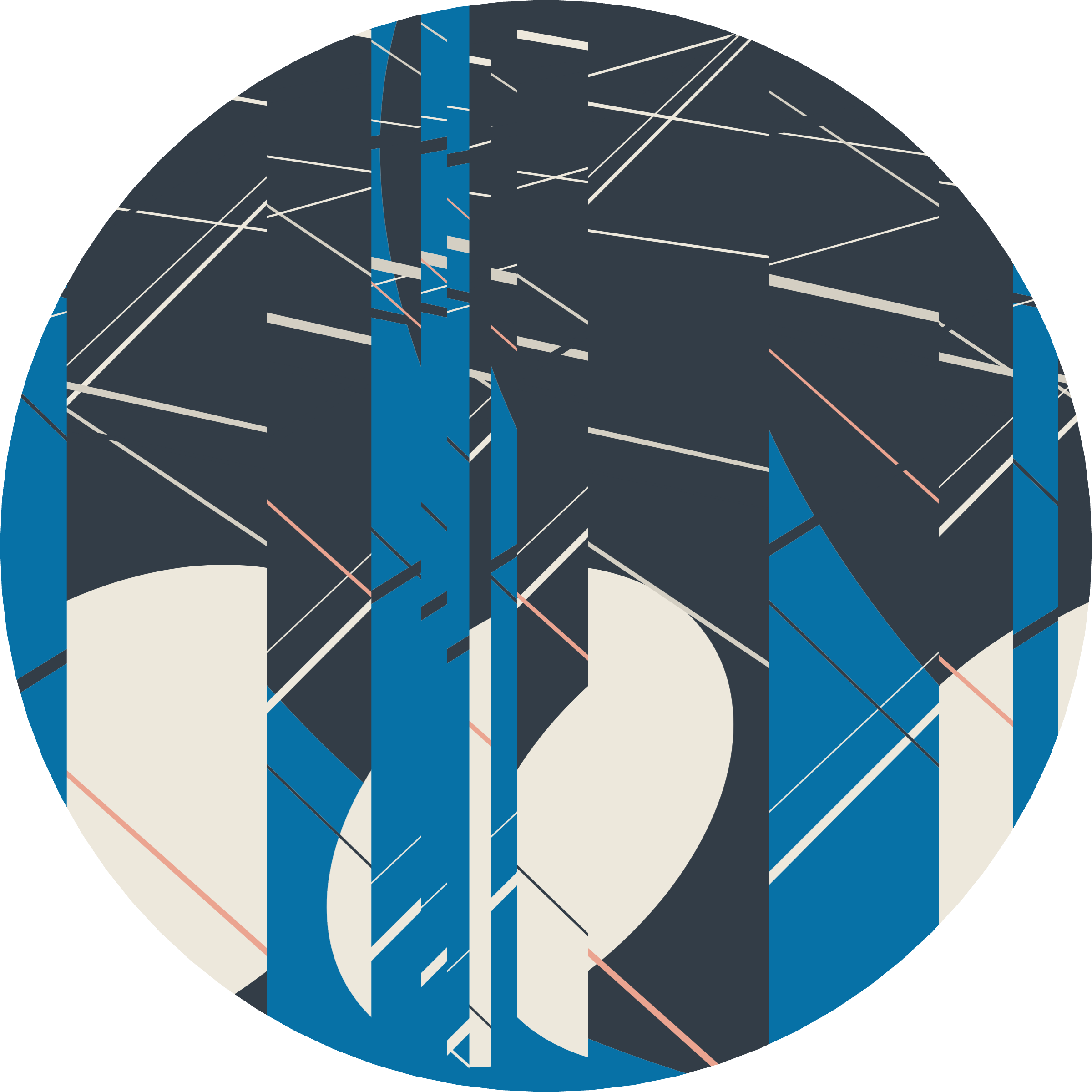
The second relation is formal. The three CENTURY works use one project grammar to produce markedly different visual experiences. #31 compresses blue, slate, cream, and salmon into a densely spliced circle. #724 opens into cream space crossed by rust arcs and sparse diagonals. #401 uses grayscale and transparency to create shallow, unstable architecture. Together, they make variation visible as a difference in pictorial structure.
The remaining four works change the unit through which a system becomes visible. In Pre-Process #63, populations and collisions accumulate across a panoramic black-and-white field. In Phototaxis #308, artificial agents leave pale trajectories that condense duration into loops, knots, and escapes. In 923 EMPTY ROOMS #713, an acid-green raster breaks around charcoal voids until an impossible room appears. In Ex Nihilo #248, segmented white traces nearly assemble geometric solids against black and then release them.
Trace, slice, void, and segment are four ways to make relation visible. Across the changing forms, one artistic problem persists.
III. The scope of the gift
Seven works form a focused study of Casey Reas; they do not represent the full practice. The group contains no early Path, Tissue, or MicroImage print or installation; no {Software} Structures implementation; no principal Process work; no source-image work from Signal to Noise or ULTRACONCENTRATED; no Compressed Cinema or In Silico work; and no book, mural, woodblock, plotter drawing, or other physical translation.
Those absences matter because Reas's practice extends far beyond on-chain generative art. He co-initiated Processing with Ben Fry in 2001, has taught at UCLA since 2003, has made software, prints, installations, moving images, public works, and books, and co-founded Feral File. His practice has moved between internally generated systems and existing images, between screen and matter, and between individual studio work and shared cultural infrastructure.6
The gift forms a focused study group of seven on-chain works. Its limits identify future research and collecting priorities.
Feature scarcity is not an importance criterion. OpenSea and marketplace rarity metrics are inadmissible. Project features may be studied only through the Museum's published NextGen-compatible methodology, with a cited source snapshot and configuration and a deterministic result set. Such analysis describes an edition's distribution; it cannot replace close looking or establish an object's quality. The three CENTURY works matter together because of what their differences reveal, not because one is statistically rarer.
Chain evidence establishes the accession transfer; it does not answer every historical question. The project and artist sources disagree on the date attached to Phototaxis: Art Blocks and Reas's contemporary technical note support a 2021 release, while the artist's current NFT register lists 2022. The Museum preserves the discrepancy. For 923 EMPTY ROOMS, the artistic title and documented sequence refer to 923 rooms, while the retained release population contains 924 invocations numbered 0 through 923; invocation 0 has the separate code 999999. The record states both facts and invents no theory to reconcile them.7
Preserving these distinctions gives interpretation a firmer ground.
IV. From ownership to obligation
The transfer changed the works' institutional life. Once privately held, they became part of a permanent collection maintained for public benefit. Accession created a continuing obligation to document, preserve, interpret, and exhibit them.
The Museum must maintain exact identity, title history, custody evidence, rights information, and technical records. It must preserve the difference among token, code, live generator, official static output, and Museum-created documentation. It must exhibit the works at a scale and duration adequate to their behavior. It must disclose when a fallback image or video is a surrogate rather than the complete live work. It must revise errors through visible amendments rather than quietly rewriting the past.
This responsibility is particularly demanding because the works are executable. A durable token does not make a browser runtime durable. Source code may depend on libraries, network routes, fonts, color behavior, or hardware assumptions. A generator can remain reachable while its output changes. A still can survive while the capacity for movement and interaction disappears.
The accession's technical outcome was therefore “pass with conditions.” Tested official generator routes supported display, and no red technical blocker prevented accession. Autonomous preservation remains incomplete. Self-contained capture of generators and dependencies, wider browser and rendering tests, monitoring, and documented fallback states remain active stewardship work.8
Conservation can deepen interpretation. Phototaxis has lived through C++, Processing/Java, and p5.js; understanding that migration reveals the work as maintained behavior across technical generations. A CENTURY still and moving execution disclose different aspects of the same token-specific work. Ex Nihilo #248 makes continuous non-repetition central, giving a screenshot value as a record of one passing state.
Software left dormant can fail silently. Regular, documented execution provides monitoring evidence and helps the Museum evaluate which properties matter; it does not replace preservation work.
V. A founding accession
6529NM. is the first completed accession package of the 6529 Network Museum. “First” records sequence alone. The package sets a standard for chain-native accession: exact object identity, verifiable delivery, independent acceptance, title and rights review, provenance, technical condition, preservation obligations, curatorial interpretation, and public disclosure of unresolved facts.
Each control answers a known risk. Identity control keeps the token attached to the correct work. Rights analysis preserves the distinction between ownership and copyright. Technical review prevents live software from being catalogued as a static asset. Close looking keeps metadata subordinate to judgment. Historical research places blockchain within an artistic practice that preceded it by decades.
The accession also establishes a model for works minted elsewhere. The Museum entered an existing history and assumed responsibility for documenting its continuity, preserving the works, and opening a public chapter.
This package pairs chain-native evidence with reproducible provenance, versioned publication, inspectable technical dependencies, and public corrections. These methods earn their place by supporting sustained encounters with art.
The Casey Reas gift offers that encounter. The public presentation should let visitors compare the group as art. They can move among three states of CENTURY, follow behavior becoming line, enter an optical room, and watch geometry struggle into existence. They can inspect evidence without having the artwork buried beneath it. They can understand both why the seven belong together and why they do not complete the story.
VI. Public trust as a continuing act
A gift to a museum begins a continuing institutional duty. The collection becomes public through repeated acts: preserving, exhibiting, interpreting, researching, lending where appropriate, supporting accessibility, correcting records, and allowing future viewers to ask questions the accession team did not anticipate.
For these seven works, the most immediate public task is to let the images act. #31's fractured circle should be large enough for its seams to register. #724's negative space should not collapse into a thumbnail. #401's translucent planes require tonal fidelity. Pre-Process #63 needs width. Phototaxis #308 needs time as well as its official 1,000-iteration thumbnail state. #713's room depends on optical scale. #248's geometry needs continuous execution and an honest still fallback.
The second task is to build scholarship around the group while preserving uncertainty where the evidence requires it. Braitenberg and artificial life; LeWitt, instruction, and implementation; Kelly, seriality, and kinetic art; Shannon, pixels, and channels; Vasarely and optical space; experimental film and machine learning: these histories sharpen the view of Reas's formal decisions.
The third task is to keep the gift open to disagreement. Museum publication should not certify every work as equally successful or treat technological novelty as quality. Reas's systems can produce visual exhaustion as well as intensity; transparency of rule can coexist with opacity of experience; multimedia integration can fail. Public trust requires criticism as well as care.
Punk6529's gift created the conditions for this work to begin. The Museum can accurately say what was transferred and when. It cannot invent a donor motive, artist endorsement, or final verdict. Its strongest claim is also its most demanding: seven privately held works have entered a collection that intends to keep them identifiable, executable, debatable, and available for sustained public study.
Notes
Selected bibliography and records
- Art Blocks. “In Conversation with Casey Reas on CENTURY.” https://www.artblocks.io/articles/in-conversation-with-casey-reas-on-century.
- Art Blocks. “In Conversation with Casey Reas on Pre-Process.” https://www.artblocks.io/articles/in-conversation-with-casey-reas-on-pre-process.
- Art Blocks. “Ex Nihilo (Cosmos) by Casey Reas.” https://www.artblocks.io/collection/ex-nihilo-cosmos-by-casey-reas/purchase.
- Bright Moments. “923 EMPTY ROOMS.” https://www.brightmoments.io/923emptyrooms.
- Reas, Casey. “Atomism.” https://reas.com/atomism.
- Reas, Casey. “CENTURY.” https://reas.com/century.
- Reas, Casey. “MicroImage.” https://reas.com/microimage.
- Reas, Casey. “Process.” https://reas.com/process.
- Reas, Casey. “Digital art is a kind of performance.” Interview, LACMA Unframed, 13 November 2024. https://unframed.lacma.org/node/3771.
- 6529 Network Museum. Gift acceptance authorization, accession certificate, accession statement, title and rights review, technical and condition review, and raw receipt for accession
6529NM..2026. 001
Publication metadata and revision history
- Publication date: 2 August 2026.
- Version 1.5.0 — 4 August 2026: Removed an internal production label from the published opening; the gift, accession, rights, and custody facts are unchanged.
- Version 1.4.0 — 4 August 2026: Completed the publication copy desk and distinguished regular execution from preservation work.
- Version 1.3.0 — 4 August 2026: Deep copy-edited the public narrative for curatorial cadence and directness; no factual, evidentiary, rights, provenance, or collection-status assertion changed.
- Version 1.2.0 — 3 August 2026: Copy-edited the published narrative for directness, cadence, and institutional voice; no factual, evidentiary, rights, provenance, or collection-status assertion changed.
- Version 1.1.0 — 2 August 2026: replaced an overbroad preservation equation with “technical and artistic continuity relevant to preservation”; replaced unsupported canonical-state language with “official 1,000-iteration thumbnail state”; and added exact links to the receipt, gift authorization, accession certificate, title bindings, seven rights records, and seven technical-condition reports.
- Version 1.0.0 — 2 August 2026: initial completed publication manuscript.
Research cutoff: 2 August 2026. This narrative interprets the gift and accession but does not replace or amend the canonical records. No donor-selection thesis or artist endorsement is asserted.
Footnotes
-
6529 Network Museum, raw Ethereum receipt and receipt acquisition record for transaction
0xbdde33b3, block2d4b7033 5b10cbd3 7c0b00a0 27844f14 c900d82a a4f75b7a 7b390498 25660311; accession statement. ↩ -
6529 Network Museum, gift acceptance authorization, effective 1 August 2026 at 22:55 UTC; accession certificate and accession statement, accession effective 2 August 2026. ↩
-
6529 Network Museum, title and rights review, gift authorization, accession certificate, and the object-level
title_records for 01, 02, 03, 04, 05, 06, and 07. ↩binding -
6529 Network Museum, rights records 01, 02, 03, 04, 05, 06, and 07, together with the title and rights review. The records preserve the retained metadata's CC BY-NC 4.0 statement and the Museum's approved-use analysis. ↩
-
Casey Reas, “MicroImage,” https://reas.com/microimage; “Process,” https://reas.com/process; “CENTURY,” https://reas.com/century; “Atomism,” https://reas.com/atomism. ↩
-
UCLA Design Media Arts, “Casey Reas,” https://dma.ucla.edu/people/casey-reas; Processing Foundation, “Processing Overview,” https://processing.org/overview/; Feral File, “About,” https://feralfile.com/learn/about. ↩
-
Casey Reas, “Notes on Phototaxis,” 2021, https://medium.com/@REAS/notes-on-phototaxis-db7aa7641ad8; Casey Reas, “NFTs,” https://reas.com/nfts; Bright Moments, “923 EMPTY ROOMS,” https://www.brightmoments.io/923emptyrooms; 6529 Network Museum, 923 project descriptor and retained snapshot. ↩
-
6529 Network Museum, technical-condition records 01, 02, 03, 04, 05, 06, and 07, together with the technical and condition review, visual-observation record, and accession certificate. ↩
Research context
Research context
- Related acquisitionThe System in Seven StatesStatus Accessioned into the permanent CollectionStatus as of