

Institutional record
From public repository to on-chain Museum record
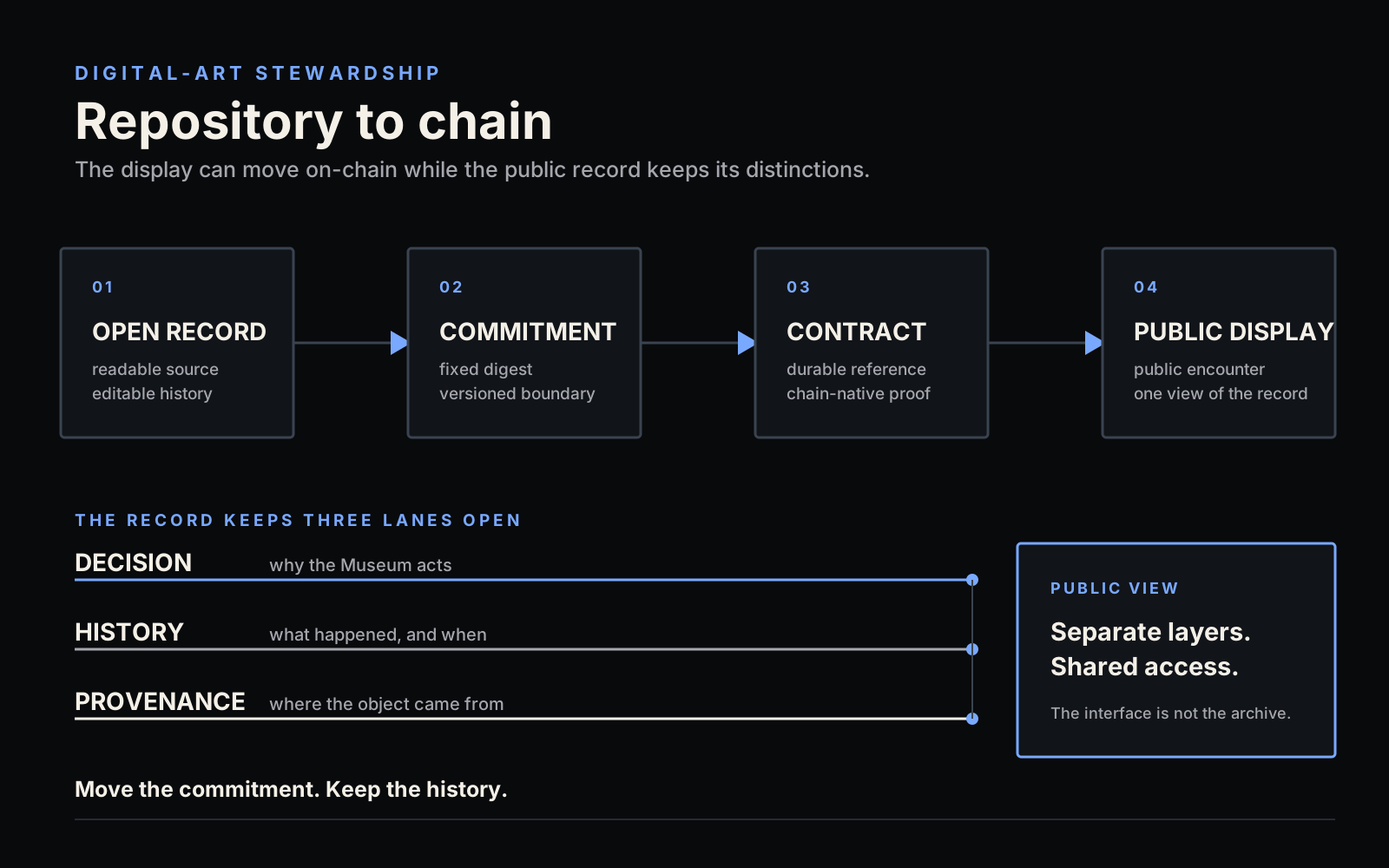
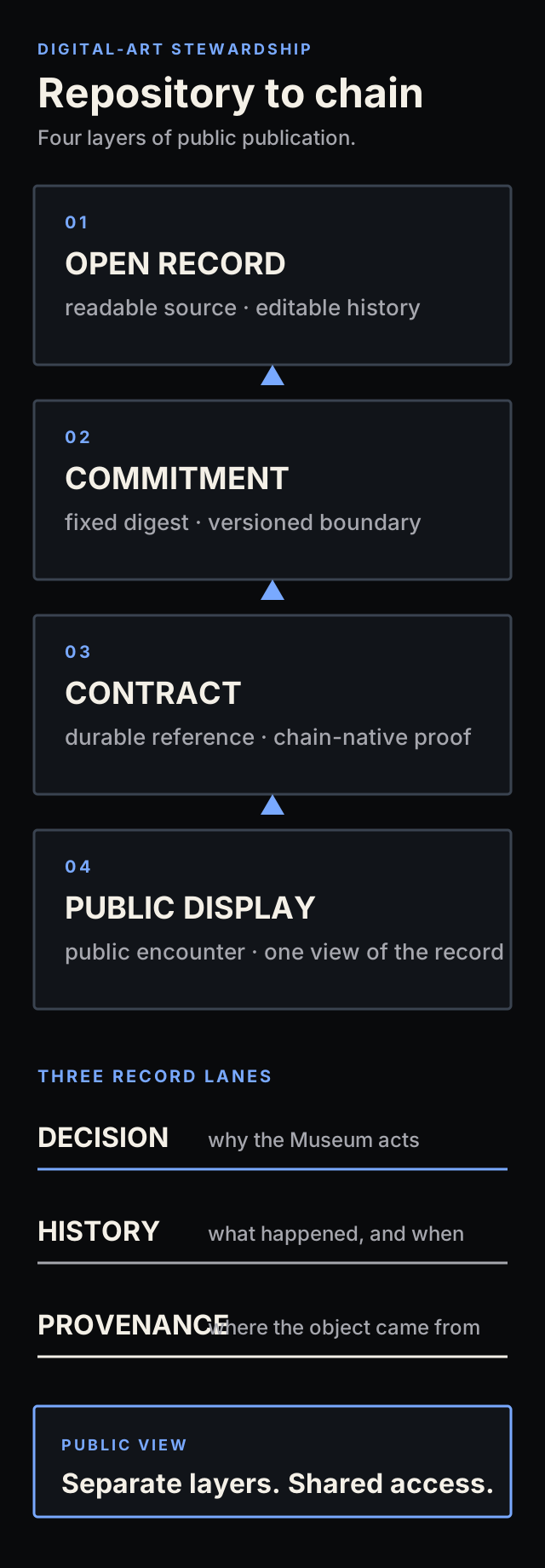
The open record, its cryptographic commitment, the future contract, and the website remain separate layers of the Museum's publication system.
Read the complete studyOpen the full essay, notes, bibliography, and publication record.
This document sets out the proposed migration of the Museum's public record from GitHub to a custom on-chain registry.
Purpose
The Museum needs records that remain readable and verifiable beyond GitHub, the current website, and its original operators.
The stated Fall 2026 goal is for every admitted Museum record—from governance decisions and policies to accessions, provenance, rights, preservation events, and later corrections—to have an on-chain commitment and append-only lineage in a custom contract. This includes the record of what the Museum decided, what it accepted, how an object entered the collection, which evidence supports its identity and history, and how later corrections relate to what came before.
The contract will record each authorized assertion with its author, content, effective time, evidence commitment, and place in the record's history.
What moves on-chain
Each admitted public-safe institutional record receives a state-readable entry that commits to:
- a stable subject and record type;
- the schema that gives the record meaning;
- a canonical content hash and content-addressed location;
- the authority responsible for the assertion;
- the time at which the assertion became effective;
- its append-only position and any superseded record;
- the release from which the record was migrated.
The registry keeps governance decisions, policies, approved collections, acquisition programs, selected outcomes, accessions, work descriptions, rights statements, provenance, preservation events, and corrections as separate record types with their own authorities and meanings.
Restricted donor, legal, custody-security, and personal information remains in the restricted registrar record. A public record may cite a restricted instrument by hash and non-sensitive custodian reference.
Content-addressed documents and media
Essays, images, video, software packages, and conservation dossiers can remain outside contract storage.
Large public-safe payloads can live on durable content-addressed storage. The contract commits to the payload's identity, schema, hash, URI, authority, effective time, and lineage. A third party can retrieve the payload and verify that its bytes are exactly those admitted under the stated schema. Availability and the truth of the underlying assertion remain separate questions.
An externally minted artwork retains its canonical token identity. The Museum registry records the institution's claims about that work while leaving its contract and token unchanged.
Exhibition and interpretation
The public website presents the collection and links each work to rights, provenance, technical documentation, and sources. Future exhibitions, research tools, and community publications will draw on the same institutional record preserved by the contract and its committed documents.
The responsibilities are divided as follows:
| Layer | Responsibility |
|---|---|
| LayerArtwork and canonical token | ResponsibilityThe work's own chain, contract, code, metadata, and preserved manifestations |
| LayerMuseum record | ResponsibilityDecisions, accession, provenance, rights, preservation, evidence commitments, authority, and revision lineage |
| LayerPublic display | ResponsibilityExhibition, interpretation, discovery, accessibility, and interaction |
Public presentation may change with new exhibitions and forms of access. New evidence and corrections enter the Museum record as attributable, append-only revisions.
The transition from GitHub
Before migration, the repository is the public review and release layer:
- records are written and reviewed in public;
- automated validation checks their schemas, relationships, evidence boundaries, and status claims;
- each governed release receives deterministic SHA-256 and Keccak commitments;
- payloads and schemas are published to content-addressed storage;
- the custom contract admits the records with their authority and lineage;
- public indexes are regenerated from chain state and committed payloads;
- the website begins reading from the contract without changing Museum identities or visitor addresses.
Migration will be complete when an independent third party can reproduce the record hashes and public exports directly from contract state and committed payloads.
Release and export invariant
The repository release format is 6529NM_, version 1..
Its governed inventory is the exact union of inventory_ and
inventory_ declared in the manifest. The generator rejects symbolic
links, reparse points, duplicate JSON keys, missing configured paths, and
non-regular inventory entries. It writes POSIX-style relative paths in
lexicographic order.
Each entry contains path, LF-normalized byte size, and SHA-256 over those
normalized bytes. JSON entries also contain Keccak-256 over RFC 8785 JCS using
the museum- profile and canonicalization ID
0x886c7c89.
The manifest's SHA-256 and Keccak-256 commitments cover the same JCS-encoded
manifest body before either commitment field is added.
Contract readback exports must reproduce this schema, inventory ordering, hash rules, record identities, and append-only lineage from contract state and committed payloads. A Git commit may document the repository edition that preceded migration; it is not required to verify a contract-derived export.
Follow the work
- Open Museum statement
- General on-chain design requirements
- Registry design for externally minted works
- Implementation-ready migration specification
- Contributing to the Museum