

Artist study
Casey Reas: The Conditions for an Image
For more than twenty-five years, Casey Reas has made images by constructing the conditions under which they occur. Artificial agents turn behavior into line; the Process works convert instruction into execution;...
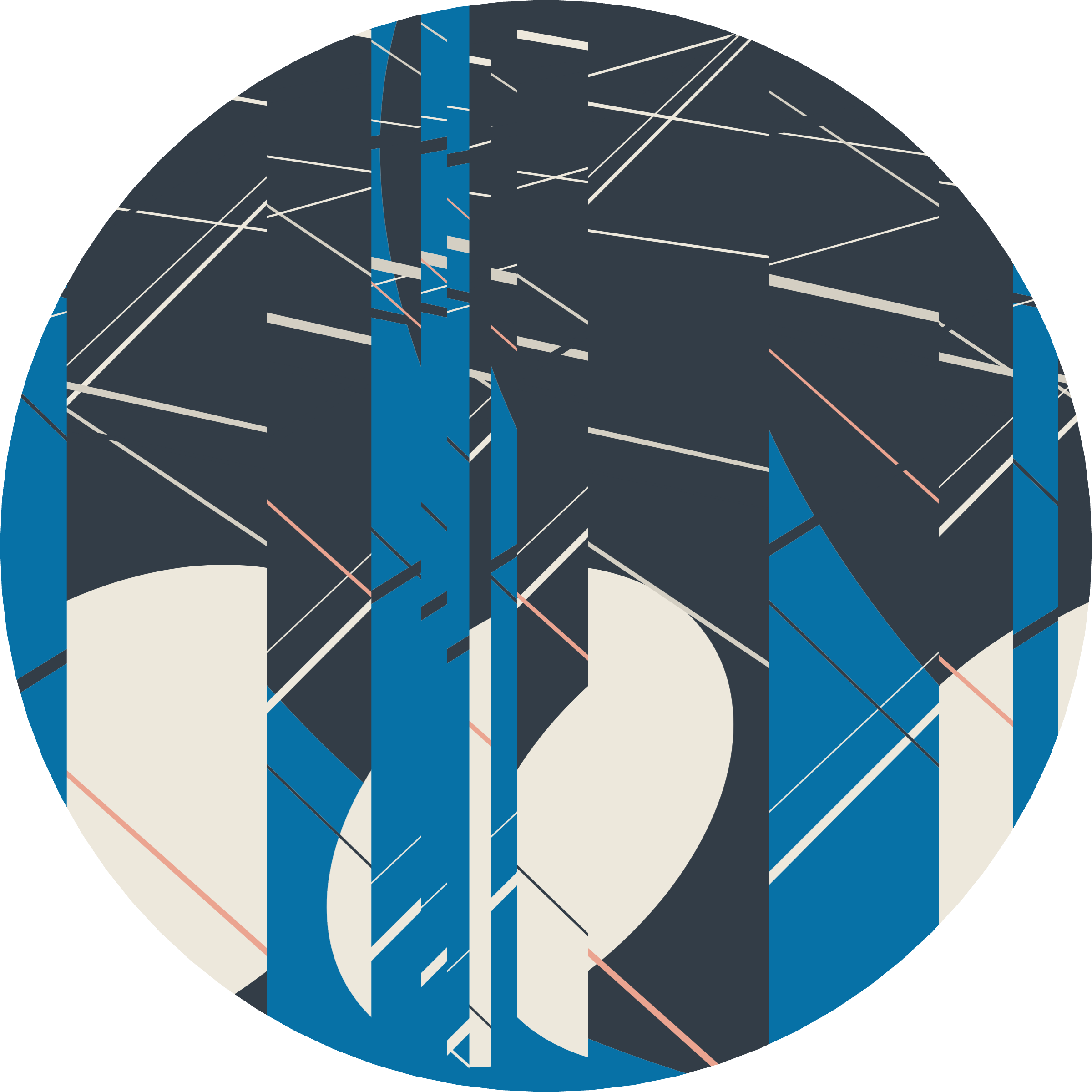
Read the complete studyOpen the full essay, notes, bibliography, and publication record.
For more than twenty-five years, Casey Reas has made images by constructing the conditions under which they occur. Artificial agents turn behavior into line; the Process works convert instruction into execution; Processing makes code a public language; later works move through executable collage, machine-learned cinema, on-chain editions, optical rooms, and unstable geometries. Across these bodies, rule, code, material, execution, and encounter determine where an artwork resides. Reas's systems yield pictures of marked sensual and formal intensity. The seven works given by punk6529 to the 6529 Network Museum offer a concentrated view of that practice and set a direction for future collecting.
I. The image is happening
In Ex Nihilo (Cosmos) #248, white marks cross a black field in broken chains. They gather into edges and then lose them. A cluster of short diagonal strokes suggests one plane; a longer sequence implies another; intersections briefly propose a dodecahedron before scale, interruption, and movement return it to a field of signals. The image does not settle. Even its geometry seems conditional, present only while enough lines agree.
The Museum's documentation records one time-specific still from this activity.1 Its hard black and granular white form an unstable architecture that appears to advance and recede, yet the image is necessarily partial. The work runs continuously and does not repeat. A viewer may alter speed and channels, pause the system, or initiate another state. The token identifies a particular work in a fixed edition; the software gives that work duration; the screen makes it visible; the still testifies that one moment occurred. The artwork is constituted through relations among these layers.
This dispersed identity predates Reas's engagement with blockchain technology and names a central problem of his practice. Again and again, he asks what happens between a rule and its realization. The rule may take the form of an English sentence, source code, a sensor-motor relation, a set of geometric transformations, a color model, or a machine-learning pipeline. Its realization may be live software, a print, an installation, a mural, a moving image, a book, a browser-native edition, or a plotter drawing. The work makes the relations among these forms available to thought and perception without appointing one universal form as definitive.
The categories commonly attached to Reas describe distinct parts of his practice. Generative art names his methods of variation; software art names a material and historical field; Processing names a public language he helped build; blockchain names one recent structure for editioning and provenance. Across them, Reas has developed a sustained account of the image as an event under conditions.
Those conditions are authored. Reas determines the entities a system contains, the actions they can perform, the fields they occupy, the probabilities and constraints that govern them, the data they ingest, the ways they become visible, and the interfaces through which a viewer may intervene. He also determines the system's exclusions. Generative authorship becomes a composition of limits: the artist creates the world in which each unplaced line can acquire a history.
The outcome exceeds foresight without becoming arbitrary. A local rule may be transparent while its aggregate consequences remain difficult to predict. A viewer can know that simulated machines follow lights and still be unable to reconstruct the dense loops of Phototaxis #308. One can understand that CENTURY slices and recombines a base composition and still experience the sudden partitions of #31 as visual violence. One can know the finite combinatorics of 923 EMPTY ROOMS and remain unsettled by the room-like absence in #713. Reas's work joins conceptual legibility to perceptual opacity.
That tension keeps the art from becoming a demonstration of algorithmic cleverness. The system is never only an explanation for the image. It produces images whose density, rhythm, scale, color, duration, or difficulty exceed explanation. The viewer moves between two forms of knowledge: understanding what a work does and confronting what it feels like while doing it.
His systems are accompanied by texts, diagrams, interviews, books, and accessible software. Those materials make the procedures inspectable without exhausting the images, which can still resist possession.
Six domains organize the career: behavioral drawing; instruction as executable score; emergent systems; images made from other images; geometry broken into digital atoms; and the institutions through which software is learned, exhibited, owned, and preserved. The Museum's seven works trace a concentrated route through them. Five project lines return to questions Reas formulated in 2001 and 2003, while Ex Nihilo (Cosmos) carries them into 2026. The group reveals continuity through revision.
II. Learning to draw with a system
Casey Edwin Barker Reas was born in Troy, Ohio, in 1972. He studied design at the University of Cincinnati's College of Design, Architecture, Art, and Planning, completing a Bachelor of Science in 1996, and received a Master of Science in Media Arts and Sciences from MIT in 2001. He taught at the Interaction Design Institute Ivrea from 2001 to 2003 and joined UCLA Design Media Arts in 2003, where he has remained an artist and educator.2
The practice grew from a combination of drawing, rhythm, design, and tool-making. Reas drew and played drums before software became his central medium. Around 1999, he began learning to code because he wanted to make drawings unavailable to his hand alone. In later accounts, the move appears as the discovery that a line could be given behavior. A drawn mark could move, sense, respond, remember, and accumulate. The artist could compose a picture together with the conditions through which further pictures emerged.3
At MIT, Reas worked in the environment of the Aesthetics and Computation Group, founded by John Maeda. The group's name joined terms that design and engineering cultures often separated. Computation became a mode of visual inquiry, and aesthetics entered the technical work at the level of structure. Maeda's insistence on making one's own tools offered an alternative to commercial software, whose interfaces and assumptions predefine what counts as an operation. Reas could work at the level of behavior beyond the menu choices supplied by someone else.
The word “tool” is too simple. A tool usually waits for a user to direct it toward an outcome. Reas's early programs behaved more like artificial environments. The artist established populations, forces, stimuli, boundaries, and possible actions; then he observed events that unfolded within them. The shift changed drawing at the level of authorship. Rather than moving a hand through space and recording its pressure, Reas constructed relations whose execution produced lines.
The connection to drumming offers a useful account of temporal form without asserting direct influence. Repetition in Reas is rarely mechanical sameness. It is repetition under changing conditions: loops that accumulate, patterns that drift, units that collide, channels that enter and recede. The work often resembles a score in which a restricted vocabulary produces dense variation. In later collaborations with musicians, including Jan St. Werner, image and sound develop as parallel structures rather than illustration and accompaniment. Rhythm is the means by which rule becomes duration.
Design also remains active in the practice beyond the functions of a service discipline. Reas designs visual systems together with the means by which systems become legible: project texts, interfaces, books, diagrams, archives, and display conditions. His publications range from educational works written with Ben Fry and others to artist books devoted to Process, information, machine learning, and cinema. He has often designed and typeset the books himself.4 Publication becomes another structure for arranging rules, images, sequences, and explanations.
This commitment to legibility has an ethical dimension. Reas helped create Processing with Ben Fry in 2001, first as a software sketchbook and teaching environment for the visual arts. The project made rapid visual feedback central to learning: write a small amount of code, execute it, see a result, revise, and execute again. Programming became a studio loop rather than a remote engineering procedure.5 Yet accessibility never meant that strong work would emerge automatically. A shared language enlarges the field of possible authors; it does not replace artistic judgment.
For evaluating Reas's own work, technical exclusivity is beside the point. He contributed to a culture in which many people could code. What remains specific is how he composes systems: the economy of rules, the calibration of variation, the movement between explanation and experience, and the refusal to identify any single output with the full work.
III. From instruction to execution
The history of twentieth-century art offered Reas a way to understand this distributed identity. Sol LeWitt's wall drawings begin with instructions that other people may realize in different places and at different times. The written score is constitutive, but it is not identical with a particular drawing. John Cage similarly used scores and chance operations to redistribute compositional decision across rule, performer, event, and listening. Programming changed what instruction could become: a written score could be implemented across languages, runtimes, and displays, with each implementation carrying new decisions.
His 2004 Whitney artport commission {Software} Structures made that difference explicit. Reas wrote three natural-language “Structures” describing dynamic relations among elements, then developed software interpretations and invited Jared Tarbell, Robert Hodgin, and William Ngan to interpret one structure in Processing, ActionScript, and C++. The project exposed several gaps at once: between idea and text, text and implementation, one language and another, artist and invited programmer, code and behavior, behavior and display.6
Natural language is exact enough to orient a human and ambiguous enough to require judgment. Code must become syntactically executable, yet its apparent precision does not eliminate interpretation. A programmer chooses coordinates, timing, data structures, rendering methods, randomization, and interface. A language favors certain operations and makes others cumbersome. A runtime, processor, graphics library, and screen shape the result. Reas's project revealed that software is not an immaterial vessel for an idea. It is a field of consequential decisions.
The braces in the title perform their own argument. In many programming languages, braces enclose statements that belong together and can be executed as a block. Here they frame “Software,” making the word appear simultaneously as material and container. The title also destabilizes the tendency to call code a language as though all languages operated in the same way. English instructions and C++ source may both be notational, but they distribute ambiguity, labor, and agency differently.
The Whitney later restored and re-presented the work, including it in Programmed: Rules, Codes, and Choreographies in Art, 1965-2018. Restoration made historical contingency newly visible. Preserving a screenshot would have kept an appearance but lost the capacity for behavior. Updating software could preserve execution while changing speed, antialiasing, color, and interface. A museum had to decide which relations were essential and which could migrate. Conservation became interpretation enacted through technical choices.
The analogy between software and score is useful but incomplete. A musical score usually anticipates human performers within a culture of interpretation. Software anticipates execution by machines, but machines are themselves historical arrangements of languages, operating systems, libraries, processors, and displays. A work may execute exactly according to code and still look or feel different because its environment has changed. Technical exactness does not guarantee experiential continuity.
Reas's later practice repeatedly returns to this lesson. Phototaxis migrated from C++ through Processing/Java to p5.js. Pre-Process revisited a 2003 system in 2022. CENTURY placed a modernist operation inside a browser and an edition. Each return asks whether identity resides in source, rule, behavior, image, or some negotiated relation among them.
The question could encourage a dry ontology of digital art. Reas avoids that fate because the relations are made visible as form. Different implementations move differently. An instruction becomes circles, lines, collisions, densities, or cuts. The gap between notation and result is not merely explained; it is experienced.
IV. Lines that remember: Path, Tissue, MicroImage
The works now grouped under MicroImage give this experience its earliest sustained form. Their immediate conceptual source is Valentino Braitenberg's 1984 book Vehicles: Experiments in Synthetic Psychology, which Reas encountered in an artificial-intelligence course at MIT taught by roboticist Rodney Brooks. Braitenberg describes hypothetical vehicles whose simple sensor-motor connections produce behavior that observers read as fear, aggression, love, or curiosity. Complexity is built from minimal relations rather than explained by hidden interior states.7
Reas translated these conceptual vehicles into machines for drawing. Simulated agents moved through a field in response to stimuli. Their coordinates were joined over time, turning behavior into line. The image was not a picture of the agents. It was their history.
The earliest Path works, exhibited in 2001, establish this distinction. A line bends because a machine has turned. It thickens into a field because many paths overlap. The system offers no expressive hand, yet the result can feel tentative, energetic, anxious, or calm. Those qualities emerge from the viewer's encounter with behavior rather than from a biographical gesture embedded in a stroke.
At the time, available screens and processors could not present the full density of the system at the resolution Reas wanted. Prints fixed selected states with a clarity early real-time display could not sustain. Years later, updated software versions returned attention to movement. The chronology disrupts a simple hierarchy in which live digital art is original and print is reproduction. For Path, paper could reveal density before screens could; later software could reveal temporal qualities that paper withheld. The work moved among manifestations because no single medium disclosed every property.
Tissue, developed between 2002 and 2005, shifted from trajectory toward permeable surface. Lines overlapped into translucent strata that could evoke membrane, atmosphere, or growth without depicting anatomy. An interactive version allowed viewers to reposition environmental points and watch populations reorganize. The viewer did not draw directly. Intervention changed a condition, and the system registered the consequence.
The move from Path to Tissue is a change of scale and perception. A local trace becomes part of a porous whole. Close inspection recovers separate lines; distance condenses them into skin. The work makes emergence a visual labor: the eye tries to stabilize an object, then discovers that the object is made from crossings.
MicroImage increased population and density again. Thousands, and in some animations hundreds of thousands, of simulated machines produced fields that oscillate between microscopic, atmospheric, cartographic, and cosmic associations. Scale is undecidable because no represented object supplies a measure. What appears cellular from one distance resembles a weather system or a network from another.
The title joins the smallest addressable unit to the total visible field. “Micro” does not name a thing under a microscope; it names a scale at which separate behaviors disappear into collective texture. “Image” names the perceptual event that results. The work asks how much local difference an image can absorb before it appears continuous.
Twenty years later, Phototaxis returned to this code lineage and translated it into p5.js for an Art Blocks edition of 1,000. The title refers to movement toward or away from light. Four Braitenberg-derived machine types move through token-specific light fields, leaving colored trajectories. The software halts after 1,000 iterations to produce the official thumbnail state; viewers can then continue, pause, restart, magnify, and reveal light positions.8
The Museum's Phototaxis #308 forms a broad pale-cyan circulation around a dark lower-center knot, with a second convergence above and long paths escaping beyond the field. The still turns duration into density, curvature, and reach. Tight loops imply repeated circling; long lines register departure; knots condense sustained activity. Yet the flattened image cannot tell us which machine made which path or why. It preserves behavior as evidence while withholding causal certainty.
The work makes its migration history operative. C++, Processing/Java, and p5.js belong to different moments in creative computing. By carrying the system across them, Reas demonstrates that preservation and revision can be part of an artwork's life. Its continuity resides in the maintained relation among machine behavior, visual trace, temporal structure, and artist judgment, rather than in one untouched technical object.
V. Process and the disciplined loss of control
If MicroImage converts behavior into trace, the Process series makes the system itself available as a textual and visual proposition. Developed from 2004 through roughly 2014, the series grew from {Software} Structures and became the central body of Reas's first mature decade. Each Process combines Forms, Behaviors, Elements, and an environment. A concise English description states what components can do; software executes those relations; images, prints, installations, and books disclose different states.9
The phrase “generative process” can make the work sound automatic. Process depends on intensive authorship at several levels. Reas defines the vocabulary, writes the rule, implements and revises the software, tunes parameter ranges, watches large numbers of outcomes, selects manifestations, and determines how they enter a space or publication. Repeated judgment constructs the space within which individually uncomposed events emerge.
This disciplined loss of control lets the artist work at the level of relations rather than local placement. He can understand every instruction and remain unable to predict the total field. Surprise is produced by scale, iteration, interaction, and time.
The Process works often evoke roots, tissues, neural networks, swarms, maps, or urban systems. Such resemblance can be seductive, but it is secondary. Reas does not begin with a photograph of a natural structure and encode its appearance. He begins with actions such as move, rotate, connect, grow, attract, repel, or respond to proximity. Organic form emerges from distributed relation.
That consequence links Reas to systems aesthetics and cybernetic art while preserving a difference. Jack Burnham's account of systems shifted attention from isolated objects toward relations, processes, and environments. Cybernetic works often foreground feedback between viewer and machine. Reas shares the emphasis on relation, but his Process texts also retain conceptual art's economy and inspectability. The system may become visually baroque while the rule remains concise.
Process gains its philosophical force from the gap between parts and whole. Knowing the parts does not grant mastery of the whole. The work offers a model for life under computational systems without illustrating any particular social algorithm. Contemporary networks are frequently described as transparent because their components can be documented, even while aggregate effects remain difficult to anticipate or contest. Process turns that condition into perception: the rule is available; the field exceeds it.
The Process Compendium 2004-2010 clarified the role of publication. Two sets of fifteen prints, labeled A and B, paired different outcomes generated from the same Process texts. The accompanying book reproduced images, instructions, alternate software interpretations, and time sequences. The paired prints prevented any single image from claiming definitive status. The book stabilized an archive while preserving the proposition that each rule could continue to generate other realizations.10
Pre-Process makes the archaeology of this method visible. Reas developed its early circle-based system in 2003 and showed unresolved material in the 2005 exhibition Process/Drawing but did not offer it as a finished work. In 2022 he returned to the code and released 120 works representing every significant permutation of eight surfaces, three origins, and five growth configurations: 8 × 3 × 5 =. He has called it a “Rosetta Stone” for the practice because it reveals the grammar from which Process developed.11
The metaphor is useful if handled carefully. Pre-Process does not decode every later work, and the 2022 edition does not make an unfinished 2003 experiment inevitable. It is an artist-led historical construction: a mature practice looks back at a formative system, decides what remains significant, and gives the earlier code a finished public form.
The Museum's Pre-Process #63 is panoramic. Three horizontal registers of dark circular masses attach to strong axes while translucent arcs and repeated sweeps accumulate around them. The system's one hundred Elements do not resolve into equilibrium. Instead, collision and avoidance become visible as black density, partial erasure, and layered passage. The image resembles a mechanical notation whose components have generated more activity than the staff can contain.
Placed beside the three CENTURY works in the Museum collection, #63 reveals a basic difference between compositional and behavioral systems. CENTURY begins with a field that is sliced and recombined; Pre-Process begins with elements whose actions generate the field. Both distribute authorship through code, but they organize becoming from opposite directions.
Independent criticism locates the mature Process work at the point where conceptual clarity meets pictorial excess. Meredith Hoy argues that Reas unsettles an inherited split between software art understood as reflexive code and generative art dismissed as attractive surface. In her account, the instructions and execution remain conceptually available while the results acquire the continuous, gestural morphology of painting. The digital mechanism can be discrete and rule-bound even as the eye encounters a fluid field.12
Hoy's reading gives the works a sharper art-historical position than the generic label “systems art.” Process carries LeWitt's proposition from a humanly interpreted score into computational execution, then reintroduces the visual plenitude that some accounts of conceptual art had treated with suspicion. Its tension lies there: linguistic economy does not purify the image, and painterly richness does not conceal the procedure. Each tests the other. Reas makes code's determinacy support a form that feels organic without asking the viewer to mistake computation for nature.
VI. A public language
The history of Reas's studio cannot be separated from the history of Processing, though the two remain distinct. Processing is not the artwork behind all the artworks, and an account of Reas that treats his career mainly as a contribution to creative coding mistakes influence for form. What Processing changed was the cultural and technical situation in which form could be made. It gave artists, designers, students, and eventually a much larger public a language organized around immediate visual experience.13
That reorientation was practical before it was symbolic. In the early 2000s, programming instruction usually began with data types, text output, or abstractions whose visual consequences arrived late. Processing put a canvas on the screen and made a line, shape, or color available at once. The novice could alter a number, run the sketch, and perceive the effect. This tight circuit between notation and appearance made programming behave more like drawing: exploratory, iterative, and tolerant of provisional states.
The name was exact. A sketch did not need to be a product; it could be a way of thinking. A process did not need to conceal itself behind a finished interface; it could remain available for inspection and revision. The software encouraged people to work through examples, modify existing code, and learn by making visible changes. Such an environment weakened the distinction between a supposedly technical back end and an aesthetic front end. Structure and appearance could be composed together.
Reas and Ben Fry described Processing as a programming language and environment for the media arts, but also as an effort to increase software literacy within visual culture.14 Literacy is a stronger word than access. Access gives a person permission to use a tool. Literacy implies the ability to read, write, criticize, and understand the consequences of a medium. A culture saturated by software cannot adequately interpret its images if code remains an occult service performed elsewhere.
The project's open-source development and extensive documentation turned this pedagogical proposition into infrastructure. Examples, libraries, contributed tools, forums, and books made individual learning cumulative. The Processing Foundation, established in 2012, gave organizational form to that public commitment. Processing's later ecosystem, including p5.js, extended the sketchbook into web browsers and broadened the communities able to make and encounter computational work.15
The relation between public tools and studio pictures follows from this history. The opacity in a Process image survives the disclosure of its source, and the strangeness of a Phototaxis field survives an account of its simple machines. Reas has spent much of his career making computational operations more legible. His art demonstrates that instruction-level legibility leaves perception open: one can understand a rule and still be surprised by its execution; one can read a program and still need to look.
Teaching is part of the same position. Reas has taught at UCLA Design Media Arts since 2003, after earlier teaching at the Interaction Design Institute Ivrea. The studio, classroom, software project, and publication are distinct sites, but they share a method: establish a constrained environment, make its operations available, and create conditions in which other people can act. Learning code remains difficult; shared tools accumulate conventions; communities reproduce exclusions as well as overcome them. The significance lies in treating those conditions as matters for design rather than as facts of nature.
The educational books Reas wrote or co-wrote—including Processing: A Programming Handbook for Visual Designers and Artists and Getting Started with Processing—use carefully staged examples to connect syntax to perception. His artist books proceed differently. Process Compendium 2004–2010, A Mathematical Theory of Communication, Making Pictures with Generative Adversarial Networks, and Compressed Cinema arrange sequences, source material, transformations, and images so that the book becomes a temporal instrument. Pages distribute information through an order chosen by the reader's hand. In software the machine executes; in a book the reader does.
This movement between private construction and public language helps explain Reas's influence. Many artists invent tools to preserve an individual style. Reas helped build a tool that withheld a house style. Processing sketches became recognizable as a cultural phenomenon, while the language remained open to abstraction, data visualization, games, typography, performance, and political work. Reas's own art had to earn its identity inside a medium he helped make widely available.
The reception of Processing confirms both the scale and the specificity of that intervention. Ars Electronica awarded it the Golden Nica for Net Vision in 2005; MoMA later described the environment, in the collection record for Ben Fry's Distellamap, as simple enough for nonprogrammers and sophisticated enough for advanced design, architecture, visualization, and animation. AIGA's 2021 oral history placed Processing in a lineage running from Muriel Cooper's Visible Language Workshop through Maeda's Aesthetics and Computation Group, emphasizing how a digital sketchbook became a community built by thousands of contributors.16
These accounts register influence without turning accessibility into a frictionless myth. Processing altered the first encounter with code: the screen answered quickly, examples could be modified, and a community accumulated libraries and explanations. At the same time, its syntax, Java lineage, graphics model, and pedagogical conventions shaped what beginners could imagine. The environment opened a field by giving it a structure. That constraint parallels Reas's studio systems, while the many independent practices made with Processing demonstrate that the tool exceeded the aesthetic identity of either founder.
It earned that identity through rigor rather than ownership. The recurring circles, lines, agents, cuts, channels, and volumes are not software signatures. They are choices within possibility. Reas's contribution to a public language makes those choices more, not less, visible as aesthetic decisions.
VII. Images already in the world
The story of Reas's art is sometimes told as a clean progression from early agents to Process systems and then to blockchain editions. That sequence leaves out a decisive turn. Around 2012, he began working intensively with images he had not generated from elementary forms: television broadcasts, photographic sources, and cinematic sequences. The shift changed what entered the system while leaving its systemic logic in place.
In the early works, a small behavioral vocabulary produces an image from within. The field has no photographed before-state. In bodies including Signal to Noise and ULTRACONCENTRATED, existing media is sampled, segmented, layered, delayed, and recomposed. The program becomes a machine for executable collage. Its units are not only circles or lines but fragments already carrying histories of representation.17
The shift is ethically and perceptually consequential. A black line generated by an artificial agent may acquire metaphorical associations; it does not begin as the face of a broadcaster, a body in a news image, or the edge of an advertised product. Source images arrive socially marked. Processing them can expose how media is constructed, and it can aestheticize the material it breaks apart. Reas's turn toward broadcast material placed pressure on the self-sufficiency of his abstractions.
The title Signal to Noise invokes a technical ratio while refusing an easy separation. In communications engineering, noise disrupts the transmission of a desired signal. In culture, the distinction is unstable: repetition may render a message into texture; a glitch may disclose the channel; what one system rejects as interference may be the information another observer needs. Reas's software subjects content to operations that make transmission itself perceptible.
The resulting works can hover between recognition and refusal. A source may remain legible long enough to activate memory and then disintegrate into fields, bars, or pulses. Temporal reordering turns editing into behavior. A picture no longer simply appears; it is performed through recurrence, interruption, and replacement. The viewer sees an image and the machinery of losing it at once.
This phase complicates any belief that Reas's central subject is “the algorithm.” Algorithms are present, but the work's force comes from what they encounter. The same operation applied to two sources yields different artworks because visual culture is not neutral input. A compelling source does not guarantee a compelling result. Reas must calibrate persistence: enough recognition to give transformation stakes, enough disruption to prevent the source from remaining an untouched quotation.
Montage provides one art-historical lineage. From photomontage to found-footage film, artists have broken images apart to expose political or psychic relations suppressed by continuous representation. Video art added feedback, signal manipulation, and the material behavior of electronic transmission. Reas brings these histories into programmable time. A cut can recur according to a rule, respond to data, mutate at computational speed, or generate a state that has no equivalent in an editing timeline.
The body also exposes a limit in the rhetoric of systems. A system can be formally coherent while the experience it generates becomes exhausting. Repetition can intensify attention or flatten it. Complexity can reward sustained looking or produce illegibility without residue. The question is whether a perceptual and conceptual relation survives execution.
That pressure was made explicit in Nora N. Khan's 2016 review of There's No Distance. Writing about Reas's software paintings, Khan attended to their disconcerting force—the way decomposition and recombination could deny stable purchase—while also judging the exhibition's sound insufficiently integrated with the visual works.18 The criticism matters because it refuses the technological sublime as an automatic verdict. A large moving image does not become important by overwhelming the viewer. Duration, scale, sound, and density must be composed.
Reas's strongest works accept this risk. They do not promise that more information produces fuller understanding. They show that systems may expose their operations and still exceed our capacity to synthesize them. The image becomes a temporary achievement assembled from fragments that can always fall apart.
VIII. Atomism: pixel, channel, solid
The bodies Reas groups under Atomism begin from the proposition that a digital image is both whole and divisible. On a screen, color appears continuous from normal viewing distance. At the level of computation it is organized into discrete pixels and numerical channels. Reas brings that usually hidden technical structure forward as artistic material.19
The term “atomism” carries an old philosophical dream: that the world can be explained through indivisible units and their arrangements. In digital imaging the analogy is useful but imperfect. A pixel is not an irreducible particle of nature. It is an address within a technical system, represented differently across hardware, file formats, color models, and display conditions. Its apparent elemental status is designed.
Reas's A Mathematical Theory of Communication, commissioned for the University of Texas at Austin and installed in 2014, makes the designed character of information monumental. The title cites Claude Shannon's foundational theory, in which information concerns the statistical structure of possible messages rather than their semantic meaning. Reas translated images through discrete channels and material processes into a large architectural work. At bodily scale, the mural gives material presence to the passage from information to physical surface.20
The Atomism works repeatedly separate and recombine red, green, blue, hue, saturation, brightness, and geometric form. A channel may behave like a layer; a pixel may expand into a block; a sampled color may detach from the image that gave it context. Analysis becomes composition. The work asks what remains of a picture when its technical constituents act independently.
In Still Life, developed from 2015 and publicly presented in 2016, that question enters the historical genre of objects arranged for contemplation. Geometric solids, channels, masks, and changing image fields take the places traditionally occupied by fruit, flowers, and vessels. Platonic solids introduce another account of elemental form: the tetrahedron, cube, octahedron, dodecahedron, and icosahedron as perfectly regular bodies associated since antiquity with an ideal order.21
On screen, no solid is simply present. A three-dimensional model is calculated, projected into two dimensions, rasterized, colored, occluded, and refreshed. Reas can split channels, interrupt surfaces, and alter temporal relations. Ideal geometry arrives as an event in an imperfect medium. The solid rotates or fractures; the image changes before inspection can stabilize it.
The phrase “still life” becomes a contradiction with historical depth. The genre traditionally fixes perishable matter in an enduring image while encoding time through ripeness, decay, reflection, and vanitas symbols. Reas's software replaces literal stillness with continuous execution. Its objects may be mathematically ideal, yet their screen existence remains contingent. The work persists by changing.
Material translations deepen this contradiction. Reas has carried Atomism and Still Life imagery into murals, woodblocks, books, plotter drawings, prints, and other physical forms. Each manifestation changes the unit of attention. A pixel translated into carved wood acquires grain, pressure, ink, and edge. A plotter line records the inertia and calibration of a machine. A mural makes a data structure answer to architecture and the moving body.
Such translations expose medium specificity. If the same system can enter a screen, page, block, or wall, the differences among those states become part of the work's intelligence. Resolution ceases to be a number and becomes a physical relation. Duration may move from animation to the sequence of pages or the time required to walk along a wall.
The 2016 exhibition also demonstrated the danger of treating visual intensity as sufficient. Khan described a field in which forms continuously arrived and failed to settle, producing fascination and discomfort. Her reservation about the sound underscored that a multimedia installation must compose relations among channels rather than allow one layer to accompany another decoratively. The criticism remains useful for later Reas works: technical integration is not the same as aesthetic integration.
Atomism avoids cold formalism and technological spectacle when its geometry remains exact while perception stays unstable. Its pixels are countable, while images exceed counting. The works show that every apparent whole is a temporary organization of units, standards, and acts of display.
This proposition connects early and late Reas without making them identical. The machines in MicroImage aggregate into fields; the channels in Atomism disaggregate existing fields; the solids in Still Life continually cross between model and image. In each case, the work occupies the interval where separate operations become perceptual form.
IX. Cinema compressed, memory generated
Beginning in 2018, Compressed Cinema brought machine learning into Reas's sustained engagement with found images. The title names a literal procedure and a conceptual problem. Feature films are reduced into short sequences generated through adversarial networks. Narrative duration, acting, editing, production design, and genre are compressed into another visual temporality, often lasting less than ten minutes.22
Compression in ordinary media preserves a recognizable signal while discarding data judged less perceptually important. Reas's procedure is more radical. A model trained on film frames does not retain the movie as a sequence of retrievable scenes. It learns a statistical organization and generates new images from that training. Characters, landscapes, and gestures may appear as unstable tendencies rather than as quotations.
The early works used deep convolutional generative adversarial networks; later works used progressive growing techniques that produced different resolutions and textures. This chronology matters. “AI” is not a timeless medium. Architectures structure what can be learned and what kinds of artifact appear. Low-resolution smearing, abrupt transitions, and unstable faces belong to particular technical conditions rather than to machine intelligence in general.
Reas composed with those artifacts as properties of particular models. The machine's inability to reconstruct cinematic coherence becomes a material of memory. A frame seems to recall a face without securing identity; a setting gathers and dissolves; motion occurs without an actor who can be followed. The generated sequence resembles remembrance under pressure, an effect produced when a human viewer interprets statistical continuity through the language of recollection.
The source films remain ethically and historically active. A model trained on a film inherits its framing, bodies, sets, and distributions of visibility even when it no longer reproduces an exact shot. Compression can reveal recurring structures while obscuring the labor and politics of the source. Reas's strongest images hold generation and appropriation in unresolved relation: they are newly synthesized, while their field of possibility was learned from someone else's cinema.
His collaborations with Jan St. Werner add sound as a parallel generative problem. Image and sound do not need to narrate one another, but they must create a shared temporal architecture. A sonic pulse can mark discontinuity, thicken expectation, or establish a scale against which visual change is perceived. The earlier critical problem of loosely attached sound makes this compositional relation especially important.
The series also belongs to a history of experimental film that has treated cinema as material rather than transparent story. Stan Brakhage's hand-painted films, contact printing, found-footage montage, structural film, and electronic image processing all make the apparatus visible. Reas's machine-learning works extend this history into an apparatus that includes a training corpus, model architecture, iterative optimization, sampling procedure, and artist-directed selection.
Selection is central. The mythology of machine learning often imagines an autonomous system producing a torrent from which an artist casually chooses. In practice, corpus construction, preprocessing, model choice, training duration, parameter exploration, editing, sequencing, display, and sound demand sustained judgment. Reas's authorship is again environmental. He creates conditions for images that he cannot specify in advance and then composes from what those conditions make possible.
The body also changes how his earlier work can be seen. Process begins with explicit behaviors; Compressed Cinema begins with learned distributions that are harder to summarize in a sentence. The work moves from rule transparency toward statistical opacity. Yet the central question persists: what is the relation between a constructed system and an event that exceeds the artist's local control?
Independent writers have pushed this body beyond a studio history of changing GAN architectures. In laFuga, Diego Gómez-Venegas reads Compressed Cinema through Bernard Stiegler's concept of arche-cinema: film as a technical organization of individual and collective memory. Reas's learned images complicate that account because their “retention” occurs in machine-processed symbol systems. The source film is reorganized statistically rather than replayed; human recollection meets a model's unfamiliar way of storing relations.23
Holly Willis places Reas's work within a broader change in the relation between archive and moving image. Her account of machine-learning cinema treats datasets and image collections as porous, processual archives whose ordering can generate new views rather than guarantee stable historical recovery. That framework clarifies both the force and the risk of Compressed Cinema. A source film becomes available as a field of latent relations, but the operation can detach appearance from scene, performer, sequence, and labor. The resulting dreamlike intensity deserves scrutiny precisely because its softness may conceal how aggressively a model has reorganized the archive.24
Here “compression” names the movement of several agencies onto one surface: filmmakers and performers in the source; Reas's corpus, model, training, sample, and sequence; St. Werner's sonic structures; and the viewer's effort to recognize fragments that never regain narrative identity. Their mature achievement lies in making that layered memory perceptible. Their unresolved question is whether the source histories remain legible enough to resist becoming generalized atmosphere.
Recent works grouped as In Silico bring that question into relation with botanical photography and the long history of artists using plants as forms of classification, symbol, and projection.25 “In silico” names experiments performed through computation, by analogy with “in vivo” and “in vitro.” The phrase marks distance from the living specimen while retaining the language of life. A generated flower is not a plant, but it activates the visual conventions through which plants have been made available to science, commerce, and art.
Reas's practice is not adequately described as a sequence of technologies. Artificial-life agents, image-processing systems, GANs, and browser-based editions differ profoundly. What connects them is a method of staging mediated behavior. The machine is a historically specific arrangement through which images become possible.
X. CENTURY: modernism under execution
The wider CENTURY body began in 2012, nearly a decade before the 1,000-work Art Blocks project released in 2021. Its central operation is direct: generate a composition, divide it into vertical slices, and recombine those slices over time. The result places modernist abstraction inside a computational procedure that can move, vary, and distribute itself across an edition.26
Reas has identified Ellsworth Kelly as a decisive source, especially Kelly's use of observed fragments and chance procedures to build compositions, and has also discussed the importance of kinetic artists including George Rickey. The relation is an encounter with modernism as a set of operations: isolate, crop, transpose, repeat, permute, balance, and move.27
Kelly's abstractions often achieve force through radical selection. A curve seen in architecture or landscape can be detached from its source and become a precise colored shape. Reas begins from generated compositions rather than observed fragments, then performs a further cut. Slicing destroys the continuity of the first image while retaining its colors and partial forms. Recombination creates a second composition haunted by the one it interrupts.
On screen, the slices can change position. Motion does not animate an otherwise complete picture; it repeatedly renegotiates completeness. A curve aligns briefly across adjacent strips and then breaks. A large shape appears as separate slivers before coalescing into a partial body. The viewer alternates between reading each vertical band as an independent unit and reconstructing forms across their seams.
This operation connects CENTURY to montage, but the cut is spatial and ongoing rather than fixed in an edited sequence. It also connects to serial modernism, concrete art, and kinetic art. Max Bill's systematic variation, Jesús Rafael Soto's optical activation, and Rickey's motion offer relevant historical coordinates. Yet software changes seriality. A sequence no longer needs to be fabricated as separate objects; it can be performed within one work and differentiated across many token-specific works.
Each token hash in the 2021 Art Blocks edition establishes a particular composition and parameter state within the project's rule set. One thousand works form a population whose differences make the project's grammar perceptible.
That population should not be reduced to traits. Feature labels such as palette, line count, slice count, Oculi, Alpha, or Janky record aspects of generation. They can support transparent distribution analysis, but they are not aesthetic verdicts. A low-frequency feature does not confer formal success; a common feature does not diminish it. The work must still be seen.
The Museum's three CENTURY works make this point clear. They were donated and accessioned as part of a seven-work group; they are not an artist-designated triptych. Their importance together lies in comparison.
CENTURY #31 is the densest of the three. A circular field holds slate, saturated blue, cream, and pale salmon. Seventeen lines and sixteen slices produce an interior in which vertical interruption competes with diagonals and buried curves. Cream forms seem large enough to organize the composition but are repeatedly submerged by the slicing structure. The circle gives the work a firm boundary while increasing pressure within it: activity cannot dissipate beyond the edge.
The visual action occurs at seams. A cream diagonal crosses from one band to another with a slight displacement, asking the eye to repair it. Blue regions gather as mass but refuse to settle into a stable ground. The work's “Oculi” feature may identify circular elements in the generation, yet it would be a mistake to let the label explain the experience. What matters is how curved, diagonal, and vertical organizations compete for priority.
CENTURY #724 opens the system. Its broad cream field and seven slices leave larger areas of negative space. Rust-red arcs and upper bands establish weight near the top; sparse charcoal and salmon lines traverse the field; a dark crescent anchors the lower right. Where #31 compresses, #724 suspends. The intervals among forms become active, making every displacement more exposed.
The token's recorded “Janky” feature names a project parameter, but the picture's instability is specific. Several vertical elements near the bottom appear detached from the larger action, as though fragments had dropped out of alignment. The dark lower crescent holds the field without closing it. The composition does not look unfinished; it makes incompletion into balance.
CENTURY #401 converts the system into a grayscale architecture. Black vertical columns, white diagonals, and translucent circular or arc forms occupy a gray field. Ten slices are fewer than #31's sixteen but more than #724's seven; their variable opacity produces shallow layers. Some bands read as interruptions on a surface, others as planes standing in front of or behind it.
The recorded Alpha parameter helps establish how transparency entered the output, but the important result is perceptual. Grayscale removes the strong color separations that organize the other two works, forcing value, overlap, and edge to carry depth. A white diagonal appears to pierce black uprights, then flatten into the same plane. The field resembles an architectural elevation that cannot decide which side of the wall it describes.
Across the three works, the system does not reveal a ladder from simple to complex. #724's openness is no less constructed than #31's density; #401's restricted palette does not make it less variable. The comparison demonstrates that generative quality lies in relations, not maximal event count. Negative space, interruption, transparency, and boundary each establish a different pace of looking.
The works also test the category of the “output.” An official static image allows exact comparison of seams, colors, and forms. The live generator restores movement and user interaction, revealing that the platform still is one documented presentation of a durational composition. Stillness supports scrutiny; execution discloses becoming; neither mode exhausts the work.
CENTURY thus returns modernist abstraction to a condition it often implied but could not literally sustain. The composition is not a final arrangement but an active set of operations. At the same time, the work resists a triumphalist story in which software supersedes painting. Its force depends on the history of looking that painting, print, collage, and kinetic sculpture have already built. Code does not leave that history behind. It makes some of its procedures executable.
XI. Building conditions around art
Reas's practice includes substantial institution-building: Processing, its foundation and educational ecology, artist books, the a2p exchange, and Feral File. These projects belong in an account of the art, though they do not share one seamless philosophy. A programming environment, a school, an exhibition platform, and an artwork have different publics, powers, and criteria of success.
What connects them is a sustained interest in conditions. Reas often composes a work by defining what elements may do rather than fixing every event. In collective projects he similarly attends to protocols through which other people can make, exchange, and present work. The resemblance is methodological, not metaphorical. An artist using Processing is not an Element in one of Reas's systems, and a platform participant is not raw material for his authorship.
This separation protects the agency of collaborators. Processing was initiated with Ben Fry and developed through a wide open-source community. The Processing Foundation is an organization larger than either founder. Feral File grew from a2p, an artist-to-artist exchange begun in 2019, and was co-founded in 2020 by Reas and Sean Moss-Pultz in the Bitmark context.28 Its exhibitions depend on artists, curators, designers, engineers, writers, and audiences whose work cannot be absorbed into a single-artist narrative.
Even so, Feral File addresses questions already active in Reas's art. How should a digital work be presented when it can execute in many environments? What information belongs beside it? How can an edition circulate while retaining a relation to artist, exhibition, and context? How can a group exhibition become more than a grid of interchangeable files? These are aesthetic questions with technical and economic consequences.
The platform's importance in Reas's career also lies in the exhibition as a unit of thought. Digital art markets often isolate tokens as assets and rank them through sales. A curated exhibition establishes relations among works before transaction. Text, sequence, interface, edition structure, and installation become part of public interpretation. Feral File's model has varied over time, but its premise that digital work needs an exhibition culture rather than only a marketplace remains consequential.
This institutional activity can invite overstatement. Open source is not automatically democratic; blockchain ownership is not automatically public; decentralized storage is not the same as decentralizing authority; a global website does not guarantee meaningful access. The relevant question is always what a specific structure enables, for whom, and under what dependencies.
Reas's career offers rich material for asking that question because he has worked on both sides of the interface. He has written low-level image systems and public-facing educational examples; made solitary studio works and shared languages; placed software in museums and built online exhibition contexts. Across this practice, the conditions surrounding an image become part of cultural form.
XII. The on-chain turn
Reas's first activity with non-fungible tokens dates to 2019, before the Museum's seven works and before the broad market expansion of 2021.29 His on-chain practice belongs to a longer history of editions, software distribution, artist exchange, and network culture. Blockchain changed the identification, instantiation, transfer, and public comparison of work whose computation, variability, and distributed authorship were already mature.
The change is substantial. A token can bind a unique identifier to a project, contract, invocation, and ownership history. In long-form generative projects, a mint transaction and token hash can select a state from code at the moment of creation. A collector chooses within an edition disclosed through sequential instantiation rather than only among images an artist has already rendered. The public can inspect relations among outputs while the project unfolds.
This structure redistributes curation across layers. The artist curates the system and its possible range before release. A platform curates projects and defines technical conditions. Collectors decide whether and when to mint, often without knowing an exact result. Later collectors choose among revealed works. Museums select particular tokens or groups for accession. Each decision occurs at a different layer and should not be conflated.
For the donated Art Blocks works, the token exceeds the function of an external certificate while remaining one layer of the artwork. Token identity, contract, script, token hash, generator, runtime, and output are related but distinct. Ownership of the token establishes title to the token and the transferable interests attached to it; copyright remains separate. A static platform image documents a token-specific state while the live work continues through execution.
This layered identity continues problems first articulated in {Software} Structures. A work exists among instruction, implementation, execution, and manifestation. Blockchain adds chain identity and provenance to that arrangement. It can make some facts more durable and publicly verifiable while leaving others dependent on web services, browser standards, libraries, or institutional care.
The Art Blocks releases mark several different kinds of return. CENTURY in 2021 translated a body begun in 2012 into a 1,000-work long-form edition. Phototaxis, also released in 2021 according to Art Blocks and the artist's contemporary technical note, migrated a lineage extending back to MicroImage; the artist's current NFT register lists 2022, a discrepancy that should remain visible rather than be silently corrected.29 Pre-Process in 2022 completed and publicly framed a system begun in 2003. Each release revisits an earlier body through a new decision about what may persist, change, and become editioned.
923 EMPTY ROOMS in 2023 and Ex Nihilo (Cosmos) in 2026 develop newer institutional and formal possibilities. The former distributed minting across a six-city exhibition project with Art Blocks and Bright Moments. The latter joined Art Blocks and Feral File around a new branch of Still Life. In both cases, the release structure is part of provenance and reception, but the art cannot be reduced to sale mechanics.
The on-chain turn also creates a critical temptation: to treat serial difference as a hierarchy of rarity. Feature frequencies may describe the population, but frequency does not establish quality, and marketplace rarity scores substitute an opaque ranking for visual judgment. A museum should use transparent analysis to understand distribution, then return to the work's relations, behavior, and historical stakes.
Reas's on-chain practice transforms earlier concerns with rule, edition, migration, and public comparison under new technical and economic conditions. The chain creates a consequential break in identity and circulation within a practice that remains artistically continuous. It explains how a work is instantiated and owned; the work's pictorial and historical claims remain open to judgment.
Independent reception has begun to describe that distinction with useful precision. A Toledo Museum of Art essay on CENTURY #554 follows the work below the visible interface into p5.js, browser memory, coordinate transforms, rasterization, processor scheduling, and display refresh. That account treats computation as material action: the seams, timing, and apparent smoothness arise through specific technical relations shaped by the artist.30 CENTURY is a durational picture realized through code, browser, processor, and display, with behavior that may vary across environments.
J. J. Charlesworth's 2023 ArtReview feature places Feral File within the post-boom institutional field. He calls it one of the more inventive projects to emerge from the conjunction of digital art, blockchain, and NFT platforms, emphasizing its attempt to rebalance relations among artists, curators, collectors, and markets.31 The judgment matters because it locates Reas's on-chain significance in exhibition culture as well as minting. Yet the interview also exposes unresolved dependencies: platform migration, collector location, display infrastructure, and market participation continue to shape access. “On-chain” describes one durable layer inside an ecology that remains materially and institutionally contingent.
The critical case for these editions begins with what the chain makes possible—a public population of token-specific, transferable software works—and continues with what it leaves unfinished. Each instance can acquire provenance and ownership without collapsing into a fungible copy; the population can be compared at a scale difficult to achieve with unique installations. Browser execution, platform routes, licensed imagery, curatorial framing, and adequate screens still determine whether anyone encounters the art as more than a record in a wallet. Reas's mature on-chain work matters where it makes that distributed identity artistically active, rather than inheriting the prestige or price language of the medium.
XIII. Rooms without walls
The room enters Reas's recent work through a historical encounter. In 2023, LACMA presented METAVASARELY and An Empty Room, a two-part digital work developed in relation to an unrealized commission by Victor Vasarely. Reas did not reconstruct a lost Vasarely object. He responded to a proposed environment by treating the room as an executable field—an arrangement that could be perceived through changing relations rather than a container awaiting decoration.32
Vasarely's optical art had already made the apparently static surface unstable. Repeated forms and contrasting colors produce expansion, recession, vibration, and curvature in the viewer's perception. Software can place those effects in actual duration, but literal movement does not make optical ambiguity obsolete. It adds another layer: the image changes, and the eye changes it again.
923 EMPTY ROOMS, presented later in 2023 through Art Blocks and Bright Moments, extended the room into a distributed project minted across six cities.33 Its title refers to 923 rooms generated through the documented combinatorial sequence. The release population contains 924 invocations numbered 0 through 923; invocation 0 carries the separate code 999999, while invocations 1–923 form the sequence associated with the title. The extra invocation is a record fact, not an invitation to invent a hidden cosmology.
Each room is built from a six-part code that selects colorforms and their ordering. The project names those forms with concrete nouns—including Pyramid, Cargo, and Moon—while their appearance remains abstract. Naming supplies a mnemonic and combinatorial grammar; it does not turn the image into an illustration of objects in a literal room.
The Museum's 923 EMPTY ROOMS #713 carries code 555536, documented as four Pyramids, one Cargo, and one Moon, with a gray background. In its static state, an acid-green diagonal raster cuts across a charcoal field. The lattice bends perception without outlining a stable solid. Dark interruptions imply voids; a bright seam at the right and a luminous lower ledge produce the suggestion of a corner. Space appears where color stops.
The room is constructed negatively. No perspectival box contains the forms. Recession emerges from broken continuity, unequal brightness, and the eye's attempt to reconcile diagonals. The green raster can read as surface, light, or barrier. The charcoal area can read as wall, aperture, or absence. Each interpretation reorganizes the others.
This instability differentiates the work from an architectural rendering. A rendering promises that the image corresponds to a coherent space, even if the viewer cannot see every surface. #713 offers no such guarantee. It gives enough spatial cues to solicit reconstruction and enough contradiction to prevent completion. The “empty room” is full of perceptual labor.
The exact code makes the combinatorial construction inspectable. 555536 remains an object-specific fact rather than a critical summary. Knowing that four positions select Pyramid does not explain why the green diagonals generate pressure or how the right seam changes depth. Data establishes the work's place in a system; close looking establishes what that state does.
The project's distribution across Tokyo, Berlin, London, New York, Mexico City, and Los Angeles linked each portion of the sequence to a physical gathering. The structure joined online execution, local event, chain-based minting, and global edition. “Distributed” here meant that a shared project was encountered through distinct sites and communities.
That relation between location and chain complicates the room further. A room is conventionally the basic unit of interior enclosure: one enters it from somewhere else. A tokenized room can be executed anywhere, yet its initial provenance remains attached to a city and event. The work oscillates between local encounter and network portability.
For a museum, this duality is consequential. Displaying #713 as a thumbnail eliminates scale, duration, and the destabilizing relation between screen and viewer. Treating the original city assignment as mere metadata loses a chapter of the work's public life. Reconstructing the 2023 event is not required every time the token is shown. The institution must distinguish constitutive identity, historical presentation, and a new exhibition's choices.
The work's diagram and interface states can help viewers understand the system when explanation follows the encounter. A museum display ought to give the room enough size and time to act. The code then becomes another way of entering the work rather than a badge of technical sophistication.
XIV. From nothing: Ex Nihilo (Cosmos)
Ex Nihilo (Cosmos), released in 2026 by Art Blocks and Feral File, is the most recent work in the Museum group. It comprises 256 works, of which 255 were distributed through the recorded ranked-auction process. The edition extends the Still Life lineage while narrowing the image toward luminous geometry on black.34
The Latin phrase ex nihilo—“from nothing”—carries theological and philosophical claims about creation without prior material. Reas's work sets the phrase against its own conditions. A software image requires source code, libraries, a token hash, a browser, a processor, a display, and an electrical and institutional infrastructure. What appears from blackness is densely conditioned.
The subtitle Cosmos adds a second tension. Cosmos can name the universe, but also order: a world arranged into intelligible relation. The project repeatedly proposes geometries that form, cross, and dissolve. Order is not given. It is enacted long enough to be perceived, then displaced by another configuration.
In Ex Nihilo (Cosmos) #248, segmented white traces move across black in unstable polygonal and dodecahedral suggestions. Lines do not fully enclose a volume. They break, change scale, and pass through one another, producing layered depth without a settled solid. The recorded features—RGB false, CHUNK 3, COSMOS 3, and white active—locate the output within the project grammar. They do not explain its severe concentration.
Black is more than background. It separates segments, gives intervals duration, and allows incomplete geometry to remain active. Because the eye tends to connect aligned marks, absence becomes a drawing material. A solid is inferred across gaps and then lost when another alignment takes precedence.
The live work unfolds continuously and without a single final composition. Controls for pausing, changing speed, regenerating, and altering channels make viewing partly performative. A still can preserve one exact appearance for study, while converting transition into object. The live generator locates #248's identity in a constrained manner of becoming rather than one constellation of lines.
The work recalls the ideal solids of Still Life while stripping away much of their pictorial setting. It also returns to the earliest Reas problem: lines record an event whose full cause is not visible in the image. These fragments propose geometric order through a different system from the Braitenberg-derived paths.
As the latest dated work in the accession, #248 keeps the collection from becoming a closed historical survey. It points toward a practice still in motion. Its relation to recent physical drawings and the broader Atomism lineage also makes the Museum's absence of material works more noticeable. The token is an endpoint for the seven-work group, while the full range of Reas's current studio remains outside it.
XV. Seven works, seven states
The seven works given by punk6529 to the 6529 Network Museum form a coherent study group without constituting a retrospective. Three CENTURY works establish internal comparison; Pre-Process #63 and Phototaxis #308 reactivate systems with roots in the early 2000s; 923 EMPTY ROOMS #713 and Ex Nihilo (Cosmos) #248 bring the sequence through 2023 and 2026. All are already-minted, chain-native editions. None is an early print, installation, book, or physical translation.
The group reveals sharply different states within a single practice, sets behavioral trace beside compositional slicing, follows Reas's mature return to earlier code, and links on-chain editioning to his longer inquiry into instruction, execution, and manifestation. The juxtaposition of a room and a cosmos makes software's construction of space especially vivid.
It cannot represent {Software} Structures or the principal Process works directly. It contains no Signal to Noise, ULTRACONCENTRATED, Compressed Cinema, or In Silico work. It does not show the force of a mural, woodblock, plotter drawing, artist book, or large installation. Those absences shape what kind of history the Museum can responsibly tell with its holdings.
Recursion is the group's central internal relation. Phototaxis carries the behavioral drawing of MicroImage into a browser edition. Pre-Process brings a 2003 system to public completion in 2022. CENTURY transforms a body begun in 2012 through long-form generation in 2021. 923 EMPTY ROOMS develops the spatial and combinatorial questions of An Empty Room. Ex Nihilo extends Still Life. The tokens are recent, but their code lineages reach backward.
Reas makes continuity through revision: he revisits a behavior, rewrites a language, changes an edition structure, or places a system under different historical pressure. Each return keeps the past active and available to new conditions.
The three CENTURY works perform the collection's central lesson at small scale. The same project can become compressed, suspended, or architectural while retaining its identity. Difference is the means through which the template becomes knowable. The single output and the population explain one another.
Across the remaining works, the unit of action changes. Pre-Process #63 stages Elements whose collisions and movements accumulate into a panoramic field. Phototaxis #308 turns machine behavior into a pale circulation of paths. 923 #713 creates a room through interrupted colorforms. Ex Nihilo #248 lets geometry form across black intervals. System becomes image through trace, slice, void, and segment.
The collection provides seven states of a larger proposition: an image is a thing seen and a relation performed among rule, execution, medium, and viewer. “Seven states” names a comparative structure rather than fixed rungs in a linear development. Early code returns late; modernist operations coexist with artificial-life behaviors; a static still and a live generator disclose different truths at once.
The Museum did not receive evidence that Reas selected or endorsed this grouping, and donor choice cannot be converted into artist intention. A donor's private rationale remains unknown. The defensible claim is institutional and visual: once offered as a full gift, the seven works were accepted because together they sustain study of Reas's practice.35
The Museum's ownership of the seven tokens changes the horizon of that study. The works are held for continuing exhibition, research, preservation, and disagreement; copyright remains with Casey Reas under the recorded CC BY-NC 4.0 terms.
XVI. Conserving behavior
Reas's art makes conservation intellectually unavoidable. A conventional object can also change, depend on environment, and require interpretive judgment, but software foregrounds those conditions. The work may rely on source code, a runtime, external libraries, browser behavior, fonts, network calls, color management, processor timing, screen resolution, interaction, and sound. Any one of these can alter while the token remains unchanged.
The appropriate aim is to identify significant properties and maintain an accountable relation among them, rather than preserve every technical component in amber. For Phototaxis, machine behavior, trajectory accumulation, the official 1,000-iteration thumbnail state, continued execution, and controls may each matter. For CENTURY, token-specific composition, slicing, motion, palette, and interaction matter differently. For 923, spatial behavior, code, diagram states, and presentation scale require attention. For Ex Nihilo, continuous non-repeating display and controls are central to an experience a still cannot retain.
Source capture is necessary but insufficient. Code without its dependencies may not execute. A virtualized environment may execute while producing different timing or rendering. Video can document behavior while removing interaction. Screenshots can preserve exact visible states while denying duration. A complete strategy needs several forms of evidence because each loses something.
These multiple records form an argument about the work as well as technical redundancy. Recording a token's CAIP-19-shaped identity establishes which chain object the Museum owns. Retaining script and hash evidence establishes constitutive inputs. Capturing platform metadata records a presentation context. Testing the generator records observed behavior at a particular date and environment. High-resolution stills and video provide surrogates for research and fallback. Artist documentation and project statements help establish intention and acceptable variability.
Migration must be documented as interpretation. When Phototaxis moved from C++ through Processing/Java to p5.js, the artist directed a historical return. A museum migration performed later will not have identical authority. It should record what changed, why the change was necessary, what comparisons were made, and which properties were judged essential. Silent improvement is as dangerous as silent decay.
The Museum's accession condition is appropriately “pass with conditions,” rather than “preserved.” The official generator routes were tested, and no red blocker prevented accession. Self-contained capture of generators and dependencies, broader render testing, and continuing monitoring remain active obligations. A public record should make that incompleteness visible without presenting the works as fragile curiosities.
Regular, documented execution can provide monitoring evidence because unexercised software can fail unnoticed; it does not replace preservation work. Display can also damage interpretation if the work is reduced to a thumbnail, an autoplaying decoration, or a screenshot presented as complete. The preservation plan and the exhibition plan must inform one another.
Rights are part of this care. The Museum owns the seven tokens and the donor's full transferable interest, but copyright was not transferred. The retained metadata states CC BY-NC 4.0. That license supports noncommercial exhibition, documentation, publication, adaptation, preservation, migration or emulation, accessibility, and internal noncommercial computational research when its conditions are observed; commercial use is not approved. Rights clarity makes responsible access possible; it does not turn the images into unrestricted raw material.
Software conservation also benefits from the openness Reas helped cultivate. Processing and p5.js have extensive communities, documentation, and historical versions. That public ecology can support migration and interpretation. Yet community availability does not relieve the Museum of custody. A GitHub repository, platform generator, or public library can disappear or change. Stewardship begins where the convenient external dependency ends.
Conservation in this practice is finally a mode of close reading. To decide whether timing matters, one must experience timing. To preserve interaction, one must understand what intervention changes. To document a surrogate honestly, one must know what it omits. Technical care becomes criticism carried out over time.
XVII. The conditions for an image
Across twenty-five years, Reas has returned to a stubborn proposition: an image is an event whose conditions can be composed. The event may be made by agents leaving paths, Elements colliding, broadcast fragments being processed, film frames passing through a learned distribution, a modernist field being sliced, colorforms constructing a room, or line segments assembling a cosmos.
Reas is, above all, a maker of pictures with formal intensity. His systems become specific arrangements of line, color, density, rhythm, scale, interruption, and duration. Conceptual availability alone cannot redeem an unconvincing image. The pictures must hold.
That intensity invites criticism: density can harden into manner, technical histories can be mistaken for artistic arguments, and institutional innovation can be celebrated without asking whom it serves. The formal relations remain available to be seen and tested against that scrutiny.
Reas's authorship resides in the chosen rule, excluded possibility, source image, code revision, parameter range, material translation, sequence, interface, edition, and display. He relinquishes local command while retaining responsibility, building structures whose events can exceed his foresight.
This balance between construction and discovery links the studio to Reas's public work. Processing made computational seeing writable by others. Books turn execution into sequence. Feral File treats exhibition as a designed relation around digital objects. None of these projects guarantees an open culture, but each insists that technical conditions can be examined and changed.
The seven works in the 6529 Network Museum offer an entry into this practice without resolving it into one style. Their images range from saturated circular fracture to panoramic collision, pale behavioral trace, optical room, and black-and-white geometric emergence. Their code histories stretch from 2003 to 2026. Together they show an artist repeatedly returning to old systems under new conditions.
What they cannot show is equally important. Reas's physical translations, source-image works, cinema, machine-learning practice, foundational Process works, and institutional projects exceed the group. A museum that takes the accession seriously should use its limits to guide research and future collecting, not conceal them behind the word “representative.”
The title of this essay—The Conditions for an Image—names both an artistic method and a museum obligation. Reas composes conditions under which images happen. The institution must preserve enough of those conditions for the images to keep happening, document what changes, and create encounters in which viewers can see more than proof of ownership.
The system remains available for inspection while the image continues to change. A line can be read as an instruction and encountered as a trace; a room can be specified by code and remain spatially unresolved; an ideal solid can be defined mathematically and remain visually unstable.
Notes
Selected bibliography
Primary sources and artist publications
- Braitenberg, Valentino. Vehicles: Experiments in Synthetic Psychology. Cambridge, MA: MIT Press, 1984.
- Reas, Casey. A Mathematical Theory of Communication. Paris: Jean Boîte Éditions, 2015.
- Reas, Casey. “Atomism.” https://reas.com/atomism.
- Reas, Casey. “CENTURY.” https://reas.com/century.
- Reas, Casey. “Compressed Cinema.” https://reas.com/compressed-cinema.
- Reas, Casey. “In Silico.” https://reas.com/in-silico.
- Reas, Casey. “MicroImage.” https://reas.com/microimage.
- Reas, Casey. “Notes on Phototaxis.” 2021. https://medium.com/@REAS/notes-on-phototaxis-db7aa7641ad8.
- Reas, Casey. “Process.” https://reas.com/process.
- Reas, Casey. Process Compendium 2004–2010. Berlin: DAM Gallery, 2010.
- Reas, Casey, and Ben Fry. “Processing: Programming for the Media Arts.” AI & Society 20 (2006). https://doi.org/10.1007/s00146-006-0050-9.
- Reas, Casey, and Ben Fry. Processing: A Programming Handbook for Visual Designers and Artists. Cambridge, MA: MIT Press, 2007.
- Reas, Casey, and Allison Parrish. Compressed Cinema. Montreal: Anteism, 2023.
Criticism and historical context
- Burnham, Jack. “Systems Esthetics.” Artforum 7, no. 1 (September 1968).
- Charlesworth, J. J. “Casey Reas and Art After the Crypto Crash.” ArtReview, 30 August 2023. https://artreview.com/casey-reas-and-art-after-the-crypto-crash-nft-feral-file/.
- Gómez-Venegas, Diego. “Redes vivas: trans-corporalidad y tecno-individuación.” laFuga 25 (2021). https://www.lafuga.cl/redes-vivas-trans-corporalidad-y-tecno-individuacion/1048.
- Hoy, Meredith. “Painting as Programming: Casey Reas and the Aesthetics of Generative Code.” ISEA 2011. https://isea-archives.siggraph.org/wp-content/uploads/2020/06/ISEA2011_220_Meredith-Hoy.pdf.
- Khan, Nora N. “Casey Reas's Disconcerting Software Paintings.” Village Voice, 13 October 2016. https://www.villagevoice.com/casey-reass-disconcerting-software-paintings/.
- LeWitt, Sol. “Sentences on Conceptual Art.” 0–9, 1969.
- Paul, Christiane. Digital Art. 3rd ed. London: Thames & Hudson, 2015.
- Whitelaw, Mitchell. Metacreation: Art and Artificial Life. Cambridge, MA: MIT Press, 2004.
- Youngblood, Gene. Expanded Cinema. New York: Dutton, 1970.
- Willis, Holly. “Images Big and Soft: The Digital Archive Rendered Cinematic.” Frames Cinema Journal 19 (March 2022). https://doi.org/10.15664/fcj.v19i0.2379.
Institutional and collection sources
- Art Blocks. “In Conversation with Casey Reas on CENTURY.” https://www.artblocks.io/articles/in-conversation-with-casey-reas-on-century.
- Art Blocks. “In Conversation with Casey Reas on Pre-Process.” https://www.artblocks.io/articles/in-conversation-with-casey-reas-on-pre-process.
- Art Blocks. “Ex Nihilo (Cosmos) by Casey Reas.” https://www.artblocks.io/collection/ex-nihilo-cosmos-by-casey-reas/purchase.
- Bright Moments. “923 EMPTY ROOMS.” https://www.brightmoments.io/923emptyrooms.
- Feral File. “About.” https://feralfile.com/learn/about.
- Los Angeles County Museum of Art. “Introducing METAVASARELY and An Empty Room, a Two-Part Digital Work by Casey Reas.” https://unframed.lacma.org/2023/02/13/introducing-metavasarely-and-empty-room-two-part-digital-work-casey-reas.
- Los Angeles County Museum of Art. “Digital art is a kind of performance.” https://unframed.lacma.org/node/3771.
- Processing Foundation. “Processing Overview.” https://processing.org/overview/.
- 6529 Network Museum. Casey Reas accession statement, gift acceptance authorization, accession certificate, title and rights review, and visual-observation record.
- Whitney Museum of American Art. {Software} Structures archive and Programmed: Rules, Codes, and Choreographies in Art, 1965–2018 record.
Publication metadata and revision history
- Publication date: 2 August 2026.
- Version 2.5.0 — 4 August 2026: Removed production labels from the public text and moved the accession-era media-retention condition out of the opening argument; the underlying condition record and citation remain unchanged.
- Version 2.4.0 — 4 August 2026: Completed the publication copy desk, clarified token ownership and copyright, and separated software monitoring from preservation work.
- Version 2.3.0 — 4 August 2026: Deep copy-edited the public manuscript for curatorial cadence and directness; no factual, evidentiary, rights, provenance, or collection-status assertion changed.
- Version 2.2.0 — 3 August 2026: Copy-edited the published essay for directness, cadence, and institutional voice; no factual, evidentiary, rights, provenance, or collection-status assertion changed.
- Version 2.1.0 — 2 August 2026: corrected the initial visual-capture retention boundary, the Phototaxis 1,000-iteration terminology, the complete
8 × 3 × 5Pre-Process combinatorics, and the 923 EMPTY ROOMS city schedule; substantially expanded independent reception of Process, Processing, Compressed Cinema, and Reas's on-chain practice; recast repetitive corrective negations; and replaced vague citations with direct URLs or exact repository links. - Version 2.0.0 — 2 August 2026: completed publication manuscript superseding the prior visitor-facing artist-practice essay within the stated scope.
Research cutoff: 2 August 2026. This curatorial manuscript interprets the accession but does not amend its canonical records. The exact group was formed by donation and Museum accession; it is not represented as artist-selected.
Footnotes
-
6529 Network Museum, visual-observation record, especially the object-level
retention_statements, researched 2 August 2026. ↩boundary -
UCLA Design Media Arts, “Casey Reas,” faculty profile, accessed 2 August 2026, https://dma.ucla.edu/people/casey-reas; Casey Reas, “Information,” artist archive, accessed 2 August 2026, https://www.gray.reas.com/information. ↩
-
Casey Reas, interview in “Digital art is a kind of performance,” Unframed, Los Angeles County Museum of Art, 13 November 2024, https://unframed.lacma.org/node/3771. ↩
-
Casey Reas, “Books,” accessed 2 August 2026, https://reas.com/books. ↩
-
Processing Foundation, “Processing Overview,” accessed 2 August 2026, https://processing.org/overview/. ↩
-
Casey Reas, {Software} Structures, Whitney Artport commission, 2004, https://artport.whitney.org/commissions/software-structures/text.html; Whitney Museum of American Art, “Casey Reas,” Programmed: Rules, Codes, and Choreographies in Art, 1965–2018, https://whitney.org/exhibitions/programmed/art?section=1&subsection=14. ↩
-
Casey Reas, “MicroImage,” accessed 2 August 2026, https://reas.com/microimage; Valentino Braitenberg, Vehicles: Experiments in Synthetic Psychology (Cambridge, MA: MIT Press, 1984). ↩
-
Casey Reas, “Notes on Phototaxis,” 2021, https://medium.com/@REAS/notes-on-phototaxis-db7aa7641ad8. ↩
-
Casey Reas, “Process,” accessed 2 August 2026, https://reas.com/process. ↩
-
Casey Reas, Process Compendium 2004–2010 (Berlin: DAM Gallery, 2010); Casey Reas, “Process,” https://reas.com/process. ↩
-
Art Blocks, “In Conversation with Casey Reas on Pre-Process,” 2022, https://www.artblocks.io/articles/in-conversation-with-casey-reas-on-pre-process; Reas, “Process.” ↩
-
Meredith Hoy, “Painting as Programming: Casey Reas and the Aesthetics of Generative Code,” ISEA 2011, symposium record and full paper. ↩
-
Processing Foundation, “Processing Overview,” https://processing.org/overview/. ↩
-
Casey Reas and Ben Fry, “Processing: Programming for the Media Arts,” AI & Society 20 (2006), https://doi.org/10.1007/s00146-006-0050-9. ↩
-
Rhizome, “Interview with Casey Reas and Ben Fry,” 23 September 2009, https://old.rhizome.org/editorial/2009/sep/23/interview-with-casey-reas-and-ben-fry/; Processing Foundation, “Processing Overview.” ↩
-
Liz Stinson, “Processing: the Software that Shaped Creative Coding,” AIGA Eye on Design, 28 October 2021, https://eyeondesign.aiga.org/processing-the-software-that-shaped-creative-coding/; Museum of Modern Art, “Ben Fry, Distellamap (Pac-Man), 2004,” https://www.moma.org/collection/works/110352; Ars Electronica, 2005 Golden Nica announcement, https://webarchive.ars.electronica.art/documents/EN_PR_02_goldenenicas_Aenderung_2005.pdf. ↩
-
Casey Reas, “Ultraconcentrated,” accessed 2 August 2026, https://reas.com/ultraconcentrated; bitforms gallery, “ULTRACONCENTRATED,” 5 September–12 October 2013, https://www.bitforms.art/exhibition/casey-reas-ultraconcentrated/. ↩
-
Nora N. Khan, “Casey Reas's Disconcerting Software Paintings,” Village Voice, 13 October 2016, https://www.villagevoice.com/casey-reass-disconcerting-software-paintings/. ↩
-
Casey Reas, “Atomism,” accessed 2 August 2026, https://reas.com/atomism. ↩
-
Landmarks, University of Texas at Austin, “Casey Reas, A Mathematical Theory of Communication,” https://landmarks.utexas.edu/artwork/mathematical-theory-communication; Christiane Paul, “A Mathematical Theory of Communication Audio Guide,” https://landmarks.utexas.edu/audio/audio-guide-32. ↩
-
Reas, “Atomism”; bitforms gallery, “Casey Reas: It Doesn't Exist (In Any Other Form),” 2023, https://www.bitforms.art/exhibition/casey-reas/. ↩
-
Casey Reas, “Compressed Cinema,” accessed 2 August 2026, https://reas.com/compressed-cinema; Casey Reas and Allison Parrish, Compressed Cinema (Montreal: Anteism, 2023); Creative Applications Network, publication record, https://www.creativeapplications.net/books/compressed-cinema-casey-reas-allison-parrish/. ↩
-
Diego Gómez-Venegas, “Redes vivas: trans-corporalidad y tecno-individuación,” laFuga 25 (2021), https://www.lafuga.cl/redes-vivas-trans-corporalidad-y-tecno-individuacion/1048. ↩
-
Holly Willis, “Images Big and Soft: The Digital Archive Rendered Cinematic,” Frames Cinema Journal 19 (March 2022), https://doi.org/10.15664/fcj.v19i0.2379. ↩
-
Casey Reas, “In Silico,” accessed 2 August 2026, https://reas.com/in-silico. ↩
-
Casey Reas, “CENTURY,” accessed 2 August 2026, https://reas.com/century. ↩
-
Art Blocks, “In Conversation with Casey Reas on CENTURY,” 2021, https://www.artblocks.io/articles/in-conversation-with-casey-reas-on-century. ↩
-
Feral File, “About,” accessed 2 August 2026, https://feralfile.com/learn/about; UCLA Design Media Arts, “Casey Reas,” https://dma.ucla.edu/people/casey-reas. ↩
-
Casey Reas, “Notes on Phototaxis,” 2021, https://medium.com/@REAS/notes-on-phototaxis-db7aa7641ad8; Casey Reas, “NFTs,” accessed 2 August 2026, https://reas.com/nfts. Art Blocks and the contemporary technical note date the release to 2021; the current artist register lists 2022. ↩ ↩2
-
Toledo Museum of Art, “Towards Ekphrastic Writing for Digital Arts,” Infinite Images, https://infiniteimages.toledomuseum.org/essay/towards-ekphrastic-writing-for-digital-arts. The essay's CENTURY case study is #554, not a Museum-owned token; it is cited for project-level material analysis. ↩
-
J. J. Charlesworth, “Casey Reas and Art After the Crypto Crash,” ArtReview, 30 August 2023, https://artreview.com/casey-reas-and-art-after-the-crypto-crash-nft-feral-file/. ↩
-
Los Angeles County Museum of Art, “Introducing METAVASARELY and An Empty Room, a Two-Part Digital Work by Casey Reas,” Unframed, 13 February 2023, https://unframed.lacma.org/2023/02/13/introducing-metavasarely-and-empty-room-two-part-digital-work-casey-reas. ↩
-
Bright Moments, “923 EMPTY ROOMS,” accessed 2 August 2026, https://www.brightmoments.io/923emptyrooms; Casey Reas, “Atomism,” https://reas.com/atomism. ↩
-
Art Blocks, “Ex Nihilo (Cosmos) by Casey Reas,” 2026, https://www.artblocks.io/collection/ex-nihilo-cosmos-by-casey-reas/purchase; Casey Reas, “Atomism,” https://reas.com/atomism. ↩
-
6529 Network Museum, accession statement, accession certificate, gift acceptance authorization, and the file-by-file object, rights, and technical-condition links in source and chronology matrix §2, repository state researched 2 August 2026. ↩
Research context
Research context
- Related artistCasey Reas
- Related acquisitionThe System in Seven StatesStatus Accessioned into the permanent CollectionStatus as of