

Work entry
Casey Reas, Pre-Process #63, 2022
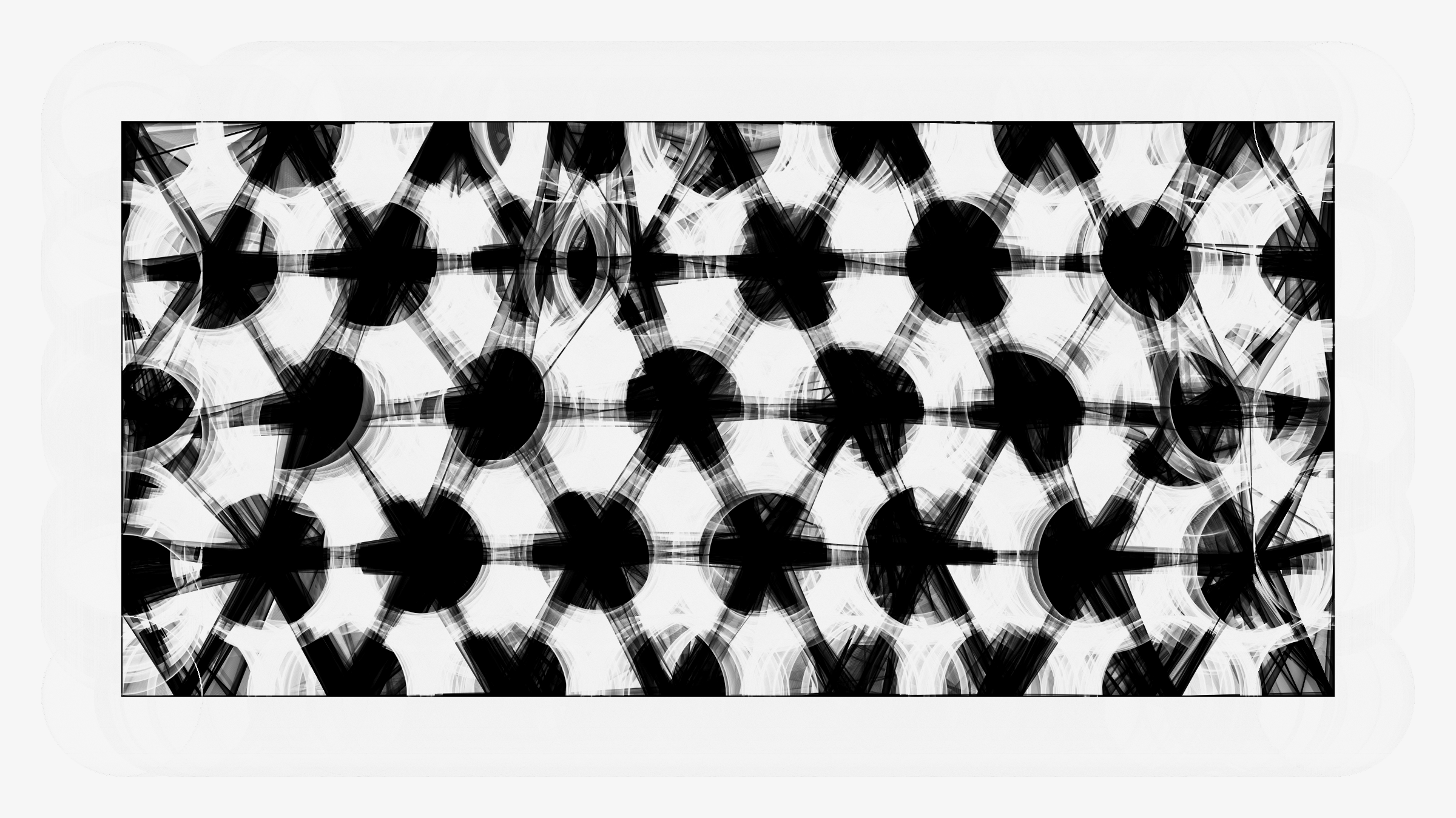
The still for Pre-Process #63 is a panoramic field of accumulated encounters. Dense circular masses repeat across three horizontal registers, linked by dark axial bands and crossed by translucent fans, loops, and...
Works in this study
- Related workPre-Process #63Status Accessioned into the permanent CollectionStatus as ofGift of punk6529; Casey REAS; Pre-Process #63; 6529 Network Museum, 6529NM.2026.001.04. Licensed CC BY-NC 4.0.
Read the complete studyOpen the full essay, notes, bibliography, and publication record.
- Accession: 6529NM.2026.001.04
- Version: 1.5.0
- Publication date: 2026-08-02
- Institutional author: 6529 Network Museum
- Publication status: Published manuscript
- Credit: Gift of punk6529
- Research cutoff: 2 August 2026
Label
The still for Pre-Process #63 is a panoramic field of accumulated encounters. Dense circular masses repeat across three horizontal registers, linked by dark axial bands and crossed by translucent fans, loops, and collisions. The repeated forms resemble an array of rotors, cells, or mechanical repeaters. They are traces produced by one hundred software elements following four concise behaviors governing movement, contact, constraint, and overlap.
The live work begins sparsely and accumulates over time; pause, reset, and surface-selection controls reveal its development from open field to density.1 Reas began the underlying system in 2003. Software sketches appeared in Process/Drawing at bitforms in 2005, marked NFS—“not for sale”—because he considered them unfinished. In 2022 he completed Pre-Process through all 120 significant combinations of surface, origin, and growth conditions.1 #63 makes that long development palpable as a live image whose history remains in motion.
Extended entry
The official still of Pre-Process #63 is crowded from edge to edge. Against a white panoramic field, dark circular concentrations recur in three broad horizontal registers. Horizontal bands appear to connect them, while translucent arcs sweep outward and collide with neighboring arcs. Some passages are nearly black from accumulation; others remain pale enough to reveal several overlapping curves at once. At a distance, the repeated masses look engineered—rotors joined by shafts, perhaps, or a diagram of transmission. Up close, that mechanical certainty breaks down. The edges are made from many partial encounters, and each apparent unit leaks into the next.
The work’s panoramic ratio encourages the eye to travel laterally, but no stable sequence emerges. Dark nuclei recur without becoming identical. Fans flare in different directions. Circular contours are clipped, doubled, or absorbed into horizontal traffic. The three-register structure gives the still an underlying order, yet the density within each register resists counting. It is a field in which repetition produces local difference. What looks like a composed pattern is the residue of behavior operating over time.
The project’s documented temporal origin changes how the still is understood.1 The work begins from a sparse condition and grows as its elements move, touch, turn, and separate; reset and surface-selection controls can reinitiate that development. The still’s saturated bands therefore do not disclose a finished design piece by piece. They record accumulated conditions produced through contact. Growth is designed to become a change of kind—from isolated event, to local structure, to environment. The Museum’s retained observation confirms only that two frames changed after a controlled wait; it preserves no evidence for the previously asserted timed sequence and records no activated controls.2
The program uses one hundred circular elements governed by four behaviors: they move straight, remain constrained to a surface, change direction on contact, and move away when they overlap.1 These rules are spare enough to state, but #63 refuses to serve as their diagram. The circles become difficult to isolate once their actions accumulate. Straight movement contributes to axial bands; changed directions multiply fans and angled crossings; avoidance prevents total collapse while producing dense borders around contact zones. The visible image is neither any single element nor the rules in the abstract. It is what the elements have done to one another over elapsed execution.
Reas began the work that became Pre-Process in 2003. He showed software sketches in the 2005 exhibition Process/Drawing at bitforms, marking them NFS because they remained unfinished. When he returned to the system for its 2022 release, he organized the project around every significant permutation of eight surfaces, three origins, and five growth conditions: 120 works in total.1 #63 records Surface 8, Origin 1, and Growth 4.3 Those labels identify its configuration; they do not explain the image or assign it rank. Their art-historical importance lies instead in the project’s refusal to select only a few visually preferred outputs from the system. Reas treated the structured field of combinations as the completed work.
The title Pre-Process places the project before the body of work for which Reas became widely known in the mid-2000s, including the Process series and Reas’s 2004 Whitney artport commission {Software} Structures.1 Nearly two decades separate the initial system from its completed public form. In that interval, browser-based execution, token-derived variation, and networked distribution provided a different way to publish a software artwork’s field of possibilities. The 2022 work is both historical and current: a 2003 investigation made legible through a 2022 technical and institutional form.
Object #63 also clarifies the difference between a generative image and a performance. Its screen can be reset, paused, or allowed to continue; number keys select surfaces and restart the development. The audience can witness and reinitiate the conditions Reas designed. Each run foregrounds duration. A static documentation image shows where accumulation arrived at one moment. The live work treats density as an outcome. Every black mass was once an interval of white; every apparent machine began as independent elements entering relation.
The work's medium is correspondingly plural. Instructions and code define the elements, surfaces, and behaviors. Token-derived state identifies #63's selected combination. A browser executes the process at display scale, and the evolving screen is the principal perceptual manifestation. The Ethereum token records chain identity and transfer history; legal title, copyright, and Museum accession are recorded separately. The official still preserves a reference state within the continuing run. In this object especially, confusing the still with the work would reverse its logic, treating an accumulation as if it were an origin.
Within the 6529 Network Museum’s Casey Reas accession, Pre-Process #63 forms a hinge. The three CENTURY works begin with compositions that software cuts and redistributes. Here, image formation moves deeper into the behavior of entities: no base composition waits behind the field to be restored. Phototaxis #308 makes the paths of autonomous machines readable as lines; 923 EMPTY ROOMS #713 turns code toward a simulated enclosure; Ex Nihilo (Cosmos) #248 turns it toward an ideal solid. #63 makes contact itself thicken into structure. The collection follows a shift from recomposing forms to constructing the circumstances under which form can emerge.
The still’s dense registers are compelling, but the live beginning is the work’s decisive revelation. What looks complete is elapsed. What looks designed as a unit is the negotiated result of a hundred actors. Pre-Process #63 makes an image by allowing relations to acquire weight, and it keeps the white field present as a memory of time before those relations began.
Object and manifestation
- Work: Casey Reas, Pre-Process #63, 2022; Art Blocks Curated, project 383; token 383000063.
- Medium: Browser-executed generative software with token-derived state; live screen manifestation and static documentation image; ERC-721 chain identity and transfer history recorded on Ethereum; legal title and rights recorded separately.34
- Recorded configuration: Surface 8; Origin 1; Growth 4; panoramic aspect ratio 1.78.3
- Live behavior beyond the still: Artist- and platform-documented accumulation from a sparse state, with pause, reset, and surface-selection controls. The Museum’s retained observation confirms frame change but did not activate controls and does not support a timed account.12
- Rights and condition: Retained object metadata reports CC BY-NC 4.0; the accession technical review outcome is
pass_.5with_ conditions
Museum record and research
- Status:
accessioned; permanent-collection object in6529NM..2026. 001 - Interpretive boundary: Museum interpretation [E] of one documented state. The official still documents one state of the executable software work.
- Rights and condition: See the title and rights review. Technical condition passes with amber preservation conditions documented in the object-specific condition record.
- Open research: The transparent linked descriptor publishes the Museum's reproducible project-level feature analysis. It uses no OpenSea or marketplace rarity metric and makes no claim that feature frequency determines artistic quality.
- Further context: Read the artist and practice profile, collection essay, and visual-observation record.
Notes and sources
Revision history
- 1.5.0 — 4 August 2026: Completed the publication copy desk and clarified the boundary between chain history, legal title, copyright, and accession.
- 1.4.0 — 4 August 2026: Reworked residual visitor-facing prose for directness and removed repeated procedural contrasts; identity, rights, condition, provenance, and evidentiary assertions unchanged.
- 1.3.0 — 3 August 2026: Copy-edited the object interpretation for directness and clarity; no identity, rights, condition, provenance, or evidentiary assertion changed.
- 1.2.0 — 2 August 2026: Final publication metadata applied after independent review.
- 1.1.0 — 2 August 2026: Removed unsupported timed-run claims; corrected the 2005 exhibition and NFS status, the 2004 Whitney artport commission wording, exact contract URLs, notes, rights, and condition references.
- 1.0.0 — 2 August 2026: Initial object-specific manuscript.
Footnotes
-
Casey Reas and Jeff Davis, “In Conversation with Casey Reas on Pre-Process”, Art Blocks, 28 November 2022; and Reas’s project description retained in the raw platform metadata. The interview documents the 2003 origin, NFS status of unfinished software, the 2005 Process/Drawing exhibition at bitforms, the four behaviors, the 120 permutations, and the 2022 completion; it also identifies Reas’s 2004 Whitney artport commission {Software} Structures. ↩ ↩2 ↩3 ↩4 ↩5 ↩6 ↩7
-
Controlled visual-observation record. The record documents changed screenshot hashes after a controlled wait; it does not document a reset, selected surface, or timed growth sequence, and the screenshot bytes were not retained. ↩ ↩2
-
Canonical object record and retained raw platform metadata, including the exact token identity, traits, contract, and aspect ratio. ↩ ↩2 ↩3
-
Exact rights record and technical and condition record. The license statement is reported by retained Art Blocks metadata; the condition record specifies an accession outcome of
pass_. ↩with_ conditions
Research context
Research context
- Related acquisitionThe System in Seven StatesStatus Accessioned into the permanent CollectionStatus as of