

Work entry
Casey Reas, Phototaxis #308, 2021
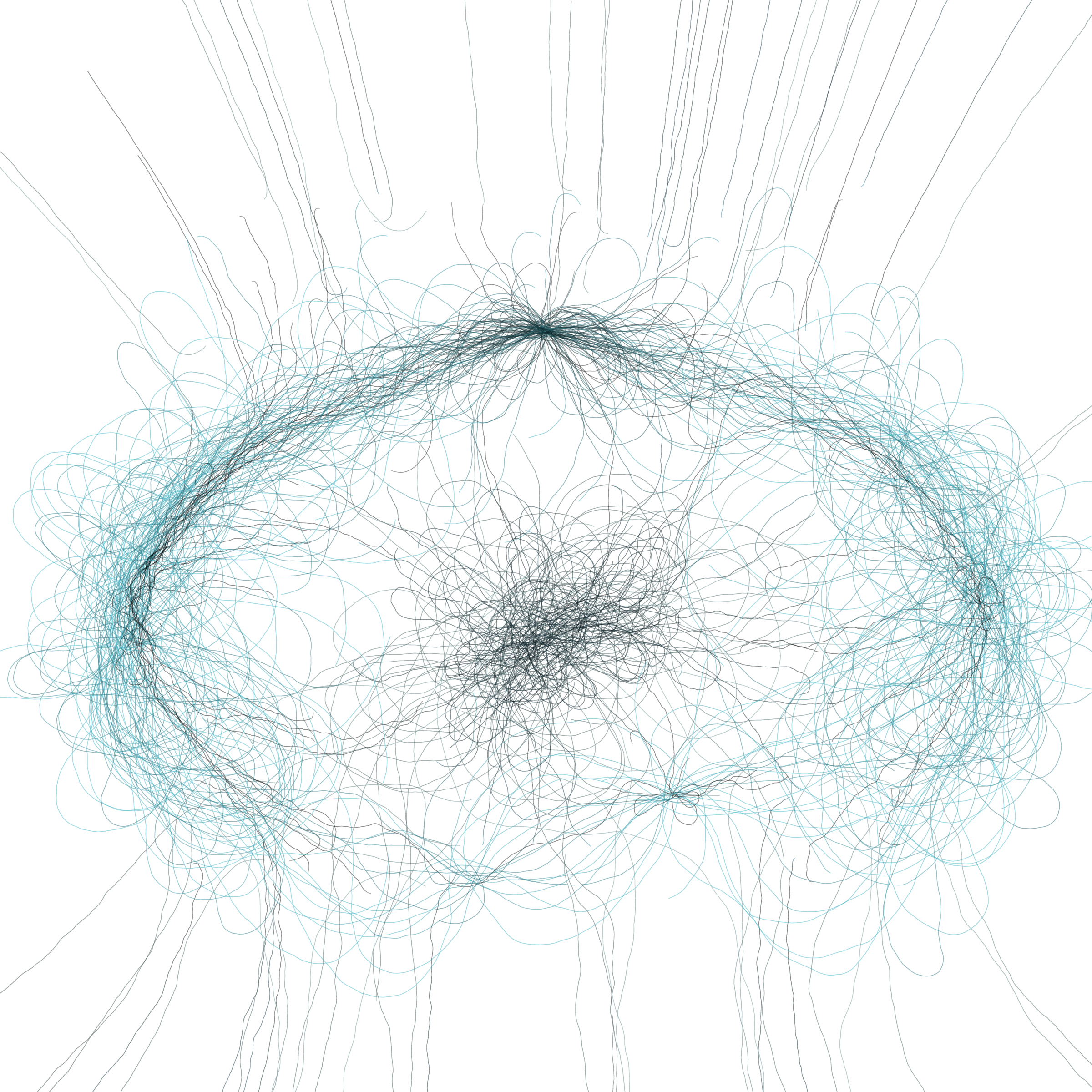
Phototaxis #308 appears as a history of moving machines. Pale cyan and gray paths circulate across a white field, gathering into a dense knot below center and a smaller convergence above it. Broad loops enclose...
Works in this study
- Related workPhototaxis #308Status Accessioned into the permanent CollectionStatus as ofGift of punk6529; Casey REAS; Phototaxis #308; 6529 Network Museum, 6529NM.2026.001.05. Licensed CC BY-NC 4.0.
Read the complete studyOpen the full essay, notes, bibliography, and publication record.
- Accession: 6529NM.2026.001.05
- Version: 1.5.0
- Publication date: 2026-08-02
- Institutional author: 6529 Network Museum
- Publication status: Published manuscript
- Credit: Gift of punk6529
- Research cutoff: 2 August 2026
Label
Phototaxis #308 appears as a history of moving machines. Pale cyan and gray paths circulate across a white field, gathering into a dense knot below center and a smaller convergence above it. Broad loops enclose these concentrations; stray vertical tracks escape toward the edges. The atmosphere comes from simulated organisms responding to lights according to four behavioral types adapted from Valentino Braitenberg’s thought experiments: Explorers, Aggressors, Lovers, and Cowards.
In the live work, paths accumulate rather than simply shift. Knots thicken, loops close, and elapsed behavior becomes spatial density. Artist-documented controls can reveal the fixed lights, pause or continue the drawing, restart it, and change its magnification.1 Reas first developed the code’s core for his MicroImage works around 2001, then translated it from C++ through Processing to browser-based p5.js. #308 is therefore both a distinct 2021 work and a record of twenty years of technical self-translation.1
Extended entry
Phototaxis #308 appears delicate before it appears systematic. Pale cyan and gray lines travel over a white square in loops, arcs, and sudden straight departures. A large circulation gathers around the center and lower half of the field. Within it, lines knot into a darkened concentration below center; above, a second, smaller convergence catches several rising paths. Around these dense zones, wide elliptical loops leave generous white intervals. At the edges, individual tracks turn vertical and seem to escape the collective movement. No body is drawn at the end of any line. The agents are present only through where they have been.
The image’s organization emerges from unequal densities rather than outlined forms. The central-lower knot carries the greatest visual weight, but it does not function as a conventional focal object. It is a concentration of histories: paths repeatedly entering, turning, and passing through the same area. The upper knot creates a secondary attractor, while the broad outer loops keep both from becoming isolated incidents. Fine differences in color and tone separate trajectories just enough for the eye to follow a few before they are absorbed. White space remains an active part of the drawing, recording regions the population has not yet crossed or has crossed too lightly to darken.
The live manifestation converts those densities back into events. Reas’s technical account specifies that the software first halts after 1,000 iterations—the state used for the platform thumbnail—and that the viewer may then continue or pause it with P, restart it with B, change scale with 1–5, or reveal its fixed lights with L.1 Existing lines remain as new movement extends the drawing, so time is not represented by a clock or sequence of frames; it acquires location and weight. The light overlay is documented to disclose the environment concealed by the trace, clarifying that curves and knots form through differential responses to fixed sources. The Museum’s retained observation records changed frames but no activated control and therefore does not support a claim about the exact position or appearance of revealed lights.2
Reas based those responses on Valentino Braitenberg’s 1984 book Vehicles: Experiments in Synthetic Psychology.1 Braitenberg imagined simple machines whose sensors connect to motors in different ways. Minimal changes in wiring produce motions that observers readily describe with psychological words—fear, aggression, affection—even though no inner life has been programmed. Phototaxis uses four named types: Explorers, Aggressors, Lovers, and Cowards. Their motion in relation to light generates the lines. Reas does not illustrate Braitenberg’s diagrams or ask the audience to identify individual personalities. He turns the thought experiment’s central problem into drawing: how complex-seeming conduct can emerge from very small behavioral rules.
In #, organism and diagram remain in suspension. No individual loop reliably identifies the machine type that made it; histories overlap until the population's record exceeds any single trajectory. The work's subject occupies the interval between the unseen machine executing a rule and the line through which its conduct becomes visible.
The code has a history as long as the paths on the screen. Reas developed its core for the MicroImage series beginning around 2001, first in C++. He later moved it into Processing/Java and then, for Phototaxis, into p5.js for execution in the browser.1 Each environment changes assumptions about display, speed, resolution, and public access. The 2021 Art Blocks project joins that technical lineage to token-derived variation and Ethereum-based identity. The artist’s current NFT register lists 2022 instead; the Museum retains that unresolved date conflict rather than silently harmonizing it.3 #308 is a particular configuration—among its recorded conditions are three lights, a lively speed, a nonlinear sensor relation, and 0.66 magnification—but the work must still run to turn those parameters into an image.4
The official still captures the output at the project’s thumbnail stop after 1,000 iterations. The live controls permit the process to resume or pause, restart from its “big bang,” alter magnification, and reveal the lights.1 The thumbnail state is a platform-authorized documentation state, not a Museum-declared canonical state. That distinction is not ancillary. In the still, the line network may be read as a completed lyrical abstraction. In execution, it is a growing record whose current density depends on elapsed behavior. The still is valid documentation; it is not the temporal boundary of the work.
The medium extends beyond a digital image. Code defines machine types, sensing, movement, and drawing. Token-derived state configures this particular environment. Browser execution allows the population to act, while the screen preserves action as line. The ERC-721 token records chain identity and transfer history; legal title, copyright, and Museum accession are recorded separately. Static and live manifestations are related evidence of the same work with different capacities.
Within the 6529 Network Museum’s Casey Reas accession, Phototaxis #308 occupies the clearest position between behavior and inscription. Pre-Process #63 lets encounters among circular elements accumulate into a field; #308 assigns every visible line to one machine’s movement through an environment. 923 EMPTY ROOMS #713 turns code toward a simulated enclosure, and Ex Nihilo (Cosmos) #248 turns it toward an ideal solid that never stabilizes. Here, the essential fact remains modest and concrete: movement leaves a mark.
That mark is not a neutral log. Reas has tuned scale, color, speed, population, and sensor relations until behavior becomes composition. #308’s outer circulation, twin concentrations, and escaping verticals possess formal clarity, yet none was placed directly. The work is a drawing made from biographies too simple to remember themselves. Software remembers for them, one line at a time.
Object and manifestation
- Work: Casey Reas, Phototaxis #308, 2021; Art Blocks Playground, project 164; token 164000308.
- Medium: Browser-executed generative software in p5.js with token-derived state; live screen manifestation and static documentation image; ERC-721 chain identity and transfer history recorded on Ethereum; legal title and rights recorded separately.45
- Recorded configuration: Size: Base; Speed: Lively; Lights: 3; Façade: Atomic A; Sensors: Nonlinear; Alignment: Neutral; Population: Assemblage; Magnification: 0.66.4
- Live behavior beyond the still: Artist-documented accumulating trajectories and pause/resume, restart, magnification, and light-location controls. The Museum’s retained observation confirms frame change but did not activate controls.12
- Rights and condition: Retained object metadata reports CC BY-NC 4.0; the accession technical review outcome is
pass_.6with_ conditions
Museum record and research
- Status:
accessioned; permanent-collection object in6529NM..2026. 001 - Interpretive boundary: Museum interpretation [E] of one documented state. The official still documents one state of the executable software work.
- Rights and condition: See the title and rights review. Technical condition passes with amber preservation conditions documented in the object-specific condition record.
- Open research: The transparent linked descriptor publishes the Museum's reproducible project-level feature analysis. It uses no OpenSea or marketplace rarity metric and makes no claim that feature frequency determines artistic quality.
- Further context: Read the artist and practice profile, collection essay, and visual-observation record.
Notes and sources
Revision history
- 1.5.0 — 4 August 2026: Completed the publication copy desk and clarified the boundary between chain history, legal title, copyright, and accession.
- 1.4.0 — 4 August 2026: Reworked residual visitor-facing prose for directness and removed repeated procedural contrasts; identity, rights, condition, provenance, and evidentiary assertions unchanged.
- 1.3.0 — 3 August 2026: Copy-edited the object interpretation for directness and clarity; no identity, rights, condition, provenance, or evidentiary assertion changed.
- 1.2.0 — 2 August 2026: Final publication metadata applied after independent review.
- 1.1.0 — 2 August 2026: Removed unsupported witnessed light and progression claims; documented the 1,000-iteration thumbnail and controls, preserved the 2021/2022 date conflict, and aligned notes, rights, and condition references.
- 1.0.0 — 2 August 2026: Initial object-specific manuscript.
Footnotes
-
Casey Reas, “Notes on Phototaxis”, 20 September 2021, with the artist’s accessible Phototaxis project record; Valentino Braitenberg, Vehicles: Experiments in Synthetic Psychology (MIT Press, 1984). Reas’s technical note documents the code lineage, four machine types, 1,000-iteration thumbnail stop, and P, B, 1–5, and L controls. ↩ ↩2 ↩3 ↩4 ↩5 ↩6 ↩7
-
Controlled visual-observation record. The record documents changed screenshot hashes after a controlled wait; it does not document the light reveal, pause, restart, or magnification controls, and the screenshot bytes were not retained. ↩ ↩2
-
The 2021 date follows the Art Blocks project record and Reas’s contemporaneous technical note; the artist’s current NFT register lists 2022. The Museum’s source and chronology matrix retains the discrepancy. ↩
-
Canonical object record and retained raw platform metadata, including the exact token identity and feature values quoted above. ↩ ↩2 ↩3
-
Exact rights record and technical and condition record. The license statement is reported by retained Art Blocks metadata; the condition record specifies an accession outcome of
pass_. ↩with_ conditions
Research context
Research context
- Related acquisitionThe System in Seven StatesStatus Accessioned into the permanent CollectionStatus as of