

Work entry
Casey Reas, Ex Nihilo (Cosmos) #248, 2026
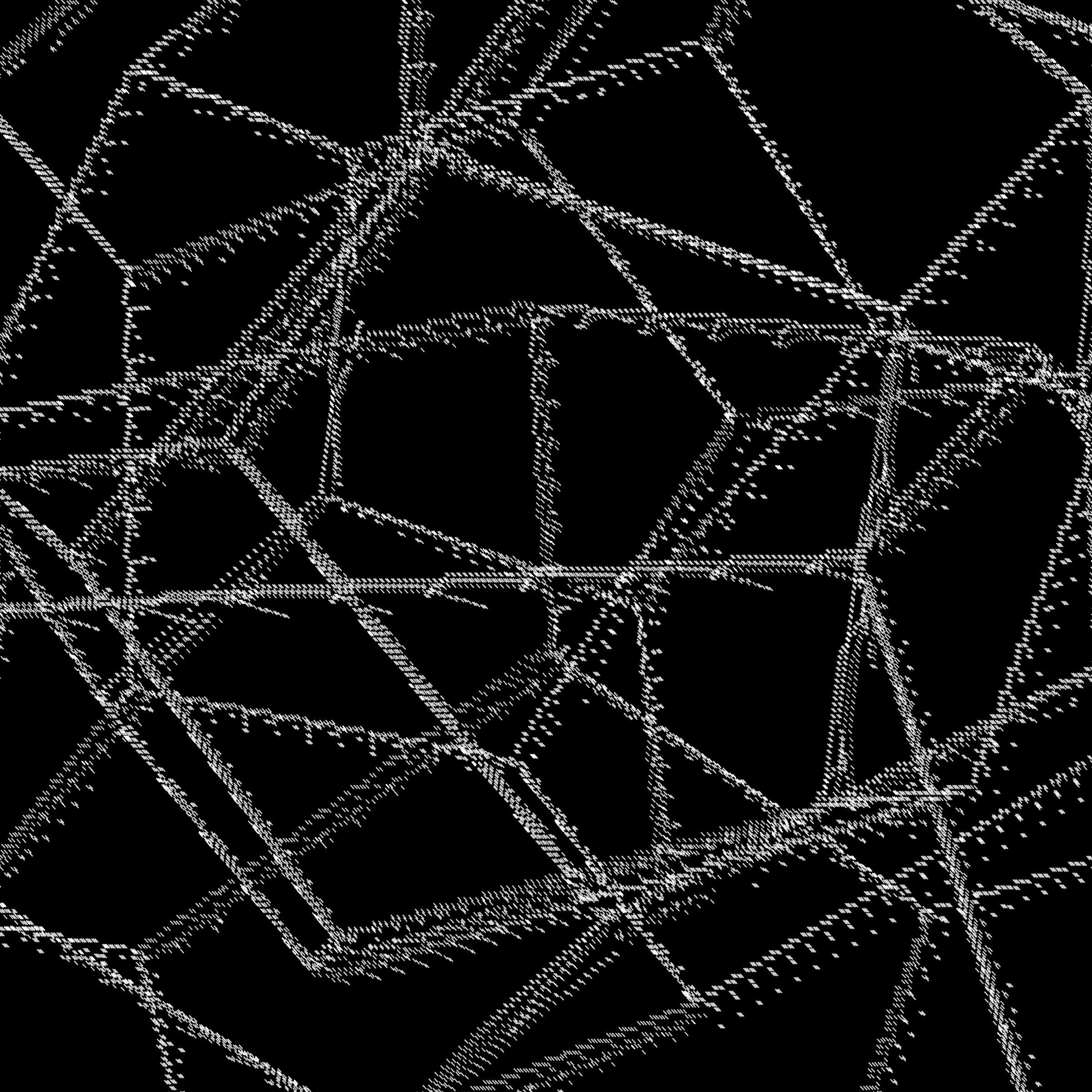
In Ex Nihilo (Cosmos) #248, a dodecahedron is less an object than a recurrent possibility. Broken white traces cross a black square in looping bands, abrupt diagonals, and partial polygonal edges. Large voids...
Works in this study
- Related workEx Nihilo (Cosmos) #248Status Accessioned into the permanent CollectionStatus as ofGift of punk6529; Casey REAS; Ex Nihilo (Cosmos) #248; 6529 Network Museum, 6529NM.2026.001.07. Licensed CC BY-NC 4.0.
Read the complete studyOpen the full essay, notes, bibliography, and publication record.
- Accession: 6529NM.2026.001.07
- Version: 1.5.0
- Publication date: 2026-08-02
- Institutional author: 6529 Network Museum
- Publication status: Published manuscript
- Credit: Gift of punk6529
- Research cutoff: 2 August 2026
Label
In Ex Nihilo (Cosmos) #248, a dodecahedron is less an object than a recurrent possibility. Broken white traces cross a black square in looping bands, abrupt diagonals, and partial polygonal edges. Large voids interrupt the network. The eye repeatedly assembles a many-sided solid, only to lose it among lines that refuse to meet.
Artist and platform documentation specifies continuous change, pause and speed controls, channel toggles, and a command that generates a new Still Life.1 The token identifies a particular work, while the software runs as a bounded performance designed to produce more than one composition. The Museum’s retained observation did not exercise those controls or independently establish long-duration non-repetition.2 Reas developed the work around the dodecahedron—the Platonic solid he associates with COSMOS—as part of his Still Life software series. Its subject is ideal geometry submitted to pixels, execution, and time.
Extended entry
The black field of Ex Nihilo (Cosmos) #248 is crossed by white lines that will not stay whole. They arrive as sequences of short marks: dashes gathered into loops, long oblique bands, and partial polygonal edges. Several passages suggest a wireframe turning in depth, yet no single contour closes around a stable volume. Large black interiors open between the traces. Some feel like faces of a solid; others cut through that reading and return the square to flatness. The image hovers at the point where scattered notation might become an object.
The dodecahedron is the form most clearly suggested; the geometry never closes. White bands bend around implied vertices, double back, and cross one another at incompatible depths. A many-sided enclosure seems to occupy the center, then a missing edge causes it to collapse into layered paths. The segmented line intensifies this uncertainty. Each band possesses direction and continuity, but the black intervals inside it keep that continuity perceptual rather than literal. The eye supplies what the display withholds.
In the live manifestation, this provisional structure is documented as kinetic rather than fixed.1 The software is designed to translate decomposed pixel values into changing lines, while its pause command can arrest one provisional state and its speed command can alter the rate of unfolding. That structure distinguishes the work from both a rotating rendered model and a single static image: movement occurs within an authored line system whose momentary organization can suggest volume. The Museum’s retained observation confirms changed frame hashes after a controlled wait but, because no controls were activated and screenshot bytes were not retained, it does not support the previously asserted account of particular dashes advancing, interiors holding, or pause taking effect.2
The artist-defined command to generate a new Still Life establishes a larger difference between token and still.1 Reinitialization is documented as a project capability; the retained observation did not use the command and makes no claim about a replacement composition.2 The official PNG records one manifestation of a token-bound software work designed to reinitialize its visual state, potentially changing density, scale, and balance while remaining governed by #248’s segmented line vocabulary.
Ex Nihilo (Cosmos) belongs to Reas’s Still Life series, whose exhibitions began in 2016 with There’s No Distance at bitforms, New York.1 The series organizes works around the five Platonic solids. In the artist’s mapping, the cube corresponds to EARTH, the tetrahedron to FIRE, the octahedron to AIR, the dodecahedron to COSMOS, and the icosahedron to WATER. #248 takes the dodecahedron as its underlying form. The reference joins ancient ideal geometry to computer graphics. Reas gives the dodecahedron to decomposition, line translation, pixel resolution, and continuous execution.
The title sharpens that contradiction. “Ex nihilo” proposes creation from nothing; software culture often repeats the fiction that code can produce images without material support. #248 stages emergence through its full material chain: written instructions, a JavaScript library, browser behavior, processing hardware, display pixels, electrical duration, and token-derived state. Even the black field is produced by a screen. By making these conditions active, the work tests the ancient promise of eternal Form.
The still-life designation is equally pointed. A still life traditionally gathers bounded things before a viewer and makes their surfaces available to prolonged inspection. #248 offers no durable thing and is never fully still unless paused. Its “object” is an ideal solid inferred from changing traces; its “table” is the black coordinate field of the display. The genre survives as an act of attention. One watches for a form to cohere, studies its temporary edges, and sees it pass into another condition.
The project description specifies that the software runs continuously without repeating.1 That statement defines the artist’s intended temporal horizon; neither a brief inspection nor the retained two-frame observation can independently prove non-repetition. The same documentation specifies pause, speed, color-channel, and new-Still-Life controls, while Museum technical research records a case discrepancy between the displayed uppercase R/B commands and lowercase responses identified in the inspected implementation.3 These are documented interface claims, not witnessed control outcomes. #248’s recorded output uses white on black, with RGB disabled, a chunk value of three, and three COSMOS forms.4 These configuration facts identify how the token is set; they do not replace looking at the visual relations the program produces.
The medium joins p5.js software, token-derived state, browser execution, and screen display. The ERC-721 token records #248's chain identity and transfer history; legal title, copyright, and Museum accession are recorded separately. Code, token-derived state, browser execution, and screen determine the image's changing appearance. A static surrogate remains essential for citation, cataloguing, and comparison. It preserves density and polygonal suggestion at a known moment; the live manifestation adds documented temporal change, pause capability, and compositional reinitialization.
Within the 6529 Network Museum’s seven-work Reas accession, #248 is the chronological endpoint and the accession’s clearest case of a work without a single canonical view. CENTURY preserves a base composition behind its cuts; Pre-Process grows from sparse beginnings; Phototaxis accumulates the past movements of machines; 923 EMPTY ROOMS stabilizes a room through optical interruption. #248 can discard an entire current arrangement and begin another while remaining the same accessioned work. It makes multiplicity internal to the object rather than a comparison among tokens.
What persists is the system's recurring proposal of a dodecahedron and the conditions that interrupt it. Mathematics proposes the solid; pixels, white traces, black intervals, and sight make its appearance provisional.
Object and manifestation
- Work: Casey Reas, Ex Nihilo (Cosmos) #248, 2026; Art Blocks Studio | 92, project 0; token 248; co-presented by Art Blocks and Feral File.
- Medium: Browser-executed generative software in p5.js 1.9.0 with token-derived state; live screen manifestation and static documentation image; ERC-721 chain identity and transfer history recorded on Ethereum; legal title and rights recorded separately.45
- Recorded configuration: RGB: false; FFFFFF: true; FF0000: false; 00FF00: false; 0000FF: false; CHUNK: 3; # COSMOS: 3.4
- Live behavior beyond the still: Artist- and platform-documented continuous change, pause and speed controls, channel controls, and generation of a new Still Life. The Museum’s retained observation confirms frame change but did not activate controls; continuous non-repetition remains a documented project claim, not an independently verified result.12
- Rights and condition: Retained object metadata reports CC BY-NC 4.0; the accession technical review outcome is
pass_.6with_ conditions
Museum record and research
- Status:
accessioned; permanent-collection object in6529NM..2026. 001 - Interpretive boundary: Museum interpretation [E] of one documented state. The official still documents one state of the executable software work.
- Rights and condition: See the title and rights review. Technical condition passes with amber preservation conditions documented in the object-specific condition record.
- Open research: The transparent linked descriptor publishes the Museum's reproducible project-level feature analysis. It uses no OpenSea or marketplace rarity metric and makes no claim that feature frequency determines artistic quality.
- Further context: Read the artist and practice profile, collection essay, and visual-observation record.
Notes and sources
Revision history
- 1.5.0 — 4 August 2026: Completed the publication copy desk, clarified chain-history boundaries, and tightened the close looking.
- 1.4.0 — 4 August 2026: Reworked residual visitor-facing prose for directness and removed repeated procedural contrasts; identity, rights, condition, provenance, and evidentiary assertions unchanged.
- 1.3.0 — 3 August 2026: Copy-edited the object interpretation for directness and clarity; no identity, rights, condition, provenance, or evidentiary assertion changed.
- 1.2.0 — 2 August 2026: Final publication metadata applied; unsupported 2015 chronology replaced with the sourced 2016 exhibition formulation after independent review.
- 1.1.0 — 2 August 2026: Removed unsupported witnessed pause and new-Still-Life outcomes; corrected Still Life chronology, retained control and determinism caveats, and aligned notes, rights, and condition references.
- 1.0.0 — 2 August 2026: Initial object-specific manuscript.
Footnotes
-
Official Art Blocks project presentation, official token presentation, and the artist’s project description retained in the raw platform metadata. These sources document the Still Life chronology, Platonic-solid mapping, continuous/non-repeating claim, controls, and March 2026 co-presentation by Art Blocks and Feral File. ↩ ↩2 ↩3 ↩4 ↩5 ↩6
-
Controlled visual-observation record. The record documents changed screenshot hashes after a controlled wait; it does not document pause, channel, speed, or new-Still-Life controls, and the screenshot bytes were not retained. ↩ ↩2 ↩3 ↩4
-
The platform description lists uppercase R and B for channel controls; Museum technical research in the art and technical research dossier records lowercase r and b responses in the inspected generator implementation. This interface discrepancy does not affect object identity, but it remains relevant to display and preservation. ↩
-
Canonical object record and retained raw platform metadata and project description, including the exact token identity and feature values quoted above. ↩ ↩2 ↩3
-
Exact rights record and technical and condition record. The license statement is reported by retained Art Blocks metadata; the condition record specifies an accession outcome of
pass_. ↩with_ conditions
Research context
Research context
- Related acquisitionThe System in Seven StatesStatus Accessioned into the permanent CollectionStatus as of