

Work entry
Casey Reas, CENTURY #724, 2021
In CENTURY #724, emptiness carries the composition. A pale cream field spreads across most of the square. Along its upper edge, a broad rust-red arc has been severed and displaced; dark navy fragments collect near...
Works in this study
- Related workCENTURY #724Status Accessioned into the permanent CollectionStatus as ofGift of punk6529; Casey REAS; CENTURY #724; 6529 Network Museum, 6529NM.2026.001.02. Licensed CC BY-NC 4.0.
Read the complete studyOpen the full essay, notes, bibliography, and publication record.
- Accession: 6529NM.2026.001.02
- Version: 1.5.0
- Publication date: 2026-08-02
- Institutional author: 6529 Network Museum
- Publication status: Published manuscript
- Credit: Gift of punk6529
- Research cutoff: 2 August 2026
Label
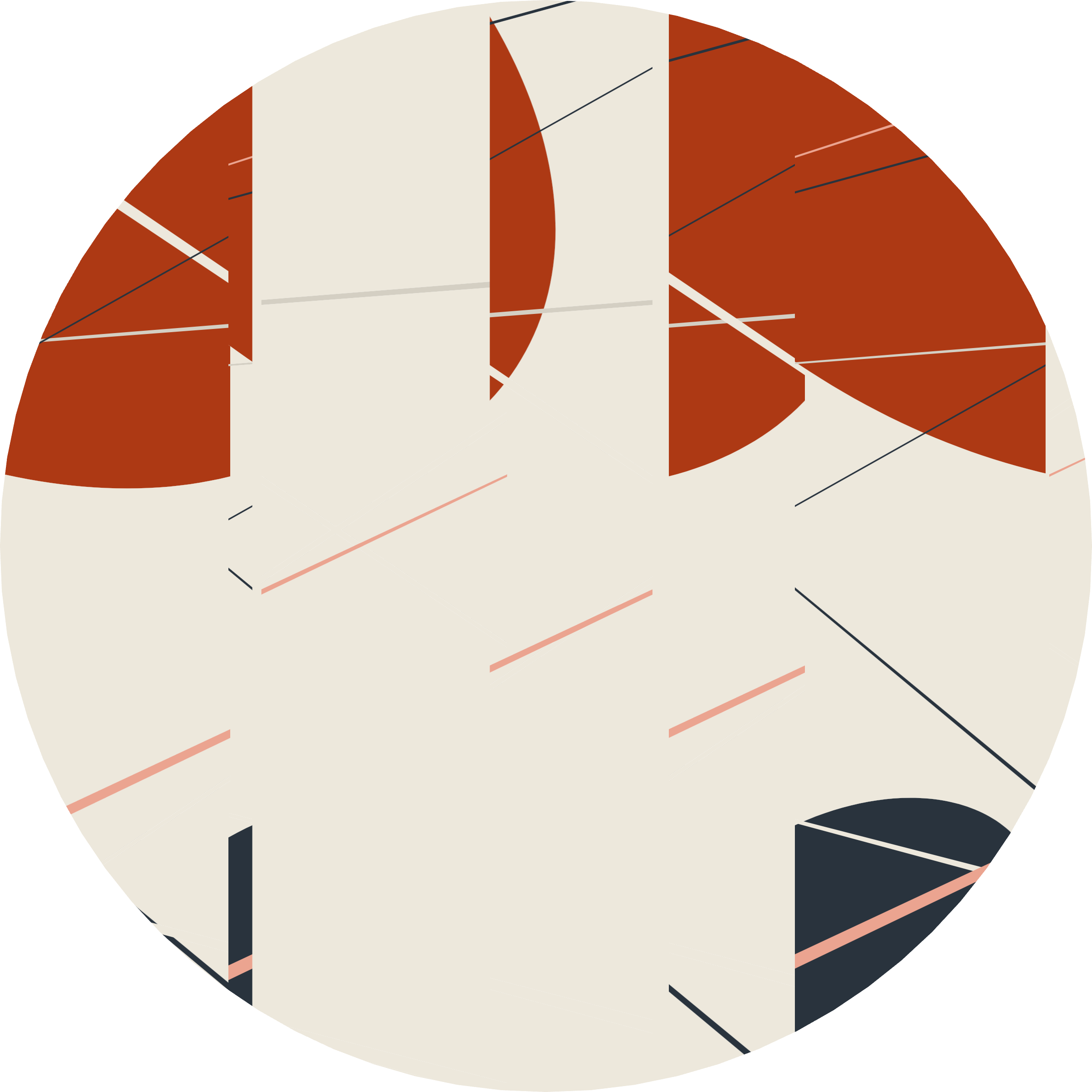
In CENTURY #724, emptiness carries the composition. A pale cream field spreads across most of the square. Along its upper edge, a broad rust-red arc has been severed and displaced; dark navy fragments collect near the bottom, while eleven thin salmon, navy, and white lines traverse the opening. Seven broad vertical slices interrupt the image, fewer than in the Museum’s other CENTURY works, so each displacement reads with unusual clarity.
Reas’s documented controls permit the sliced composition to be rearranged or returned to its original order, while the project description identifies the fine lines as moving.1 Drawing on Ellsworth Kelly’s cut-and-recombine procedure, CENTURY turns collage into an enduring temporal operation. Reas began the wider body in 2012; this exact Art Blocks work was released in 2021.1 #724 is the Museum group’s spacious counterweight. It shows that interruption need not produce congestion; a few shifted boundaries can make open space itself feel unsteady.
Extended entry
CENTURY #724 opens onto an expanse of cream. The field is so broad and luminous that the first reading is one of calm, but the calm does not last. A rust-red arc presses down from the top edge, broken into sections that no longer complete one another. Dark navy shapes gather lower in the square, including a compact fragment near the bottom right. Across these weighted forms run eleven fine lines in salmon, navy, cream, and white. Some cross at sharp angles; others pass almost alone through the open field. The composition has the scale of a sky chart or a pared-down cosmology, but its bodies have been shifted out of alignment.
Only seven vertical cuts organize this token’s disrupted state. Their relative breadth is crucial. In #31, sixteen narrow slices create a crowded screen of interruptions; here, each band retains enough of the underlying form to be read as a large shutter. Cream sections sit beside other cream sections with only a seam to announce the cut. Rust appears, vanishes, and resumes at a different height. The resulting discontinuities are economical rather than frantic. A small number of operations makes the eye continually test what belongs together. Open space becomes active because it carries the expectation that a displaced fragment might complete a form elsewhere.
The still’s spaciousness belongs to a composition that the artist’s documented controls can return to its original slice order, but the Museum’s retained observation did not activate that control and does not preserve evidence of the restored image.12 Interpretation must therefore remain with what the exact still supports: a rust form too large to be contained, smaller dark fragments below it, and a gulf of cream between weighted events. The cut state distributes that disproportion. Rust is reassigned across the upper bands, cream becomes a sequence of upright intervals, and the dark lower register remains deliberately uncertain. The possibility of restoration is integral to the work; a specific restored arrangement is not asserted here.
Movement changes the field more quietly. Reas’s project description identifies the fine lines as moving while the artist-defined controls permit another slicing operation or a return to the original order.1 Because #724 contains so much unoccupied space, even subtle motion would become legible: a line’s passage could alter the balance between the cropped upper body and the lower fragments, while an intersection could appear and loosen. The still therefore conveys the token’s color and one cut arrangement but not the full temporal behavior documented by the artist. In execution, open space is not merely a fixed pause. It is the interval through which lines are designed to travel and across which fragments may be redistributed.
Reas’s point of departure for CENTURY was an operation associated with Ellsworth Kelly: create a composition, divide it into vertical columns, then recombine them.1 Reas preserves the intelligibility of that operation while changing its ontology. Kelly’s cut pieces are material units arranged toward a physical result. In CENTURY, division and recombination are procedures maintained by executable code. A given token provides a distinct composition and state, and the work continues beyond the image minted from that state. Its lines are specified to remain in motion, and its structure can be cut again. The technique that once connected preparatory collage to a finished painting becomes an ongoing relation among source image, interruption, and display.
In #, the operation is unusually legible. Broad cream passages expose every seam and give small displacements unusual consequence. A rust arc shifted across a few bands can become disk, horizon, canopy, or ruin. A dark fragment can appear anchored in one state and stranded in another. These visible relations, rather than supply or feature counts, provide the ground for interpretation.
The medium is distributed across several distinct things. The code defines the operations. Token-derived data specifies this work's cream, rust, and navy composition and its line-and-slice configuration. A browser executes the instructions, and a screen gives their changing relation perceptible form. The Ethereum token records chain identity and transfer history; legal title, copyright, and Museum accession are recorded separately. The official PNG preserves a stable reference view for cataloguing and comparison; the live manifestation adds duration and control to the composition.
Within the 6529 Network Museum’s accession, #724 occupies a precise comparative role. The three CENTURY tokens are not an artist-designated triptych, yet together they permit sustained study of one software work through sharply different outputs. #31 is dense, blue, and occluded; #401 builds grayscale depth from opaque and translucent planes. #724 is the opening between them. Its cream field and asymmetrical pair of bodies demonstrate that the slicing procedure can intensify absence rather than fill it.
That is the token’s quiet severity. The work offers no central emblem and no stable reconstruction in the still. It asks the eye to hold a huge cropped disk, a minor dark body, moving diagonals, and a sequence of nearly empty bands in one provisional order. The cut has not destroyed the image; it has made the distance inside the image palpable. #724 turns interval into form—and makes every seam a measure of what has been moved apart.
Object and manifestation
- Work: Casey Reas, CENTURY #724, 2021; Art Blocks Curated, project 100; token 100000724.
- Medium: Browser-executed generative software with token-derived state; live screen manifestation and static documentation image; ERC-721 chain identity and transfer history recorded on Ethereum; legal title and rights recorded separately.34
- Recorded configuration: Palette B; Line Count: 11; Slice Count: 7; Oculi: true; Janky: true; Slice Order: Chaos.3
- Live behavior beyond the still: Artist- and platform-documented line movement and slicing/restoration controls. The Museum’s retained observation confirms frame change but did not activate controls.12
- Rights and condition: Retained object metadata reports CC BY-NC 4.0; the accession technical review outcome is
pass_.5with_ conditions
Museum record and research
- Status:
accessioned; permanent-collection object in6529NM..2026. 001 - Interpretive boundary: Museum interpretation [E] of one documented state. The official still documents one state of the executable software work.
- Rights and condition: See the title and rights review. Technical condition passes with amber preservation conditions documented in the object-specific condition record.
- Open research: The transparent linked descriptor publishes the Museum's reproducible project-level feature analysis. It uses no OpenSea or marketplace rarity metric and makes no claim that feature frequency determines artistic quality.
- Further context: Read the artist and practice profile, collection essay, and visual-observation record.
Notes and sources
Revision history
- 1.5.0 — 4 August 2026: Completed the publication copy desk and clarified the boundary between chain history, legal title, copyright, and accession.
- 1.4.0 — 4 August 2026: Reworked residual visitor-facing prose for directness and removed repeated procedural contrasts; identity, rights, condition, provenance, and evidentiary assertions unchanged.
- 1.3.0 — 3 August 2026: Copy-edited the object interpretation for directness and clarity; no identity, rights, condition, provenance, or evidentiary assertion changed.
- 1.2.0 — 2 August 2026: Final publication metadata applied after independent review.
- 1.1.0 — 2 August 2026: Removed unsupported witnessed-control claims; aligned project chronology, exact feature language, notes, rights, and condition references with canonical records.
- 1.0.0 — 2 August 2026: Initial object-specific manuscript.
Footnotes
-
Casey Reas and Jeff Davis, “In Conversation with Casey Reas on CENTURY”, Art Blocks, 21 June 2021; and the artist’s project description retained in the raw platform metadata. The broader body dates to 2012; this token belongs to the 2021 Art Blocks release. ↩ ↩2 ↩3 ↩4 ↩5 ↩6
-
Controlled visual-observation record. The record documents changed screenshot hashes after a controlled wait; it does not document activation of the slicing or restoration controls, and the screenshot bytes were not retained. ↩ ↩2
-
Canonical object record and retained raw platform metadata, including the exact token identity and feature values quoted above. ↩ ↩2
-
Exact rights record and technical and condition record. The license statement is reported by retained Art Blocks metadata; the condition record specifies an accession outcome of
pass_. ↩with_ conditions
Research context
Research context
- Related acquisitionThe System in Seven StatesStatus Accessioned into the permanent CollectionStatus as of