

Work entry
Casey Reas, CENTURY #401, 2021
CENTURY #401 removes the strong color contrasts seen elsewhere in the project and makes cutting an architecture of tone. A large gray circular field is interrupted by heavy black columns, translucent overlaps, and...
Works in this study
- Related workCENTURY #401Status Accessioned into the permanent CollectionStatus as ofGift of punk6529; Casey REAS; CENTURY #401; 6529 Network Museum, 6529NM.2026.001.03. Licensed CC BY-NC 4.0.
Read the complete studyOpen the full essay, notes, bibliography, and publication record.
- Accession: 6529NM.2026.001.03
- Version: 1.5.0
- Publication date: 2026-08-02
- Institutional author: 6529 Network Museum
- Publication status: Published manuscript
- Credit: Gift of punk6529
- Research cutoff: 2 August 2026
Label
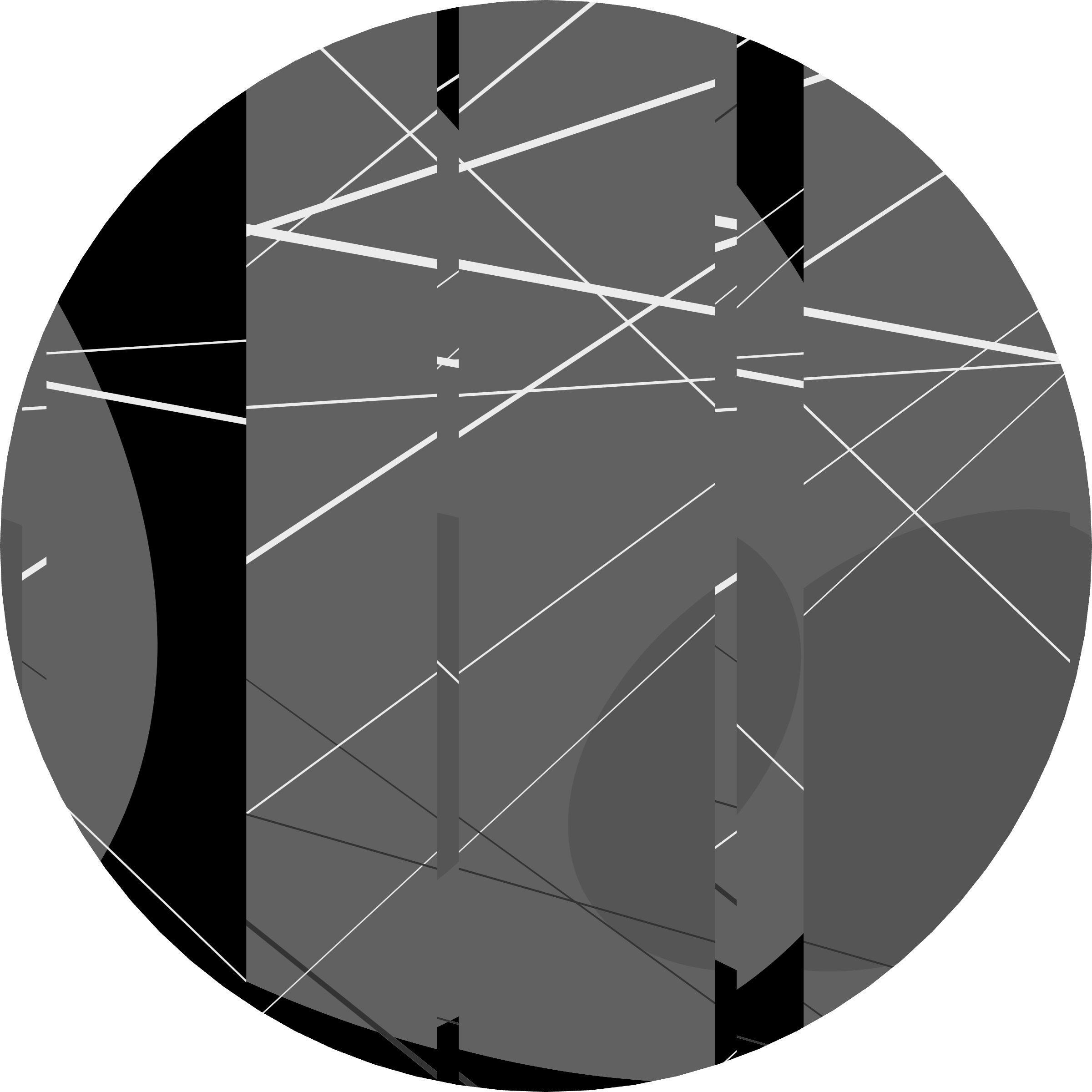
CENTURY #401 removes the strong color contrasts seen elsewhere in the project and makes cutting an architecture of tone. A large gray circular field is interrupted by heavy black columns, translucent overlaps, and ten vertical slices. Fifteen white lines cross the square diagonally, passing through the darker planes like taut wires. Near the lower right, a transparent oval seems both embedded in the disk and suspended before it.
Reas’s documented controls permit the work to be cut again or returned to its original order, while the project description identifies the lines as moving.1 The Museum’s retained observation did not activate those controls, so no particular restored image is claimed here.2 Reas adapted CENTURY’s procedure from Ellsworth Kelly’s method of dividing and recombining compositions. He began the wider body in 2012; this exact Art Blocks work was released in 2021.1 In the Museum’s three-work group, #401 is the work in which recombination most clearly crosses from collage into architecture.
Extended entry
The square of CENTURY #401 is gray, black, and white, with a layered and oddly tactile tonal range. A large gray disk fills most of the field. Heavy black uprights interrupt it, especially at the left, while narrower columns establish a broken vertical cadence across the image. Fifteen white lines pull in other directions. They cross diagonally, sometimes nearly parallel and sometimes at acute angles, as though stretched across the face of a structure. Near the lower right, a darker translucent oval overlaps the disk. Its edge can be followed until a black plane or slice seam interrupts it, then recovered elsewhere.
Color does not separate the elements; opacity does. Solid black columns stop the gaze. The gray disk receives it. The translucent oval allows one tone to pass through another, producing a third condition that belongs fully to neither. That modulation gives #401 a depth absent from a simple arrangement of black and white shapes. The image alternates between surface and shallow construction: one moment a cut paper collage, the next a bank of partitions with an elliptical chamber behind them. The white lines complicate both readings because they appear to run continuously across planes that otherwise conceal one another.
Ten vertical slices give this unstable architecture a measured, structural rhythm between #31's close divisions and #724's broad ones. Each slice carries part of the original composition to a new position. A black rim becomes a freestanding column; the translucent oval becomes an aperture; sections of the gray circle become alternating walls. Recombination changes categories as well as positions: edge becomes object, overlap becomes room, and disk becomes façade.
The official still preserves one especially resolved cut state, while the artist’s documentation explains the operation that constructs it.1 The black uprights and displaced sections are the visible consequences of a program that can alter the slice order; the documented restoration control makes an original order available without licensing an unsupported description of what that restored image looks like. Reas also specifies that the fine lines move, adding a second duration to the sudden event of recombination: a continuous shift against heavier forms. The Museum’s retained two-frame observation supports change over time, but because the screenshot bytes were not retained and no controls were used, this account does not claim to reconstruct either frame or a witnessed transition.2
CENTURY treats slicing as an active operation. Reas developed the project from a procedure associated with Ellsworth Kelly, who cut compositions into vertical columns and rearranged them.1 In #401, the historical reference appears as an operation. The work begins with an abstract composition, partitions it, and makes the partition active. Executable software changes the terms: a material collage preserves the edges of a past cut in a final physical order, while #401 keeps the underlying arrangement recoverable, permits further cuts, and specifies continuing line movement after a recombination.
Object #401 therefore shifts attention from the finished arrangement to the persistence of relations across states. The gray disk remains conceptually present even when its parts read as walls. The translucent ellipse remains an overlap even when the cut turns it into a sequence of windows. The white lines continue their trajectories despite the apparent depth of the black columns. The eye reconstructs what the program has separated, then abandons that reconstruction when the same fragments cohere as a new space. The work does not ask which state is correct. It makes the act of moving between readings its subject.
Its medium is essential to that movement. Code establishes drawing, slicing, recombination, motion, and interaction. Token-derived data gives #401 its grayscale palette, number of lines and slices, transparent layer, and initial configuration. The browser executes those relations; the screen makes their different tempos visible. The ERC-721 token records chain identity and transfer history; legal title, copyright, and Museum accession are recorded separately. A still documents the exact tonal organization of one state; artist documentation describes the live work as capable of showing columns collapsing back into a disk and lines travelling across it.1
The 6529 Network Museum holds three CENTURY works as a comparative group, not as an artist-designated triptych. Within that group, #401 occupies the tonal and architectural position. #31 uses blue, cream, and close slicing to build density; #724 uses cream, rust, and broad intervals to make displacement legible across emptiness. #401 shows how the same procedure can create depth without hue. Its transparent element is especially important: it introduces a mode of partial concealment between the project’s more emphatic acts of covering and exposing.
The result is an abstract work that never settles for flatness, although nothing in it leaves the plane of the display. #401’s black columns are made from displaced parts of a circle; its recesses are differences in opacity; its wires are moving lines. Architecture occurs as a perceptual consequence of cutting. By allowing that construction to be undone and remade, Reas turns the square into both image and instrument—a place where a disk can repeatedly become a room.
Object and manifestation
- Work: Casey Reas, CENTURY #401, 2021; Art Blocks Curated, project 100; token 100000401.
- Medium: Browser-executed generative software with token-derived state; live screen manifestation and static documentation image; ERC-721 chain identity and transfer history recorded on Ethereum; legal title and rights recorded separately.34
- Recorded configuration: Palette C; Line Count: 15; Slice Count: 10; Oculi: true; Alpha: true; Alpha Value: 209; Slice Order: Chaos.3
- Live behavior beyond the still: Artist- and platform-documented line movement and slicing/restoration controls. The Museum’s retained observation confirms frame change but did not activate controls.12
- Rights and condition: Retained object metadata reports CC BY-NC 4.0; the accession technical review outcome is
pass_.5with_ conditions
Museum record and research
- Status:
accessioned; permanent-collection object in6529NM..2026. 001 - Interpretive boundary: Museum interpretation [E] of one documented state. The official still documents one state of the executable software work.
- Rights and condition: See the title and rights review. Technical condition passes with amber preservation conditions documented in the object-specific condition record.
- Open research: The transparent linked descriptor publishes the Museum's reproducible project-level feature analysis. It uses no OpenSea or marketplace rarity metric and makes no claim that feature frequency determines artistic quality.
- Further context: Read the artist and practice profile, collection essay, and visual-observation record.
Notes and sources
Revision history
- 1.5.0 — 4 August 2026: Completed the publication copy desk and clarified the boundary between chain history, legal title, copyright, and accession.
- 1.4.0 — 4 August 2026: Reworked residual visitor-facing prose for directness and removed repeated procedural contrasts; identity, rights, condition, provenance, and evidentiary assertions unchanged.
- 1.3.0 — 3 August 2026: Copy-edited the object interpretation for directness and clarity; no identity, rights, condition, provenance, or evidentiary assertion changed.
- 1.2.0 — 2 August 2026: Final publication metadata applied after independent review.
- 1.1.0 — 2 August 2026: Removed unsupported witnessed-control claims; aligned project chronology, exact feature language, notes, rights, and condition references with canonical records.
- 1.0.0 — 2 August 2026: Initial object-specific manuscript.
Footnotes
-
Casey Reas and Jeff Davis, “In Conversation with Casey Reas on CENTURY”, Art Blocks, 21 June 2021; and the artist’s project description retained in the raw platform metadata. The broader body dates to 2012; this token belongs to the 2021 Art Blocks release. ↩ ↩2 ↩3 ↩4 ↩5 ↩6
-
Controlled visual-observation record. The record documents changed screenshot hashes after a controlled wait; it does not document activation of the slicing or restoration controls, and the screenshot bytes were not retained. ↩ ↩2 ↩3
-
Canonical object record and retained raw platform metadata, including the exact token identity and feature values quoted above. ↩ ↩2
-
Exact rights record and technical and condition record. The license statement is reported by retained Art Blocks metadata; the condition record specifies an accession outcome of
pass_. ↩with_ conditions
Research context
Research context
- Related acquisitionThe System in Seven StatesStatus Accessioned into the permanent CollectionStatus as of