

Work entry
Casey Reas, CENTURY #31, 2021
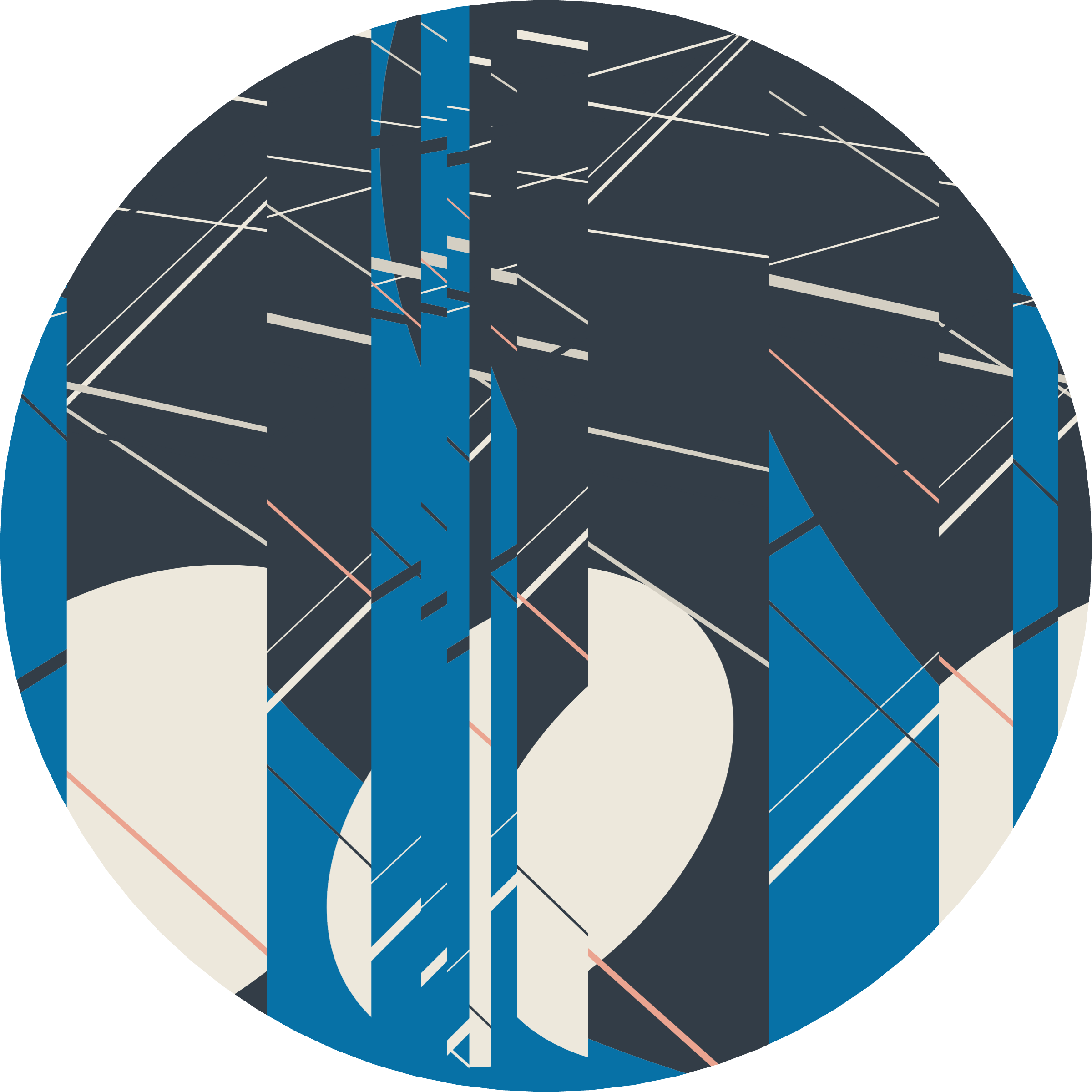
CENTURY #31 first appears as an image under pressure. A nearly full circular field has been cut into narrow upright sections: saturated blue wedges, dark slate columns, and cream-colored arcs no longer meet where...
Works in this study
- Related workCENTURY #31Status Accessioned into the permanent CollectionStatus as ofGift of punk6529; Casey REAS; CENTURY #31; 6529 Network Museum, 6529NM.2026.001.01. Licensed CC BY-NC 4.0.
Read the complete studyOpen the full essay, notes, bibliography, and publication record.
- Accession: 6529NM.2026.001.01
- Version: 1.5.0
- Publication date: 2026-08-02
- Institutional author: 6529 Network Museum
- Publication status: Published manuscript
- Credit: Gift of punk6529
- Research cutoff: 2 August 2026
Label
CENTURY #31 first appears as an image under pressure. A nearly full circular field has been cut into narrow upright sections: saturated blue wedges, dark slate columns, and cream-colored arcs no longer meet where the eye expects. Fine cream and salmon lines cross these heavier forms without restoring their continuity. Reas’s project description identifies those lines as moving and provides controls for a new slicing operation or a return to the original order. These documented possibilities disclose why the still should be read as one state of an executable work, not as its terminal image.1
Reas began the wider CENTURY body in 2012 and developed its central operation from an approach associated with Ellsworth Kelly—making a composition, cutting it into columns, and rearranging those columns. The exact Art Blocks work was released in 2021, translating that procedure into software that remains active.1 Among the Museum’s three CENTURY works, #31 is the most compressed. Its sixteen slices turn a lucid abstract image into a contest between monument and seam: the picture survives, but only as something repeatedly interrupted.
Extended entry
The first encounter with CENTURY #31 is frontal and congested. A circular field occupies almost the entire square, but the circle cannot gather itself into a single figure. It has been divided into vertical strips whose edges behave like faults. Saturated blues rise in wedges and columns; dark slate passages block them; cream-colored forms appear as partial eyes, moons, or apertures, only to disappear behind another band. Seventeen fine lines—mostly cream, with salmon accents—cross the heavier geometry at diagonals. They seem at first to promise connection, yet their oblique trajectories make the interruption more acute. The large shapes belong to an image that has been broken; the lines belong to a space that continues across the break.
That distinction between mass and line gives #31 its particular force. The blue carries different weights: a broad plane here, a narrow upright there, a wedge caught behind cream. The cream forms are equally unstable. Some read as circular bodies; others narrow to curved edges, as if the greater part of an oculus were concealed. Because the sixteen cuts are close together, the composition has little empty space in which to recover. Its vertical rhythm is insistent—more like a bank of shutters or architectural piers than a collage laid flat. Reas’s slicing operation scrambles the image and gives the screen a shallow, contradictory depth: one section appears to stand before the next even though every mark lies on the same plane.
The live work exceeds the official still, although the Museum’s retained observation establishes only that two frames captured after a controlled wait had different hashes; no keyboard controls were activated during that session.2 Reas’s own project description identifies the fine lines as moving and specifies that the audience can cut and reassemble the composition with one command and restore its original order with another.1 Those capabilities prevent the diagonal network from becoming merely an ornamental overlay: each line is potentially an event passing through a structure that cannot wholly contain it, while the existing vertical congestion remains one arrangement among others. What looks in the still like the work’s native architecture is therefore better understood as an archive of cuts imposed upon an underlying image—an interpretation grounded in the documented operation, not in a claimed Museum witnessing of the restoration.
Reas has described CENTURY as an homage to abstraction, and its central operation derives specifically from Kelly’s practice of cutting compositions into columns and recombining them.1 The relation is procedural. #31 takes an act once performed with painted paper and makes it a repeatable rule. Software changes the terms of that rule. A physical recombination culminates in a chosen arrangement. Here, the base composition, the current cut state, further recombinations, and continuous line movement coexist as documented possibilities of one token-bound work. The cut becomes a condition through which the image keeps passing.
CENTURY #31 resides across linked layers. Source code defines its possibilities; token-derived state supplies this blue, cream, and slate configuration; browser execution produces movement and interaction; the Ethereum token records chain identity and transfer history; the screen makes the process visible. Legal title, copyright, and Museum accession are recorded separately. The official PNG preserves an indispensable documentary view of one state within a work that remains open to another cut.
Within the 6529 Network Museum’s three-work CENTURY group, #31 establishes the pole of density and occlusion. #724 demonstrates how the same project can make open cream space and a few displaced arcs carry the composition; #401 replaces strong color contrast with grayscale overlap and a more explicitly architectural depth. #31 crowds the field until almost every passage participates in concealment. That comparison matters because the three works were not conceived by the artist as a triptych. Their value together lies in demonstrating how one procedure can produce meaningfully different spatial arguments without treating difference as a hierarchy.
The work’s title places this procedure within a long century of abstraction, but #31 refuses the familiar fantasy of abstract composition as timeless equilibrium. Its image is balanced only provisionally. The vertical slices preserve evidence of a prior arrangement, the moving lines submit the present to duration, and the controls hold another reconfiguration in reserve. What appears monumental is therefore also contingent. #31’s achievement is to make that contingency visible without dissolving into spectacle: a heavy blue-and-cream construction, carrying its own interruption as part of its form.
Object and manifestation
- Work: Casey Reas, CENTURY #31, 2021; Art Blocks Curated, project 100; token 100000031.
- Medium: Browser-executed generative software with token-derived state; live screen manifestation and static documentation image; ERC-721 chain identity and transfer history recorded on Ethereum; legal title and rights recorded separately.34
- Recorded configuration: Palette A; Line Count: 17; Slice Count: 16; Oculi: true; Slice Order: Chaos.3
- Live behavior beyond the still: Artist- and platform-documented line movement and slicing/restoration controls. The Museum’s retained observation confirms frame change but did not activate controls.12
- Rights and condition: Retained object metadata reports CC BY-NC 4.0; the accession technical review outcome is
pass_.5with_ conditions
Museum record and research
- Status:
accessioned; permanent-collection object in6529NM..2026. 001 - Interpretive boundary: Museum interpretation [E] of one documented state. The official still documents one state of the executable software work.
- Rights and condition: See the title and rights review. Technical condition passes with amber preservation conditions documented in the object-specific condition record.
- Open research: The transparent linked descriptor publishes the Museum's reproducible project-level feature analysis. It uses no OpenSea or marketplace rarity metric and makes no claim that feature frequency determines artistic quality.
- Further context: Read the artist and practice profile, collection essay, and visual-observation record.
Notes and sources
Revision history
- 1.5.0 — 4 August 2026: Completed the publication copy desk and clarified the boundary between chain history, legal title, copyright, and accession.
- 1.4.0 — 4 August 2026: Reworked residual visitor-facing prose for directness and removed repeated procedural contrasts; identity, rights, condition, provenance, and evidentiary assertions unchanged.
- 1.3.0 — 3 August 2026: Copy-edited the object interpretation for directness and clarity; no identity, rights, condition, provenance, or evidentiary assertion changed.
- 1.2.0 — 2 August 2026: Final publication metadata applied after independent review.
- 1.1.0 — 2 August 2026: Removed unsupported witnessed-control claims; aligned project chronology, exact feature language, notes, rights, and condition references with canonical records.
- 1.0.0 — 2 August 2026: Initial object-specific manuscript.
Footnotes
-
Casey Reas and Jeff Davis, “In Conversation with Casey Reas on CENTURY”, Art Blocks, 21 June 2021; and the artist’s project description retained in the raw platform metadata. The broader body dates to 2012; this token belongs to the 2021 Art Blocks release. ↩ ↩2 ↩3 ↩4 ↩5
-
Controlled visual-observation record. The record documents changed screenshot hashes after a controlled wait; it does not document activation of the slicing or restoration controls, and the screenshot bytes were not retained. ↩ ↩2
-
Canonical object record and retained raw platform metadata, including the exact token identity and feature values quoted above. ↩ ↩2
-
Exact rights record and technical and condition record. The license statement is reported by retained Art Blocks metadata; the condition record specifies an accession outcome of
pass_. ↩with_ conditions
Research context
Research context
- Related acquisitionThe System in Seven StatesStatus Accessioned into the permanent CollectionStatus as of
- Related organizationArt Blocks