

Project study
An ideal form cannot hold still: Still Life and Ex Nihilo (Cosmos)
In Ex Nihilo (Cosmos), a dodecahedron never fully arrives. Museum object #248 uses segmented white traces on black to make a Platonic solid appear, fracture, and recede. Casey Reas’s continuously changing Still Life...
Works in this study
- Related workEx Nihilo (Cosmos) #248Status Accessioned into the permanent CollectionStatus as ofGift of punk6529; Casey REAS; Ex Nihilo (Cosmos) #248; 6529 Network Museum, 6529NM.2026.001.07. Licensed CC BY-NC 4.0.
Read the complete studyOpen the full essay, notes, bibliography, and publication record.
- Final publication copy: version 2.4.0
- Institutional author: 6529 Network Museum
- Publication date: 2026-08-02
- Release status: final editorial copy, revised after cross-review
- Accession:
6529NM.2026. 001 - Museum object:
6529NM., Ex Nihilo (Cosmos) #248, 20262026. 001. 07 - Research cutoff: 2026-08-02 Scope note: This essay is a visitor-facing project study. It does not supersede the accession, rights, condition, custody, or preservation records.
In Ex Nihilo (Cosmos), a dodecahedron never fully arrives. Museum object #248 uses segmented white traces on black to make a Platonic solid appear, fracture, and recede. Casey Reas’s continuously changing Still Life series turns ideal geometry into a screen-based event, asking how a form can remain exact in concept while unstable in view.
Gallery label
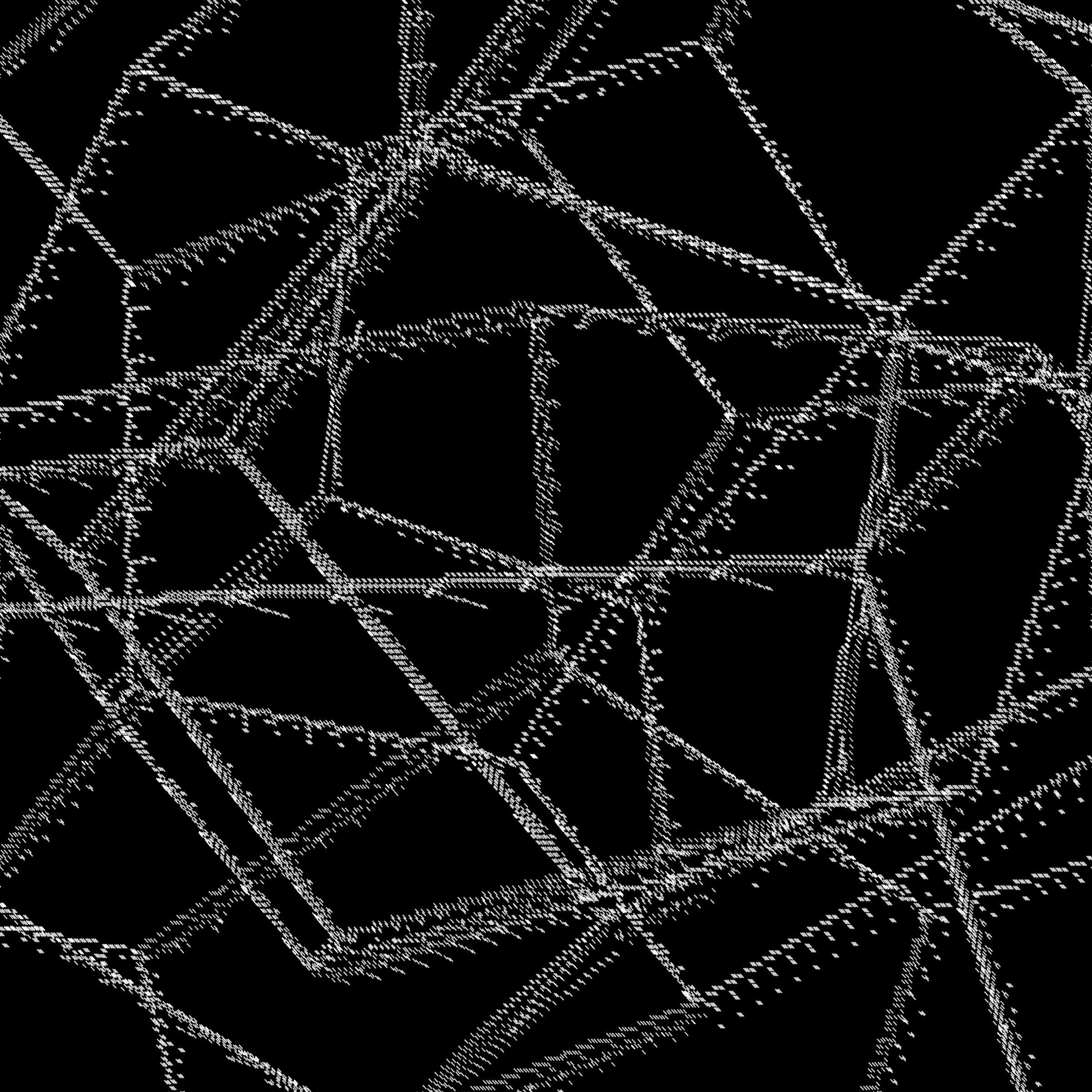
Casey Reas, Ex Nihilo (Cosmos) #248, 2026. Browser-based generative artwork; Art Blocks and Feral File. Segmented white lines cross a black field, sometimes aligning into the edges of a dodecahedron and sometimes dissolving into granular depth. The work belongs to Reas's Still Life series, which uses the five Platonic solids to test how code, pixels, color systems, and time alter an ideal form. Art Blocks and Reas describe Cosmos as a continuous, non-repeating display: a viewer can pause a formation, but no single frame exhausts the work. Its stillness lies in concentrated looking, not in a fixed image.
Revision history: v2.0.0, 2026-08-02 — completed for first publication release; v2.0.1, 2026-08-02 — reduced registrar detail and clarified the documentation limit after cross-review; v2.1.0, 2026-08-03 — copy-edited the published interpretation for directness and cadence without changing its facts or evidence; v2.2.0, 2026-08-04 — deep copy-edited the public essay for curatorial cadence without changing its facts or evidence; v2.3.0, 2026-08-04 — attributed the continuous, non-repeating-display claim to Art Blocks and Reas; v2.4.0, 2026-08-04 — removed the production-stage heading from the published opening without changing the interpretation or evidence.
The form that refuses completion
Against the black field of Ex Nihilo (Cosmos) #248, segmented white traces gather, fracture, and scatter. Some runs suggest polygonal edges; others break before contour can form. Slanting lines briefly imply a dodecahedron, then disperse into particulate atmosphere. The eye labors to assemble a solid.
Reas's Still Life series subjects the five Platonic solids to pixels, color channels, shaders, display buffers, screens, and time. Mathematical form appears through a sequence of material and technical decisions. Calculation supplies structure; performance determines appearance.
Ex Nihilo (Cosmos) sharpens this proposition through continuous change. Traditional still life offers objects arranged for prolonged inspection. Reas retains that concentrated attention to relation, surface, balance, and objecthood while setting every composition in motion. The dodecahedron persists as a possibility carried by operations that continually rearrange it.
From geometry to a live picture
The Still Life series began with There’s No Distance at bitforms in 2016. The exhibition framed Reas’s software works as performances rather than images made once in a studio and subsequently delivered to a gallery. As Reas put it in the exhibition material, there is no distance between an audience and the image being made: each encounter is an unrepeatable event.1 The new Still Life works were described as simulated compositions that deconstruct Platonic solids and flatten their planes into a single visual field. Their subject was pure geometry rather than the natural world.
The phrase “pure geometry” needs care. It can make the series sound like an escape from history or matter. Reas’s method keeps those conditions in view. A cube, tetrahedron, octahedron, dodecahedron, or icosahedron is an ideal object only in abstraction. In a software environment it must be modeled, sampled, colored, rasterized, and presented. When multiple planes appear at once, the solid no longer guarantees ordinary perspective. The image becomes a negotiation between measurable structure and the viewer’s unstable reconstruction of it.
The 2023–24 bitforms exhibition It Doesn’t Exist (In Any Other Form) shows the scale of that negotiation. The show described Still Life as conceptual software painting through simulation and computer graphics, and placed long-form generative works beside video, plotter drawings, woodblock prints, and blockchain-based pieces.2 Reas tests the same pictorial problem across supports while keeping the manifestations distinct. A plotter drawing can make a line’s discreteness and color separation palpable; a print can hold a state for prolonged looking; a screen or projection can reveal the temporal behavior that a print must arrest.
Meredith Hoy’s “Painting as Programming” gives this double commitment a precise critical account. Hoy argues that Reas’s work holds conceptual procedure and painterly surface together. It turns the executable nature of code into a condition of visual richness, refusing the premise that software art must resolve into a transparent diagram or a decorative skin.3 Still Life brings that proposition to a point of strain. The more vividly a solid appears, the more insistently the work exposes the operations—pixels, lines, changing channels, moving layers—through which it appears. The picture’s seduction becomes inseparable from its refusal to be stable.
Plato after rasterization
The official description of Ex Nihilo (Cosmos) makes Plato’s Theory of Forms the project’s explicit conceptual backdrop. It identifies the dodecahedron as Cosmos within the five-solid sequence—Cube/Earth, Tetrahedron/Fire, Octahedron/Air, Dodecahedron/Cosmos, Icosahedron/Water—and describes the work as the generation of images from code rather than physical material.4 The account is historically pointed; it does not establish that Reas retrieves a timeless philosophy untouched by media. The work’s dodecahedron is an effect generated in the image by operations that construct and disturb it.
Ex Nihilo carries geometry through incompatible representational systems. The project description says pixels are translated into lines of varying position and color, producing fields that oscillate between structure and dissolution.5 The verb “translated” is important: model, pixel value, line, screen, and visual inference each produce loss and possibility. The viewer encounters the difficulty of holding an ideal form through changing material signs.
Platonic solids matter because their regularity supplies a rigorous test for Reas's visual system. They are useful precisely because one believes one knows what they should be. The work activates that expectation, then prevents the form from settling. In the Still Life series, Reas also inherits the problems of modern abstraction: how can an image organize a field without representing an object in ordinary space? His contribution is to make the underlying operation executable and temporal. A line is generated rather than simply placed; its relation to another line may change before the viewer has finished reading it.
Nora N. Khan’s phrase “disconcerting software paintings,” written of Reas’s 2016 work, remains useful as critical pressure.6 The disturbance is not technological novelty alone. The Still Lifes give viewers enough formal coherence to invite comparison with painting—balance, mass, chromatic counterpoint, layered depth—then make that coherence unstable. They require a viewer to remain with an object that is becoming different while it is being seen.
#248: white lines, black ground, delayed cosmos
The Museum’s #248 makes this visual problem severe. Granular white lines cut across a deep black ground. Some clusters are short and nearly horizontal; others rise diagonally or curve into broken arcs. Their segmentation makes them appear drawn and digital at once: marks made with a dry instrument and sampled data refusing continuous contour.7
The black ground does more than provide contrast. It makes every white segment read as a decision in an otherwise unbounded space. At times, several segments align strongly enough to imply an edge of a solid. At other times, a disrupted line prevents the implication from becoming an object. The dodecahedron is continually proposed by the field and continually interrupted by it.
Object #248 produces a distinctive rhythm of looking. A conventional perspective image permits the eye to establish a framework and then move within it. #248 reverses that sequence. The eye searches for a framework, finds a provisional one, and is sent back to the local behavior of lines. The relation between near and far also remains unstable. White clusters sometimes float forward like bright dust; sometimes they seem to form a deep scaffold receding into the black. The image makes depth an optical event rather than a settled spatial fact.
The live work heightens the effect. The official project account describes a continuously running, non-repeating system and assigns controls for channels, white state, speed, pause, and a new Still Life state.8 The Museum records a small mismatch between published controls and the reviewed generator, so display instructions must distinguish the project’s published interface from the current observed implementation.9 A visitor encounters the work through that interface, with its specific conditions, rather than through a frictionless route to an abstract form.
The spacebar’s “new Still Life” names a field of behavior in which a viewer can provoke a new state. The Museum record does not establish that this state is determined solely by the original token parameters, so it is described here as a viewer-triggered manifestation rather than a canonical token image.10 The action clarifies the work’s wager: a geometrical form enters the work through time, variation, and user encounter. Cosmos arrives as an event that can begin again.
Color systems, supports, and the problem of the “still”
The Still Life series treats color as structure rather than expressive finish. bitforms describes RGB and HSB variants as alternative technical color spaces and shows how printed, plotter, and long-form works make their differences visible.11 RGB names an additive screen logic; HSB organizes hue, saturation, and brightness in a manner often closer to perceptual adjustment. Reas relocates painting’s color problems into systems where a palette can be parameterized, separated into channels, toggled, recomputed, and distributed across a field that changes in time.
Display is part of the medium. A screen-based Still Life is no more a neutral delivery device than a canvas is a neutral support. Screen size, orientation, black level, projector light, frame rate, browser, and duration alter what the viewer sees. The 2023 bitforms record for Still Life (HSB D) specifies custom software, computer, screen or projector, variable dimensions, and portrait or landscape orientation.12 The work is a set of relations that must be staged, not an image file scaled up or down at will.
For Ex Nihilo, the point is even sharper because the dodecahedral suggestion depends on a black field, white segmentation, and changing depth. A bright gallery with an inadequate display could flatten the interval between line and ground on which the work depends. A still screenshot can preserve one compositional state, but it cannot establish duration, responsiveness, or later variations. The Museum’s accession-era captures are time-specific documentation surrogates; their original visual bytes were not retained, and any later preservation capture must be identified as later.13
The preservation limit is central to the series’s aesthetics. Reas calls these works still lifes while making persistence impossible. A display should let viewers understand that each visible formation is both a picture and an instance of a process. The series’s proximity to painting lies in its demand for prolonged looking rather than a promise of a final image.
Pause, restart, and the ethics of a state
The controls make a second kind of “stillness” possible: a temporary decision to stop. The published project account assigns P to pause, while the spacebar produces a new Still Life state.8 This pair gives duration a visible structure. To pause is to turn a passing configuration into an occasion for looking; to restart is to acknowledge that this configuration has no exclusive claim to the work. The viewer can inhabit a state without mistaking it for an original that the software has finally delivered.
That relation complicates the curator’s usual task of choosing an image. A museum will often need a poster image, accessibility description, documentation capture, or orienting moment for a gallery visitor. Such selections help viewers look; they cannot confer priority on a single frame. #248 has an exact token-bound identity, while its visible states remain time-specific manifestations. The Museum distinguishes those states from accession-era documentation rather than treating a surrogate as a canonical image.1013
A viewer may pause, change the state, or use documented display controls, while the range of possible appearances remains authored and technically bounded. The recorded control mismatch makes the work’s dependence on interface legible: an ideal form is encountered through specifications, runtime, and a present display situation.9 This is a concrete display condition.
For #248, pause is a curatorial verb. It asks the viewer to sustain attention to a configuration long enough for the broken white lines to suggest a cosmos, then releases that suggestion back into the work’s continuous becoming. The still life is the practice of looking carefully while knowing that the form will not hold.
Reception and counter-pressure
Reas’s institutions and platforms have often presented this work through the language of innovation, simulation, and the expanded field of digital art. That history is real: There’s No Distance placed early and later work in relation, bitforms’ 2023 exhibition assembled screen works with prints and plotter drawings, and Art Blocks and Feral File co-presented Ex Nihilo in 2026.14 Institutional recognition can nevertheless make the series easier to admire than to see. The rhetoric of a work that “never repeats” risks becoming a generic guarantee of inexhaustibility.
The more useful response is ambivalent. Continuous change can fatigue attention; a field of many possible configurations can replace compositional decision with a spectacle of permanent becoming. The Still Life series answers that danger when its forms remain specific enough to create resistance. In #248, the black ground and segmented white marks prevent the work from becoming decorative flow. The dodecahedron remains a demanding proposition. It asks the viewer to hold a mathematical object in mind while accepting that the work will not allow the object to appear whole.
This tension also guards against a false opposition between a “pure” ideal and technical accident. The documented R/B discrepancy is a real condition of the current generator, not an allegory of human fallibility. It reminds us that no live software work is a frictionless conduit for an abstract plan. Dependencies, interfaces, and display instructions are part of the form in which the work appears. The Museum must disclose that fact without reducing the artwork to a bug report.
The Museum object
Ex Nihilo (Cosmos) #248 gives accession 6529NM. its contemporary horizon. It does not conclude Reas’s practice or turn the seven works into a retrospective. It brings several of their problems into concentrated contact: code as performance, a rule becoming image, a screen as a stage for drawing, and a static document’s inability to contain a live system. In the Museum group, CENTURY makes abstraction recombine; Pre-Process makes elements collide and seek equilibrium; Phototaxis turns behavior into trace; 923 EMPTY ROOMS turns units into distributed space. #248 makes an ideal form appear by giving it over to temporal instability.
The work belongs in a public collection because it makes a demanding claim about digital art without confusing technology with novelty. Its Cosmos is not a system’s grand total. It is the unsteady moment in which a viewer sees a solid almost arrive, then watches it return to lines. The image has no other form because its form is the ongoing work of coming into view.
Notes
Selected bibliography
- Art Blocks. “Ex Nihilo (Cosmos) by Casey REAS.” 2026.
- bitforms. “There’s No Distance.” 2016.
- bitforms. “It Doesn’t Exist (In Any Other Form).” 2023–24.
- bitforms. “Still Life (HSB D).” 2023.
- Hoy, Meredith. “Painting as Programming: Casey Reas and the Aesthetics of Generative Code.” ISEA 2011.
- Khan, Nora N. “Casey Reas’s Disconcerting Software Paintings.” Village Voice, 2016.
- 6529 Network Museum. Ex Nihilo (Cosmos) #248 object, technical, visual-observation, and public records for accession
6529NM..2026. 001
Footnotes
-
bitforms, “There’s No Distance,” 2016. ↩
-
bitforms, “It Doesn’t Exist (In Any Other Form),” 2023–24. ↩
-
Meredith Hoy, “Painting as Programming: Casey Reas and the Aesthetics of Generative Code,” ISEA 2011. ↩
-
Art Blocks, “Ex Nihilo (Cosmos),” 2026. ↩
-
Ibid. ↩
-
Nora N. Khan, “Casey Reas’s Disconcerting Software Paintings,” Village Voice, October 13, 2016; bibliographic record in bitforms’ Casey Reas CV. ↩
-
6529NM., reviewed object record. ↩2026. 001. 07 -
Art Blocks, “Ex Nihilo (Cosmos).” ↩ ↩2
-
bitforms, “It Doesn’t Exist (In Any Other Form).” ↩
-
bitforms, “Still Life (HSB D),” 2023. ↩
-
bitforms, “There’s No Distance”; bitforms, “It Doesn’t Exist (In Any Other Form)”; Art Blocks, “Ex Nihilo (Cosmos).” ↩
Research context
Research context
- Related acquisitionThe System in Seven StatesStatus Accessioned into the permanent CollectionStatus as of