

Project study
A line remembers: MicroImage and Phototaxis
Dating note: Art Blocks and Reas’s 2021 technical note date the edition to 2021; the current Reas NFT register lists Phototaxis as 2022. The Museum records this discrepancy as unresolved. This essay uses 2021 only...
Works in this study
- Related workPhototaxis #308Status Accessioned into the permanent CollectionStatus as ofGift of punk6529; Casey REAS; Phototaxis #308; 6529 Network Museum, 6529NM.2026.001.05. Licensed CC BY-NC 4.0.
Read the complete studyOpen the full essay, notes, bibliography, and publication record.
- Final publication copy: version 2.4.0
- Institutional author: 6529 Network Museum
- Publication date: 2026-08-02
- Release status: final editorial copy, revised after cross-review
- Accession:
6529NM.2026. 001 - Museum object:
6529NM., Phototaxis #308, 20212026. 001. 05 - Research cutoff: 2026-08-02 Scope note: This essay is a visitor-facing project study. It does not supersede the accession, rights, condition, custody, or preservation records.
Dating note: Art Blocks and Reas’s 2021 technical note date the edition to 2021; the current Reas NFT register lists Phototaxis as 2022. The Museum records this discrepancy as unresolved. This essay uses 2021 only for the Art Blocks edition and #308’s object date.1
In Phototaxis, Casey Reas turns the movement of simple simulated agents into a drawing made from their accumulated traces. Museum object #308 gathers pale cyan circulation around a dark knot, then lets lines break beyond the field. The 2021 Art Blocks edition revisits a question Reas has pursued since the early 2000s: what remains when behavior becomes image?
Gallery label
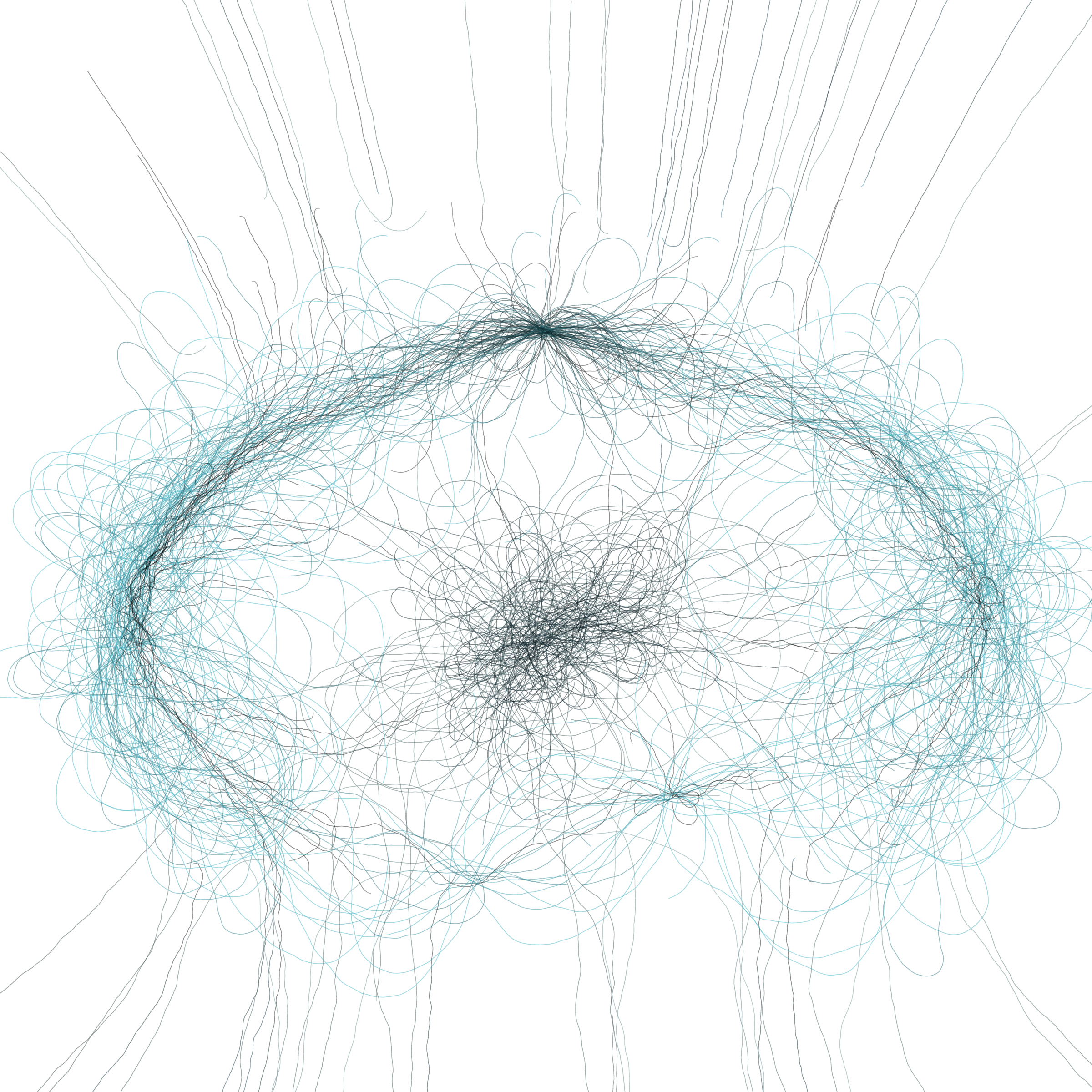
Casey Reas, Phototaxis #308, 2021. Browser-based generative artwork; Art Blocks Playground, edition of 1,000. A pale cyan field loops around a dense, dark center, with a smaller convergence above and long paths escaping vertically. The image is the residue of simulated movement: each line records an agent’s route through an environment of lights and rules. Reas developed this visual grammar across Path, Tissue, and MicroImage before returning to it for the Art Blocks edition. A static view reveals the density of the drawing; the live work unfolds over time. The Museum records both the changing performance and its documentation.
Revision history: v2.0.0, 2026-08-02 — completed for first publication release; v2.0.1, 2026-08-02 — clarified dating, repeatability, and source boundaries after cross-review; v2.1.0, 2026-08-03 — copy-edited the published interpretation for directness and cadence without changing its facts or evidence; v2.2.0, 2026-08-04 — deep copy-edited the public essay for curatorial cadence without changing its facts or evidence; v2.3.0, 2026-08-04 — completed the publication copy desk and clarified the relation between token identity and changing display; v2.4.0, 2026-08-04 — removed the production-stage heading from the published opening without changing the interpretation or evidence.
The image after the agent has gone
Phototaxis #308 presents an ovoid weather system. Pale cyan and gray trajectories circulate around a dark, congested knot below center; a second, looser convergence hangs above it; several lines peel away vertically as though the field could no longer hold them. The image carries the authority of a finished drawing while preserving movements that have already occurred. Each line is the remembered route of a simulated creature.
Reas's technical premise—simple machines, lights, four behavioral types—becomes graphic density, color, rhythm, and delay. The work converts local action into a field available for looking, memory, and projection.
Its material history spans twenty years of artistic and technical return. Reas revisits the systems behind Path, Tissue, and MicroImage, moving them from C++ through Processing and Java to p5.js. Prints, projections, software environments, and browser-based token editions carry the same artistic problem through different apparatuses, each altering how behavior becomes image.
From a thought experiment to a drawing system
Reas identifies Valentino Braitenberg’s Vehicles: Experiments in Synthetic Psychology (1984) as a decisive source for this lineage.2 Braitenberg’s conceptual machines have minimal sensors and motors. Their wiring can make a vehicle appear timid, aggressive, attracted, or evasive without requiring an interior psychology to explain it. The example shows how quickly an observer can project motives onto a simple relation between sensing and motion.
Reas takes that warning seriously and makes it visual. The Museum’s retained research dossier, following artist-controlled project material, traces Path, Tissue, MicroImage, and Phototaxis through related code principles: simulated machines respond to an environment, leave linear traces, and accumulate those traces into an image.3 The series began with Path in 2001, proceeded through the denser systems of Tissue and MicroImage, and reached an Art Blocks edition in 2021. The current NFT register’s 2022 date for Phototaxis remains unresolved, so the larger project is not assigned one settled date here.1 The core question—how a sparse rule becomes a visible field—was already being tested through software, prints, and projections.
MicroImage made scale a conceptual variable. In the 2003 work, Reas increased the number of simulated entities until the surface no longer read primarily as a collection of individual paths. It became a thick, shifting atmosphere. The artist’s current account is precise about the consequence: high-resolution prints could freeze a state whose detail early screens could not comfortably hold, while software and animation kept the system open in time.4 Paper offered a different perceptual instrument from software, allowing a viewer to study a density that live rendering made difficult to retain.
That history also sets a limit for Phototaxis. The more successful the accumulated trace becomes as a picture, the easier it is to forget the behavior it condenses. A dense field can look like expressive gesture, atmospheric abstraction, or microscopic matter. Those readings belong to the work’s achievement. The line’s relation to a moving agent also withholds the usual guarantee of a drawing: no human hand has completed it by deciding where it should stop. A succession of local decisions has done so. Reas’s art makes that delegation legible without pretending that it is transparent.
Meredith Hoy’s account of Reas’s practice helps name the stakes. In her ISEA paper “Painting as Programming,” Hoy argues against the stale division in which conceptual software is supposedly anti-visual and painterly abstraction merely decorative. Reas’s work, she proposes, keeps code’s performative execution and returns it to a visual register rich enough to resist reduction to information.5 Phototaxis sharpens that proposition. It does not reveal its program as a tidy diagram; it makes the program’s consequences available as a composition whose beauty can exceed a viewer’s ability to reconstruct the rules. That opacity is not a failure of explanation. It is where the work leaves cybernetics and becomes drawing.
Four kinds of motion, one field of traces
The project’s source is specific. The artist’s project record describes a simulated environment of Explorers, Aggressors, Lovers, and Cowards, adapted from Braitenberg’s vocabulary of differently wired machines.6 Reas’s 2021 technical note states that each line charts one organism’s movement and that the initial thumbnail state stops after 1,000 iterations.7 The line is a history rather than a contour. Its brightness and accumulation index speed, recurrence, and congestion within the system, even when a viewer can no longer identify an individual machine after the traces overlap.
The relation is particularly vivid in #308. Its central knot is a pressure point where repeated courses have made individual paths nearly illegible. The cyan perimeter remains articulate enough to show wide looping movement. Near the top, paths meet in a small, tentative cluster before releasing again. A few long near-vertical trails break the oval’s centrifugal rhythm. The eye moves between these regimes of attention: it reads the dense knot as matter, the perimeter as circulation, and the escaping lines as events that refuse enclosure.
The field holds two scales at once. From a distance, it has the calm unity of a blue-gray object—an oval, perhaps a cell or a weather front. At close range, it is restless and discontinuous. One can follow a single arc for a moment, only to lose it in an accumulation of crossings. Comprehension gives way to loss before the viewer can master the system. The rules remain perceptible without yielding an external vantage point.
Reas’s use of color intensifies that ambiguity. In the MicroImage account, types of machine are associated with color channels and line saturation corresponds to speed.8 Those correspondences make the image diagrammatic without reducing it to a diagram. In #308, cool cyan creates an atmospheric drift around the darker center. Gray marks turn that drift toward smoke or water, while the heavy central cluster gives the image a gravitational pull. The project evokes natural phenomena without depicting them. Affect enters through the experience of finding turbulence where one expected a rule.
A migration is not a restoration
The 2021 edition makes the project’s long material history visible. Reas’s technical note traces the code from C++ to Processing/Java and then to p5.js/JavaScript for the browser release.9 Each translation changes who can encounter the work, how it is executed, and what counts as its present. A projected MicroImage software environment and a browser-rendered Art Blocks work are distinct manifestations even when they share a behavioral grammar.
Processing matters here as a public language for making visual systems. Reas and Ben Fry developed it in 2001 as an open-source programming environment oriented toward artists and designers; Reas’s early practice and teaching helped make code available as a medium of drawing rather than a specialist tool used after an image had been designed.10 Phototaxis carries forward its proposition that an artist can work with code as a material of visual thought. The browser is the current site at which instructions, token-bound parameters, dependencies, display hardware, and attention meet.
Migration can make continuity easier to narrate than to guarantee. The Museum’s exact object record identifies the live generator as an observed p5.js 1.0.0 route and records the work as display-ready with conditions, while the complete self-contained generator and dependency bundle remain preservation work.11 The records do not establish that every future browser will execute the work the same way, nor that a current generator response equals an autonomous archival package. This limitation returns the work to its premise: Phototaxis has always depended on performance, and performance has conditions.
An ERC-721 token and token hash solve one part of that contingency: they fix an identity and relation within the project. A token does not itself draw the paths on a screen, and a static PNG does not exhaust the work. The Museum’s initial static response and two live screenshots were retained as hashes and observations rather than as original display bytes; the visible state is therefore a documented surrogate, not an ontological substitute.12 That limit clarifies why the live work matters. The artwork cannot be fully separated from the situation in which a rule becomes a moving line and a moving line becomes a remembered field.
Reception, difficulty, and the danger of naturalizing code
Accounts of generative art often celebrate emergence as a guarantee of life, novelty, or freedom. Phototaxis is more exact and more troubling. Braitenberg’s models are compelling because an observer attributes complex intention to a small system of connections. Reas turns that anthropomorphic trap into an aesthetic problem. The machine names—Lovers, Cowards, Aggressors—hover at the edge of the picture, tempting viewers to read emotional drama into color and motion. The accumulated traces prevent a clean narrative of one agent’s desire. What appears as intention is distributed across a crowd of local actions and the viewer’s need to make a coherent image.
The work corrects the language of autonomous creativity. Its agents act within an authored environment, a fixed edition context, and a particular runtime. Its visual energy can feel organic without turning simulation into organism. The point is sharper than a demonstration that simple rules can become complex: Phototaxis shows how visual complexity makes the desire to assign agency almost irresistible.
That resistance to easy reading is part of Reas’s broader critical reception. Hoy’s description of his work as suspended between painting and computation establishes one side of the argument: code can generate a visual richness that refuses the old anti-ocular rhetoric of conceptual art. Nora N. Khan’s title for her 2016 review, “Casey Reas’s Disconcerting Software Paintings,” supplies the counterweight.13 “Disconcerting” matters more than “software” here. Reas’s systems can produce a surplus of activity in which the viewer’s desire for a stable object, a readable operation, or an expressive gesture is repeatedly frustrated.
In #308, that frustration has form. The pale outer circulation promises that a whole can be grasped; the lower knot denies it. The image oscillates between organism and evidence, atmosphere and diagram, action and archive. Its most memorable feature may be the way a field seems simultaneously to hold itself together and to come apart.
An edition stabilizes an address, not a performance
The numbered edition gives this problem a particular public form. #308 has a token-bound identity within the 1,000-work Phototaxis edition, while its live manifestation remains time-based. The initial thumbnail state is documented as ending after 1,000 iterations.7 It supplies a shared published reference point; neither that fact nor the token identity independently verifies pixel-for-pixel repeatability after a reload. An exhibition can use the thumbnail to orient a visitor without passing it off as the whole work.
The available controls make the difference concrete. The reviewed object record describes a running system that can be paused, restarted, magnified, and altered through its light setting.11 They let a viewer experience an authored situation as duration: a field may be held long enough to inspect, returned to a beginning, or brought into a different visual relation to its environment. The artwork’s authority lies in the behavioral grammar and exact edition context; a museum display should make that grammar available while treating a screenshot as documentation rather than neutral transcription.
The token can preserve the relation of a numbered work to its project and provide a durable public reference for the object the Museum holds. It cannot, by itself, preserve a browser dependency, a display’s luminance, a visitor’s interval of attention, or the live accumulation that turns agents into drawing. The work remains materially dispersed across code, rendering, hardware, records, and looking.
That dispersion gives #308 historical density. Phototaxis looks backward to early artificial-life experiments while entering a contemporary editioning infrastructure; it also raises the practical question of how a public collection can preserve a work whose image is an event. The stable identifier names the object; the changing display shows why its state cannot be reduced to a catalogue image. In the blue-gray image, the delayed trace is also a model for accession: a way of holding a history that can be documented, seen, and revisited without claiming that its performance has stopped.
The Museum object
The Museum’s Phototaxis #308 is one exact token-bound state within the thousand-work project, with its own recorded hash, invocation, observed preview, and position in accession lot 6529NM..14 Its contribution to the seven-work group is clear: it makes time visible as accumulated behavior. CENTURY makes recomposition visible; Pre-Process makes collision and constraint visible; 923 EMPTY ROOMS turns units into a distributed spatial system; Ex Nihilo (Cosmos) allows geometry to remain unstable in continuous display. #308 supplies the line that joins them, while remaining a distinct picture made from the memory of movement.
The accession asks the Museum to preserve the relation among the project’s code lineage, token identity, behavior, interaction, browser manifestation, and documentation. That record makes the work legible in public. To exhibit Phototaxis responsibly is to let a viewer see the blue-gray ovoid and understand why it cannot be reduced to it. The line remembers a machine’s path; the work records an artist’s long effort to make systems produce images that remain difficult to possess.
Notes
Selected bibliography
- Braitenberg, Valentino. Vehicles: Experiments in Synthetic Psychology. Cambridge, MA: MIT Press, 1984.
- Hoy, Meredith. “Painting as Programming: Casey Reas and the Aesthetics of Generative Code.” ISEA 2011.
- Khan, Nora N. “Casey Reas’s Disconcerting Software Paintings.” Village Voice, 2016.
- 6529 Network Museum. “Casey Reas accession research: art-historical and technical dossier.” Repository-retained research record, accessed 2026-08-02.
- Reas, Casey. “Notes on ‘Phototaxis.’” 2021.
- Reas, Casey. “Phototaxis.” Artist project record. Accessed 2026-08-02.
- Reas, Casey, and Ben Fry. “Processing: A Programming Language and Environment for Visual Artists.” AI & Society 20, no. 4 (2006): 526–543.
- 6529 Network Museum. Phototaxis #308 object, technical, visual-observation, and public records for accession
6529NM..2026. 001
Footnotes
-
Phototaxis #, “Documented fact [A/B]”;308 6529NM.,2026. 001. 05 project.. ↩ ↩2date_ conflict -
Valentino Braitenberg, Vehicles: Experiments in Synthetic Psychology (Cambridge, MA: MIT Press, 1984). ↩
-
6529 Network Museum, “Casey Reas accession research: art-historical and technical dossier,” “Phototaxis,” repository-retained research record, accessed 2026-08-02. It registers the artist-controlled MicroImage page as long-term project context; the public
reas.route was unavailable during release review. ↩com/ microimage -
Ibid. ↩
-
Meredith Hoy, “Painting as Programming: Casey Reas and the Aesthetics of Generative Code,” ISEA 2011. ↩
-
Casey Reas, “Phototaxis,” artist project record, accessed 2026-08-02. ↩
-
Casey Reas, “Notes on ‘Phototaxis’,” 2021; 6529 Network Museum, “Casey Reas accession research: art-historical and technical dossier,” “Phototaxis” source register and technical summary (repository-retained access backstop). ↩ ↩2
-
6529 Network Museum, “Casey Reas accession research: art-historical and technical dossier,” “Phototaxis.” ↩
-
Reas, “Notes on ‘Phototaxis’”; 6529 Network Museum, “Casey Reas accession research: art-historical and technical dossier,” “Phototaxis” source register and technical summary (repository-retained access backstop). ↩
-
Casey Reas and Ben Fry, “Processing: A Programming Language and Environment for Visual Artists,” AI & Society 20, no. 4 (2006): 526–543; Processing Foundation. ↩
-
6529NM., reviewed object record; see also the associated technical and condition record. ↩ ↩22026. 001. 05 -
6529NM., visual-observation record. ↩2026. 001. VO- 01 -
Nora N. Khan, “Casey Reas’s Disconcerting Software Paintings,” Village Voice, October 13, 2016; bibliographic record in bitforms’ Casey Reas CV. ↩
-
6529NM.;2026. 001. 05 Phototaxis #, public object record. ↩308
Research context
Research context
- Related acquisitionThe System in Seven StatesStatus Accessioned into the permanent CollectionStatus as of