

Inside the System
Pre-Process
A close reading of Casey Reas's generative system
Pre-Process fixes 120 starting coordinates, then lets time and collision make each run diverge. Eight surfaces decide what remains visible.
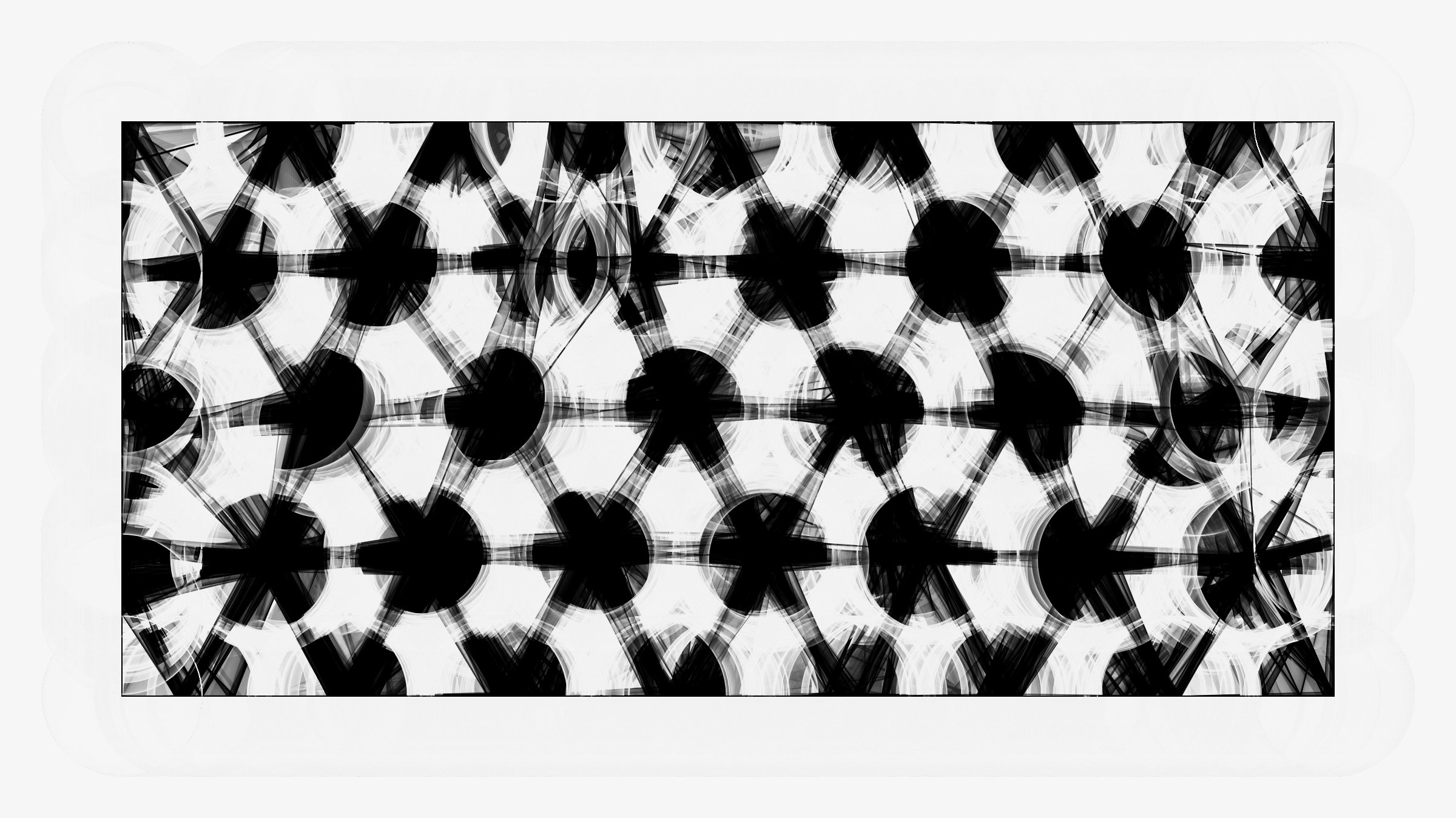
Complete 120-position lattice
- Surface
- 8
- Origin
- 1 · Center
- Growth
- 4 · All large
- Invocation
- 63
Extreme center-born overlap accumulates as contact evidence; the dark registers are an outcome, not the starting origin.
Compare
Hold the Museum work. Choose what sits beside it.
Museum artwork
 #63
Minted artwork
 #3
Compare published traits · 2 shared, 1 different
| Trait | #63 | #3 |
|---|---|---|
| Growth | 4 | 4 |
| Origin | 1 | 1 |
| Surface | 8 | 4 |
24 minted works match this filter.
Showing 1–12 of 24
Museum model · held conditions
Museum model · #3 conditions
Surface 4 · Origin 1 · Center · Growth 4
All 120 starting coordinates were minted. Restage changes the model's session view; the edition remains fixed.
Suggested minted comparisons
Now comparing minted work #3
Suggestions compare published traits; ‘less often seen’ uses the Museum's reviewed edition analysis. No marketplace data or value judgments.
Data and method
Exactly one token occupies each cell of the 8 × 3 × 5 = 120 lattice; the source invocation mapping and complete snapshot agree.
From rule to image
How the system makes the work
- 1
120 coordinates
Each invocation occupies one Surface × Origin × Growth position.
- 2
Seeded population
The hash prepares 100 cells with positions, headings, and radii; one enters every ten frames.
- 3
Collision over time
Movement, clamping, easing, and index-ordered collisions make a fixed start become a performance.
- 4
Eight surfaces
Each surface reveals bodies, fading contact memory, or persistent framebuffer history in a different way.
Curatorial finding
What becomes visible here
#63 makes collision legible as memory. Its darkness is not a backdrop imposed on the system; it is a history produced by the system.
Research apparatus
Scope and open questions
Exactly one token occupies each cell of the 8 × 3 × 5 = 120 lattice; the source invocation mapping and complete snapshot agree.
- Surface selectors create session views, not new token traits or eight different physical systems.
- Reset preserves global frameCount, so the admission phase can differ.
- The first-press pause latch still requires exact-runtime confirmation.
- The diagrams are Museum analytical views. They are not the artwork, a replacement for the live work, or newly discovered canonical token states.
- Counts describe structure or observed feature prevalence. They do not describe rarity, quality, desirability, price, or rank.
- The technical studies are constructed Museum research, not artist-approved accounts or amendments to the accession record.
- Official response hashes were reproduced, but the Museum has not yet autonomously preserved exact generator and dependency byte packages. Cross-browser and cross-GPU pixel identity is unproven.