

Inside the System
Phototaxis
A close reading of Casey Reas's generative system
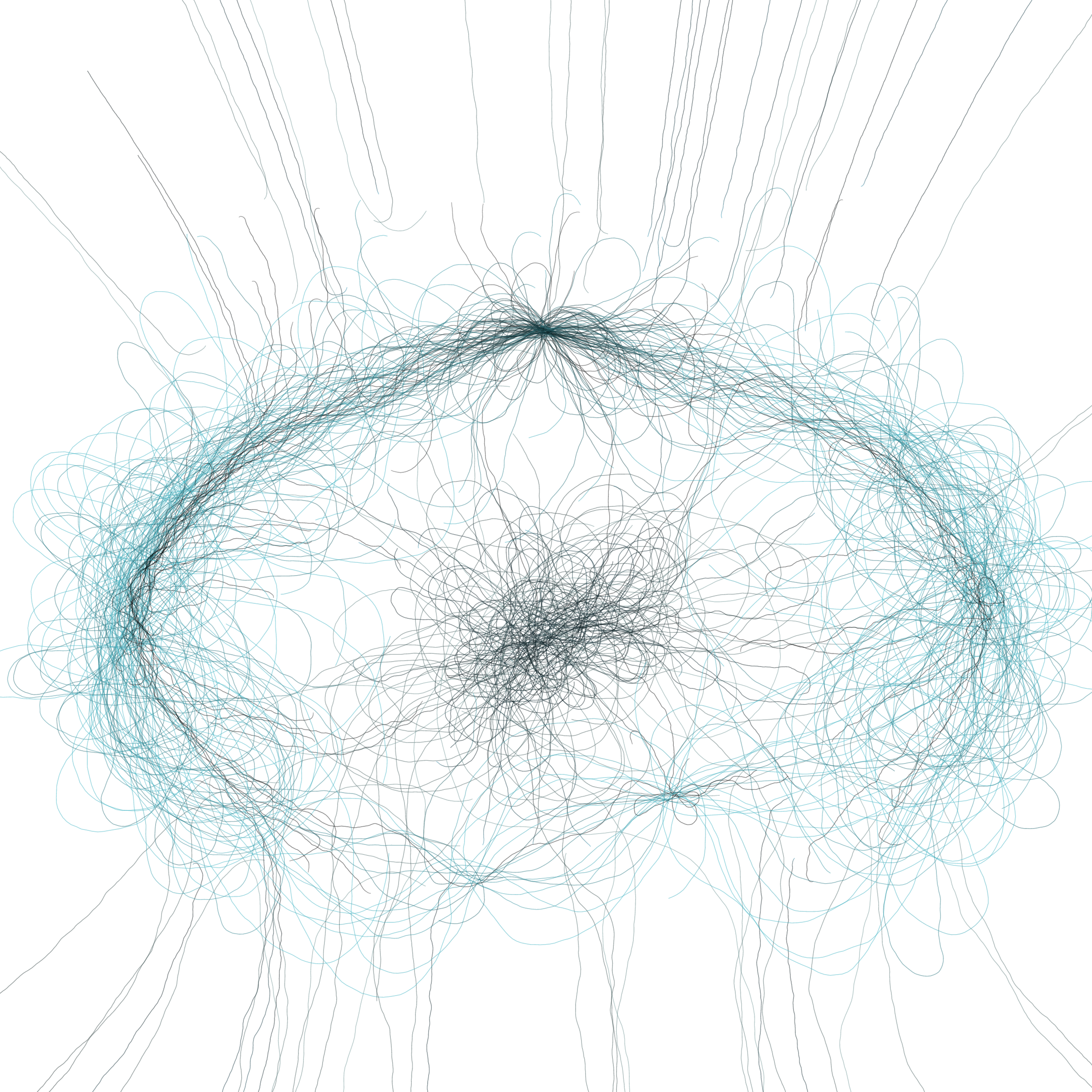
The visible image is delayed evidence of behavior: sensing becomes steering, steering becomes motion, motion becomes brightness, and duration becomes graphic density.
Causal state model
- Size
- Base
- Speed
- Lively · maximum 12
- Lights
- 3
- Facade
- Atomic A
- Sensors
- Nonlinear
- Alignment
- Neutral
- Population
- Assemblage · 200 machines
- Magnification
- 0.66
Its visible knot is an archive of sensing and steering, but the deposited marks do not expose those causes unaided.
Compare
Hold the Museum work. Choose what sits beside it.
Museum artwork
 #308
Minted artwork
 #212
Compare published traits · 6 shared, 2 different
| Trait | #308 | #212 |
|---|---|---|
| Alignment | Neutral | Lawful |
| Façade | Atomic A | Atomic A |
| Lights | 3 | 6 |
| Magnification | 0.66 | 0.66 |
| Population | Assemblage | Assemblage |
| Sensors | Nonlinear | Nonlinear |
| Size | Base | Base |
| Speed | Lively | Lively |
102 minted works match this filter.
Showing 1–12 of 102
Museum model · held conditions
Museum model · #212 conditions
Suggested minted comparisons
Now comparing minted work #212
Suggestions compare published traits; ‘less often seen’ uses the Museum's reviewed edition analysis. No marketplace data or value judgments.
Data and method
The complete 1,000-token metadata edition is observed, but runtime trajectories are open state histories rather than exhaustively mapped outputs.
From rule to image
How the system makes the work
- 1
Hidden lights
The hash fixes lights, population, speed, facade, and the machines' initial positions.
- 2
Paired sensors
Each machine measures its distance to every active light through a linear or nonlinear response.
- 3
Crossed wiring
One of four source equations converts the measurements into speed and heading, with seeded variation.
- 4
Deposited trace
Speed becomes brightness; each movement writes onto an uncleared canvas until the documented 1,000-frame stop.
Curatorial finding
What becomes visible here
#308's knots compress the history of three invisible lights. The trace records sensing while keeping its causes out of view.
Research apparatus
Scope and open questions
The complete 1,000-token metadata edition is observed, but runtime trajectories are open state histories rather than exhaustively mapped outputs.
- The relation between the reconstructed lights and particular knots in the trace is a hypothesis awaiting trace attribution.
- The four source constants should not be assigned named Braitenberg behaviors without primary confirmation.
- Pressing L while paused advances one full frame. Out-of-bounds paths are source behavior, not symbolic intent.
- Art Blocks dates the edition to 2021; the artist’s current NFT register says 2022.
- The diagrams are Museum analytical views. They are not the artwork, a replacement for the live work, or newly discovered canonical token states.
- Counts describe structure or observed feature prevalence. They do not describe rarity, quality, desirability, price, or rank.
- The technical studies are constructed Museum research, not artist-approved accounts or amendments to the accession record.
- Official response hashes were reproduced, but the Museum has not yet autonomously preserved exact generator and dependency byte packages. Cross-browser and cross-GPU pixel identity is unproven.